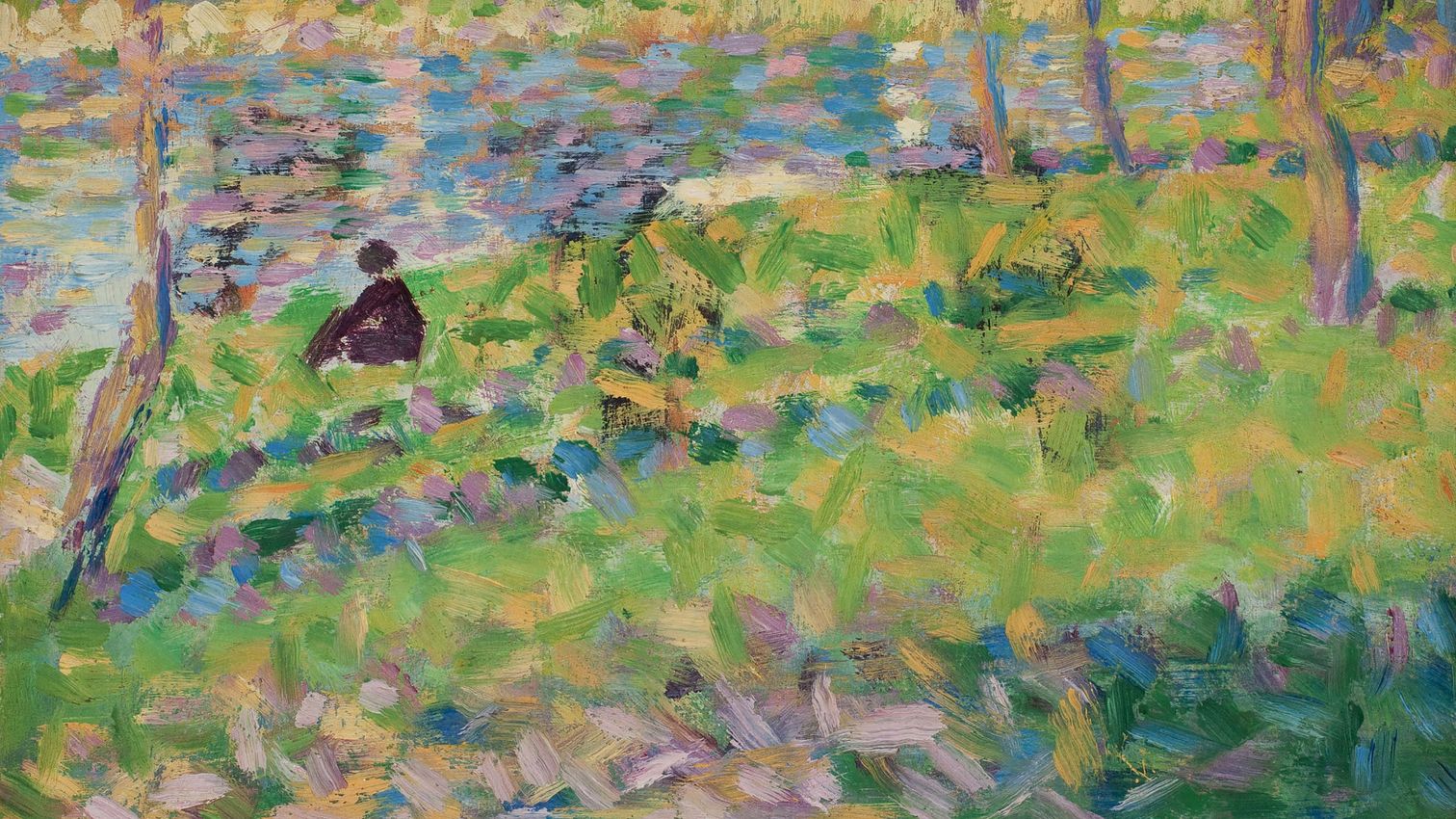
In 1883 Georges Seurat began work on Bathers at Asnières, his first real painting statement, seemingly inspired by Pierre Puvis de Chavannes’ Massilia, Greek Colony (1869).
Seurat created many preparatory studies, but after it was completed it was then rejected by the Salon. He joined the Independent Artists’ Group, but found them disorganised. Consequently, Seurat and various friends formed The Independent Artists’ Society, and Paul Signac joined him in using the pointillist methodology.
In 1884 he started painting the three metre long A Sunday Afternoon on the Island of La Grand Jatte, again based on copious drawings and colour studies, and more fully consistent with his developing research. Utilising diminishing perspective on the Seine River bank, Seurat carefully controlled the tonal dot density around the edges of each form.
The rigidity of the profiled figures can be seen as satirising the bourgeois classes, and the presence of certain animals (monkeys) or actions (fishing) interpreted as discreet symbolism for activities such as prostitution.
La Parade de Cirque, (1887—88), is like a rhythmic frieze with its gridded rectangular divisions of the canvas and silhouetted, mysteriously hooded musicians and multi-hatted audience.Seurat’s late works—such as Against the Enamel of a background Rhythmic with Beats and Angles, Tones and colours, Portrait of M. Félix Fénén in 1890, 1890; Le Chahut (The Can Can) (1889-90); The Circus (1891)—became increasingly decorative and influenced by Art Nouveau, and are not so admired as his calmer earlier outdoor works. However Seurat’s divisionism and finely calculated compositional planning later became influential on many branches of 20th century painting.
Georges Seurat died young at 31, probably of diphtheria.