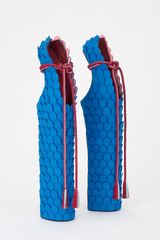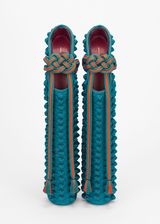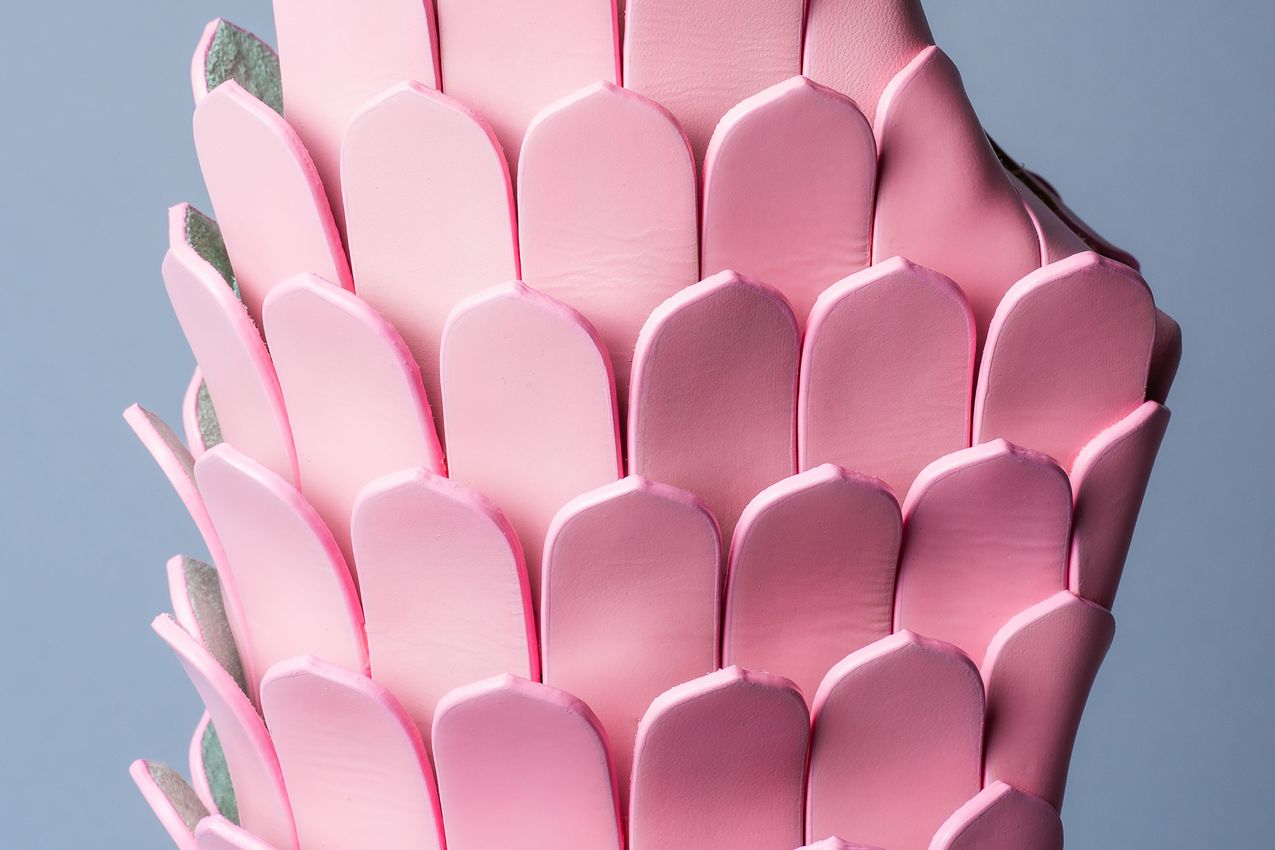
KOSAKU KANECHIKA is pleased to present Noritaka Tatehana’s solo exhibition “Heel-less Shoes” at the Kyobashi gallery from October 30 to December 12, 2026.
Tatehana began his career as an artist with his signature “Heel-less Shoes” series, which debuted when he was graduating from university, and in 2025 he marked the fifteenth anniversary of his career. It has remained the starting point for his entire body of work ever since, even as he has expanded his creative scope to include painting and sculpture, grounding his practice in a workshop model based on the theme of reimagining Japanese culture. The exhibition returns to the artist’s origins by reengaging with this seminal series by Tatehana, who has reached an important milestone in his career.
Research into Japanese culture was the starting point for the creation of Heel-less Shoes, not a concept for a particular sculpture or form. Specializing in textile arts at the Tokyo University of the Arts, Tatehana came to realize that traditions are more than conservative customs; they represent the result of innovation. This led him to study the attire and culture of oiran (courtesans) during the Edo period. As fashion pioneers of their time, the oiran set trends that were emulated by the young women in town and spread throughout society. Unlike the institutionalized forms of expression seen with Kabuki costumes, this culture formed organically from urban life, and could be described as a purely avant-garde development. Therefore, Tatehana’s Heel-less Shoes series is a product of the artist’s research of tradition, rather than something that was inspired by it.
The taka-geta (elevated wooden clogs) worn by the oiran were far more than mere footwear. The height of the geta functioned as a visual marker of social status, with only courtesans of the highest rank, known as tayu, allowed to wear geta of this extreme height. By raising the body, the shoes were a physical manifestation of the social hierarchy itself. Meanwhile, in Western culture, high heels developed as a means of symbolizing authority and accentuating the body. In light of these different physical structures in the East and West, Heel-less Shoes aim to question their fundamental premises, rather than simply merge the two traditions. The removal of the heel represents an intervention made with respect to modern views of the body and established value systems.
Tatehana has provided the following statement for his solo exhibition.
The heel was removed to expose the structures that lay behind it, rather than to simplify form.
Heel-less Shoes are a device for re-evaluating how culture has been inherited and continues to evolve, not something for referencing past culture. Culture is not something that forms based on a single lineage. I think it emerges through the intersection of different times and values. Furthermore, culture does not belong to the past. It is continually renewed within the present. The culture we are engaging with today could become part of the traditional culture of the future.
Heel-less Shoes represent a single cross-section within this continuum, and have the potential to connect directly to the culture of tomorrow.
This exhibition also presents a new series of paintings inspired by drawings made during the artist’s creative process. Lines that have lain behind previous works now emerge as independent artistic expressions in their own right. This endeavor demonstrates the fluid way Tatehana’s thinking fluctuates between three-dimensional objects and two-dimensional planes.
Noritaka Tatehana’s solo exhibition “Heel-less Shoes” consists of over thirty works, focusing primarily on twenty-two pairs of Heel-less Shoes, and including the artist’s latest paintings.
Noritaka Tatehana presents a redesigned worldview by combining elements of traditional Japanese culture with those of the contemporary era. His carefully honed artistry is elegantly expressed through various media, and his creations, which nurture the sensitivities of Japanese history, tradition,and innovation, burst with endless possibilities for the future. Gaining the attention of audiences all over the globe, Tatehana is known for his ‘Heel-less Shoes’ series inspired by takageta – elevated wooden clogs worn by traditional Japanese courtesans. The artistʼs works have been acquired by internationally acclaimed institutions such as the Metropolitan Museum of Art in New York, and the Victoria & Albert Museum in London.

A respected voice in contemporary art discourse.
Focusing on ambitious storytelling and insightful art-world commentary. Ocula Magazine publishes in-depth interviews, critical essays and timely analysis on the artists, exhibitions and ideas driving the global art world.
Learn more about Ocula Magazine
Showcasing the best of the art world.
Ocula partners with galleries from around the world to highlight their artists, artworks and exhibitions. Gallery membership is by application and invitation, with each member vetted by an independent panel.
Learn more about Ocula Membership

Specialises in the sale of major artworks.
Led by a team with deep ties to the world’s leading auction houses, galleries and collectors. Ocula’s advisory team offers bespoke services to high-net-worth clients from around the world who are looking to acquire the best of contemporary and modern art.
Learn more about our team and services