





GILBERT & GEORGE
b. 1967, United KingdomLiving sculptures and unapologetic chroniclers of urban life, Gilbert & George are a radical British artist duo known for their provocative, meticulously composed photo-based artworks exploring identity, sexuality, politics and religion in contemporary art.
Early Years
Gilbert & George met in 1967 while studying sculpture at Saint Martin’s School of Art, London. Gilbert Prousch was born in the Dolomites in northern Italy, and studied at the Wolkenstein School of Art and subsequently the Hallein School of Art and Design in Austria. George Passmore, born in Plymouth, studied at Dartington Hall School and Oxford Art School before moving to London.
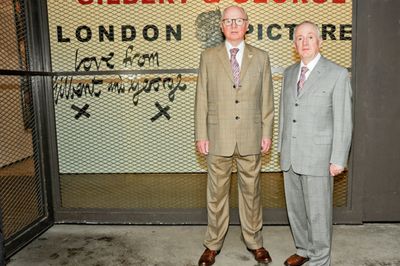
The pair quickly formed a creative and personal partnership that would redefine the role of the artist in contemporary art. Rejecting traditional sculpture, they declared themselves “living sculptures”, performing as a unified artistic entity in both life and practice. They have lived and worked together in East London for over five decades, making the city’s shifting landscape and socio-political dynamics central to their art.
Artworks
Gilbert & George’s artworks are known for their confrontational aesthetics, symmetry, and subversive use of photographic collage to explore contemporary life in all its contradictions—social, sexual, moral, and political.
The Singing Sculpture
The Singing Sculpture (1969) was the first artwork that declared Gilbert & George themselves as art. Standing motionless on a table for hours, heads coated in metallic paint, the pair mimed along to Flanagan and Allen’s “Underneath the Arches.” It was both absurd and captivating, setting the tone for their fusion of performance, identity and sculpture. The piece challenged conventional ideas of art objects, turning the artists into a spectacle. Presented in streets, galleries and biennales, it marked the beginning of their “living sculpture” identity and foreshadowed their lifelong commitment to making art inseparable from everyday life and self-presentation.
Dirty Words and Street Scenes
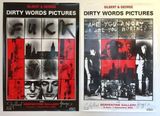
The Dirty Words Pictures (1977) emerged during a period of social unrest in Britain. Comprising 26 large-scale black-and-white photo panels, these works juxtaposed graffiti from East London—featuring slurs, expletives and political statements—with static images of Gilbert & George in suits. The artists appear impassive among scenes of disorder: smashed windows, littered pavements and sexually explicit language. The stark contrast between their composed demeanour and the raw street language emphasises themes of alienation, class division and censorship. These early photo works introduced a critical and ironic perspective on British society, exposing tensions between authority and rebellion in the urban landscape.
Postcard Aesthetics to Digital Imagery
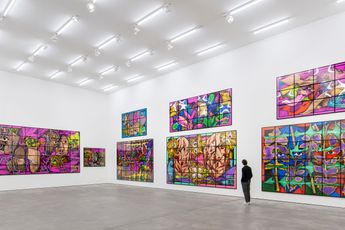
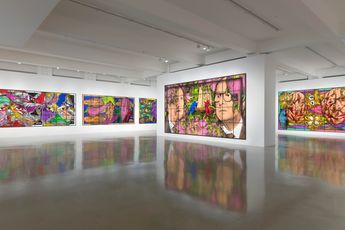
By the 1990s, Gilbert & George had shifted into full-colour, digitally enhanced artworks that intensified the theatricality of their compositions. Works like the Naked Shit Pictures (1995) and Sonofagod Pictures (2005) shocked with scatological, religious and sexual imagery layered into symmetrical grids. Their appearances multiplied across each panel—sometimes nude, masked or grotesque—within montaged scenes of decay and violence. The use of digital technology allowed them to amplify their aesthetic of controlled chaos. These monumental works addressed taboos head-on, critiquing moral hypocrisy, religious dogma and the surveillance state. Visually aggressive yet meticulously structured, they brought classical composition into dialogue with urban extremity.
The Paradisical Pictures and The Beard Pictures
In The Paradisical Pictures (2006) and The Beard Pictures (2017), Gilbert & George continued to evolve their visual language while maintaining their commitment to addressing societal contradictions. The Paradisical Pictures presented dreamlike, often garish environments filled with surreal floral motifs and kaleidoscopic colours, inviting viewers into a corrupted Eden where beauty and danger coexist. The Beard Pictures, by contrast, featured the artists buried in vivid backdrops, their faces obscured by digitally manipulated beards—symbols of identity, disguise, and religious iconography. These works extended their legacy of turning contemporary issues such as terrorism, extremism, and nationalism into visceral yet conceptually dense art.
Awards and Accolades
- Elected as Royal Academicians by the Royal Academy of Arts (2017) [Resigned in 2020]
- Represented the UK at the Venice Biennale (2005)
- Turner Prize (1986)
- Regione Lazio Award (1981)
Exhibitions
Gilbert & George have been the subject of both solo and group exhibitions at important institutions. A selection of important exhibitions are provided below.
Solo Exhibitions
- Gilbert & George: The Tāmaki Makaurau Auckland Exhibition 2022, Auckland Art Gallery Toi o Tāmaki, Auckland (2022)
- Gilbert & George: The Great Exhibition (1971–2016), Luma Westbau and Kunsthalle Zürich, Zürich, Switzerland; Reykjavík Art Museum, Reykjavík, Iceland (2020)
- Gilbert & George: There Were Two Young Men, Fondation Louis Vuitton, Paris (2019)
- Gilbert & George: The Great Exhibition (1971–2016), Luma Arles, Arles (2018)
- Gilbert & George: The Early Years, Museum of Modern Art, New York (2015)
- Notations: Gilbert & George, Philadelphia Museum of Art, Philadelphia (2008)
Group Exhibitions
- The World Exists to Be Put on a Postcard: Artists’ Postcards from 1960 to Now, British Museum, London (2019)
- Somewhat Abstract: Selection from the Arts Council Collection, Nottingham Contemporary, Nottingham (2014)
- Glam! The Performance of Style, Tate, Liverpool, UK; Schirn Kunsthalle Frankfurt, Frankfurt (2013)
- Staging Action: Performance in Photography since 1960, The Museum of Modern Art, New York (2011)
- Less is More, Haus der Kunst, Munich (2010)
Website and Instagram
Gilbert & George’s website can be found here, and their Instagram here.
Critical Reception
Gilbert & George’s work has been widely discussed in leading art publications including ArtReview, The Critic, and The Guardian. In conversation with Ocula Magazine in 2017, Gilbert said: ‘That’s why people go by the millions to museums. They’re all searching for themselves. They’re trying to heal themselves, full of anxieties. Or because life is so boring. But it is a healing process, art.’
Gilbert & George FAQs
What are Gilbert & George best known for?
Gilbert & George are best known for their large-scale, photo-based artworks that feature themselves as central figures in meticulously arranged compositions. Their signature style combines bold colours, symmetrical grids, and provocative subject matter to explore themes including sexuality, religion, identity, and urban life. They are also known for pioneering the concept of “living sculptures,” presenting their lives as part of their art. This radical fusion of performance and visual art has made them iconic figures in contemporary art since the late 1960s.
Why do Gilbert & George always appear in their art?
Gilbert & George have maintained a strict commitment to appearing in all their artworks because they view themselves as both the subject and object of art. By inserting their own bodies into each piece, they erase the boundary between artist and artwork. Their identical dress, deadpan expressions and formal poses act as consistent visual anchors amid chaotic or controversial imagery. This approach reinforces their belief that art should be personal, universal, and inseparable from the artist’s own life, identity and moral position.
Are Gilbert & George controversial?
Yes—Gilbert & George have often courted controversy through artworks that tackle taboo topics head-on. Their Naked Shit Pictures (1995) feature excrement and sexual imagery, while Sonofagod Pictures (2005) remix Christian iconography with provocative text and nudity. In The Fundamental Pictures (1996), they addressed Islamic extremism in a way that drew both outrage and debate. Responding to criticism, the artists have said, ‘We are not shocking—truth is shocking.’ Rather than provoke for its own sake, they see their work as a moral duty to reflect the unvarnished realities of modern life.
Ocula | 2025

Works at Sprüth Magers


Recently Exhibited



Works Elsewhere







Gilbert & George in Ocula Magazine







Explore and Follow Artists Shaping Contemporary Art
A respected voice in contemporary art discourse.
Focusing on ambitious storytelling and insightful art-world commentary. Ocula Magazine publishes in-depth interviews, critical essays and timely analysis on the artists, exhibitions and ideas driving the global art world.
Learn more about Ocula Magazine
Showcasing the best of the art world.
Ocula partners with galleries from around the world to highlight their artists, artworks and exhibitions. Gallery membership is by application and invitation, with each member vetted by an independent panel.
Learn more about Ocula Membership
Specialises in the sale of major artworks.
Led by a team with deep ties to the world’s leading auction houses, galleries and collectors. Ocula’s advisory team offers bespoke services to high-net-worth clients from around the world who are looking to acquire the best of contemporary and modern art.
Learn more about our team and services