





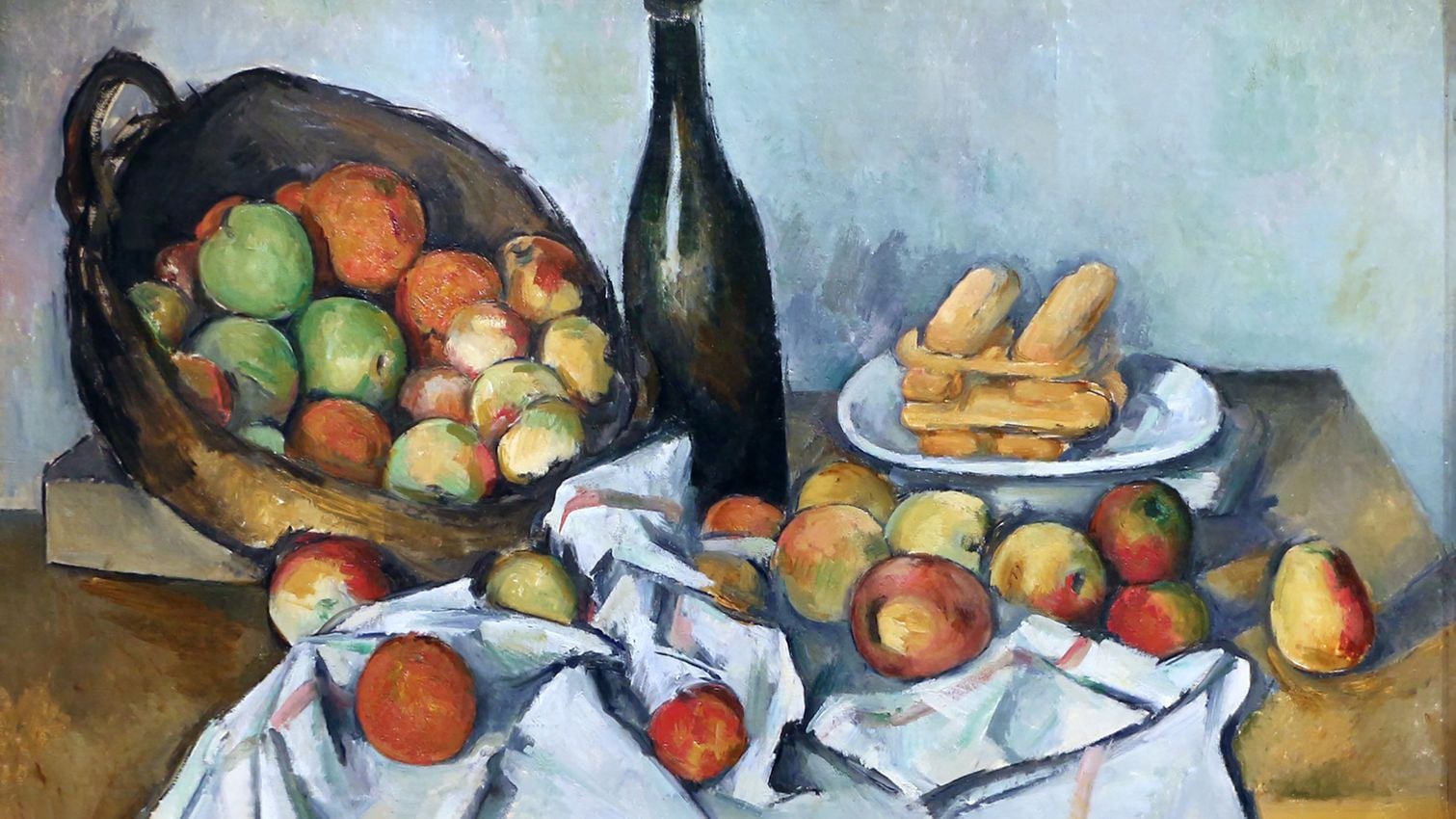
PAUL CEZANNE
1839-1906, FrancePaul Cézanne, often described as the father of Modern art, was a pioneering French painter whose radical approach to form, colour, and perspective laid the foundations for Cubism and 20th-century abstraction. He was posthumously recognised as a key influence on artists including Pablo Picasso and Henri Matisse, who reportedly called him ‘the father of us all’.
Early Years
Paul Cézanne was born in 1839 in Aix-en-Provence in southern France. Though initially encouraged to pursue a legal career, he studied at the École des Beaux-Arts in Aix before moving to Paris in 1861, where he enrolled briefly at the Académie Suisse. Cézanne developed friendships with Impressionist contemporaries like Camille Pissarro, though his distinct and often brooding aesthetic set him apart.
After several years in Paris, Cézanne began returning regularly to Provence from the late 1870s onwards. His deep connection to the rugged landscapes of his home would profoundly inform his mature works. The distinctive topography of Mont Sainte-Victoire, in particular, became a central motif throughout his life.
Paul Cézanne Artworks
Paul Cézanne’s artworks are known for their dense, analytical brushwork and rigorous exploration of geometric form. His methodical, meditative approach to painting challenged conventions of perspective and representation.
From Impressionism to Structure (1870s-1885)
Cézanne’s early works show the influence of Romanticism and Realism, characterised by dramatic tones and expressive content. Under the mentorship of Pissarro in the 1870s, his palette lightened, and he adopted the looser brushwork of the Impressionists. However, Cézanne sought greater solidity and permanence in his art.
In works like The House of the Hanged Man (1873) and Still Life with Apples (c.1890), he began breaking down objects into basic shapes—cylinders, spheres, and cones—and used shifting viewpoints, foreshadowing the principles of Cubism.
Mont Sainte-Victoire and the Late Works (1885–1906)
Cézanne’s lifelong series of Mont Sainte-Victoire paintings, completed between the 1880s and 1906, epitomise his search for a visual language rooted in nature’s underlying structure. These works are celebrated for their careful modulation of colour and the merging of pictorial space and surface.
His later still lifes, such as Still Life with Ginger Jar and Eggplants (c.1893–1894), continue this exploration, using balanced arrangements and subtle distortions to convey depth and harmony without relying on traditional perspective.
What is Paul Cézanne’s most important work?
While Paul Cézanne produced numerous iconic paintings, The Large Bathers (1906) is often considered his most important work. Completed near the end of his life, the painting synthesises his lifelong exploration of form, structure, and the human figure. Its unconventional composition and monumental treatment of the nude had a profound impact on modern artists, influencing movements such as Cubism and Fauvism. Other frequently cited masterpieces include Mont Sainte-Victoire (various versions, 1885–1906) and Still Life with Apples (c.1890), both of which exemplify his revolutionary approach to perspective and colour.
Exhibitions
Paul Cézanne has been the subject of both solo and group exhibitions at major institutions, a selection of which are highlighted below.
Solo Exhibitions
- Cézanne, Tate Modern, London (2022–2023)
- Cézanne Drawing, Museum of Modern Art, New York (2021)
- Cézanne and the Modern, Ashmolean Museum, Oxford (2014)
- Cézanne and Beyond, Philadelphia Museum of Art (2009)
- Cézanne: Landscapes, National Gallery of Art, Washington, D.C. (2006)
- Cézanne, Grand Palais, Paris (1995)
- Cézanne: The Early Years, Museum of Modern Art, New York (1971)
Group Exhibitions
- Masters of Modern Art from the Hermitage, Art Gallery of New South Wales, Sydney (2018)
- Impressionists in London, Tate Britain, London (2017)
- Faces of Impressionism, Musée d’Orsay, Paris (2014)
- The Origins of Modernism, Centre Pompidou, Paris (2011)
- Post-Impressionism from the Musée d’Orsay, National Art Center, Tokyo (2010)
- Manet to Picasso, The Art Institute of Chicago (2006)
- The French Visionaries, Musée d’Orsay, Paris (2002)
- Post-Impressionism: Cross-Currents in European Painting, National Gallery, London (1998)
Further Reading
Cézanne’s work has been covered extensively in major publications including Artnet, The Atlantic, and The New Yorker.
Paul Cezanne FAQs
1. Who was Paul Cézanne?
Paul Cézanne (1839–1906) was a French Post-Impressionist painter, often called the ‘father of modern art’. His innovative approach to color, form, and composition bridged Impressionism and Cubism, profoundly influencing the course of 20th-century art.
2. What is Cézanne best known for?
Cézanne is best known for his series of still lifes, landscapes-especially his many paintings of Mont Sainte-Victoire-and portraits. His unique brushwork, use of geometric forms, and analytical approach to painting set his work apart.
3. How did Cézanne influence modern art?
Cézanne’s exploration of color, structure, and the simplification of natural forms paved the way for Cubism and abstract art. Artists like Picasso and Matisse acknowledged his foundational role, with Picasso famously declaring, ‘Cézanne is the father of us all’.
4. Was Cézanne’s art appreciated during his lifetime?
Cézanne struggled for acceptance early in his career and was often criticised by the art establishment. However, his work gained recognition later in life, particularly among fellow artists such as Monet, Renoir, and Pissarro, who collected his paintings.
5. Why did Cézanne paint Mont Sainte-Victoire so often?
Mont Sainte-Victoire, visible from Cézanne’s hometown of Aix-en-Provence, became a personal and artistic symbol for him. He painted it over 80 times, using it to explore changing light, color, and the geometric structure of the landscape-hallmarks of his mature style.
Ocula | 2025

Explore Paul Cezanne's Exhibitions






Explore and Follow Artists Shaping Contemporary Art
A respected voice in contemporary art discourse.
Focusing on ambitious storytelling and insightful art-world commentary. Ocula Magazine publishes in-depth interviews, critical essays and timely analysis on the artists, exhibitions and ideas driving the global art world.
Learn more about Ocula Magazine
Showcasing the best of the art world.
Ocula partners with galleries from around the world to highlight their artists, artworks and exhibitions. Gallery membership is by application and invitation, with each member vetted by an independent panel.
Learn more about Ocula Membership
Specialises in the sale of major artworks.
Led by a team with deep ties to the world’s leading auction houses, galleries and collectors. Ocula’s advisory team offers bespoke services to high-net-worth clients from around the world who are looking to acquire the best of contemporary and modern art.
Learn more about our team and services