






PAULO MONTEIRO
b. 1961, British Indian Ocean TerritoryPaulo Monteiro began working as an artist in 1977, drawing comic strips in a style influenced by cartoonists such as Robert Crumb and George McManus and the renowned Brazilian caricaturist Luiz Sá.
Between 1983 and 1985, he was an integral part of the group Casa 7 alongside Carlito Carvalhosa, Fábio Miguez, Nuno Ramos, and Rodrigo Andrade. Together these artists participated in exhibitions at MAC – São Paulo, MAM-RJ and the 18th São Paulo Biennial in 1985, bringing Neo-Expressionism to the forefront of the São Paulo art scene.
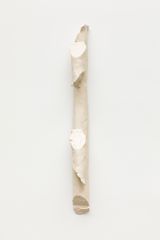
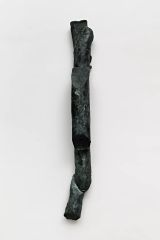
From this point on, Paulo Monteiro began to construct his work in a more synthetic manner, in an interplay of few lines and distilled the formerly-seen excess that characterised the work of his youth. The line then became the common thread in his production, manifested as strokes in his work on paper, relief in his paintings and cuts in his sculptures.
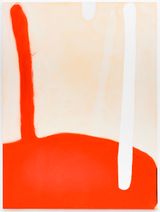
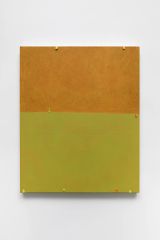
In the late 1980s and the early 2000s, Monteiro immersed himself in sculptural practice. His return to painting over a decade ago brought a new level of consciousness, while intentionally avoiding the dark, metallic tones of his sculpture. What begins to appear and which is still in development today are potent, strong colours, but without traces of gloom. Reds and blues exist side by side with peaceful pastel tones. Surfaces are almost entirely filled in uniformly.
Today, Monteiro reconciles the two forms–painting and sculpture–as if they were one and the same sibling practices, and fosters a kind of unpretentious narrative between them.
In the ordinary use of language when we employ the word polarity, we are normally referring to two or more things opposed to each other and which, in one way or another, are not in harmony, generating conflicts and even estrangement. In science, on the other hand, polarities are associated with the capacity of each chemical bond has for attracting electrical charges and, consequently, accumulating them.
Paulo Monteiro (1961, São Paulo) lives and works in São Paulo.
His works have been featured prominently in exhibitions such as The outside of distance, MISAKO & ROSEN and Tomio Koyama Gallery, Tokyo (2017); The inside of distance, Office Baroque, Brussels (2016); The inside of distance, Mendes Wood DM, São Paulo (2015); Casa 7, Pivô, São Paulo (2015); Empty House Casa Vazia, Luhring Augustine, New York (2015); Paintings on Paper, David Zwirner, New York (2014); Where Were You, Lisson Gallery, London (2014); 22nd São Paulo Art Biennial (1994) and 18th São Paulo Art Biennial (1985).
His works are in numerous permanent collections, such as MoMA, MAM-SP (São Paulo Modern Art Museum), Pinacoteca do Estado de São Paulo, MAC-SP (São Paulo Contemporary Art Museum), MAM-RJ (Rio de Janeiro Modern Art Museum) and Niterói Contemporary Art Museum.
Courtesy Mendes Wood DM

Works at Mendes Wood DM






Recently Exhibited


Works Elsewhere







Explore and Follow Artists Shaping Contemporary Art
A respected voice in contemporary art discourse.
Focusing on ambitious storytelling and insightful art-world commentary. Ocula Magazine publishes in-depth interviews, critical essays and timely analysis on the artists, exhibitions and ideas driving the global art world.
Learn more about Ocula Magazine
Showcasing the best of the art world.
Ocula partners with galleries from around the world to highlight their artists, artworks and exhibitions. Gallery membership is by application and invitation, with each member vetted by an independent panel.
Learn more about Ocula Membership
Specialises in the sale of major artworks.
Led by a team with deep ties to the world’s leading auction houses, galleries and collectors. Ocula’s advisory team offers bespoke services to high-net-worth clients from around the world who are looking to acquire the best of contemporary and modern art.
Learn more about our team and services