





PIERO MANAI
b. 1951He gained immediate notice in the early 1970s in Bolognese circles thanks to a kind of painting, to use the words of Flavio Caroli (who inserted the artist in his book Trentasette, il mistero del genio adolescente) and Pietro Bonfiglioli
“blends hyperrealism and conceptual abstraction,” “always somehow depicting the idea of painting itself.”
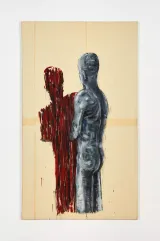
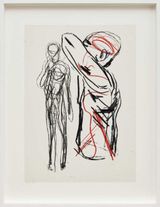
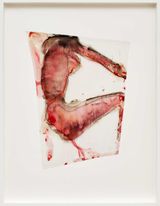
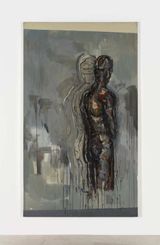
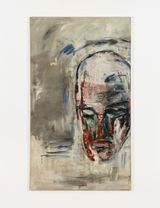
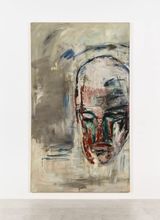
In that period Manai, just into his twenties, fell ill, and it took a number of years for him to recover. This tragic experience brought about a drastic change in his way of painting and in his subjects, in the early 1980s, which became more convulsive and dramatic. He had an almost obsessive need to draw or paint heads, nearly always deprived of most of their physiognomic features. The heads have a self-contained physical quality, blind and deaf (as underscored by some of the titles, _Deaf Figure _or Blind Painter), pensive and isolated inside their own weight, lost in a white space lacking in coordinates.
Lacking expression or psychology, almost coming apart, they are neither representations nor portraits. They are perhaps more precisely self-portraits, and they are not seen from outside, but from inside. “It is an inner work – Manai wrote – an anatomical and psychic construction. To paint a figure, to skin it three times, to put it to the test in order to reach a threshold.” Manai’s heads often bear weights, stones, figures that burden the body under their heft.
“They are men with weights on their heads,” as he defined them. The heads and bodies often degenerate into volumes whose form is like that of a rock, a large stone, a monolith.
After again falling ill, Manai died in 1988. “It was as if he had an invisible weight in his head,” Pietro Bonfiglioli recalls, after meeting him slightly earlier. His pictorial language does not seem related to any of the various artistic practices current at the time, from Austrian-German Expressionism of the 1980s to the more Italian Transavanguardia, just to indicate two of them. In fact, in its diversity it seems to reunite them all, so much so that it is hard to find a (probably useless) way of classifying the work.
Courtesy P420









Explore and Follow Artists Shaping Contemporary Art
A respected voice in contemporary art discourse.
Focusing on ambitious storytelling and insightful art-world commentary. Ocula Magazine publishes in-depth interviews, critical essays and timely analysis on the artists, exhibitions and ideas driving the global art world.
Learn more about Ocula Magazine
Showcasing the best of the art world.
Ocula partners with galleries from around the world to highlight their artists, artworks and exhibitions. Gallery membership is by application and invitation, with each member vetted by an independent panel.
Learn more about Ocula Membership
Specialises in the sale of major artworks.
Led by a team with deep ties to the world’s leading auction houses, galleries and collectors. Ocula’s advisory team offers bespoke services to high-net-worth clients from around the world who are looking to acquire the best of contemporary and modern art.
Learn more about our team and services