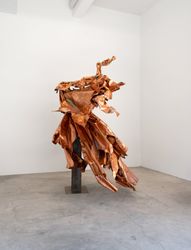
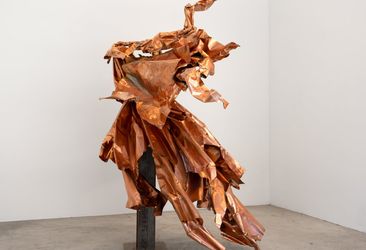
Liz Glynn’s American Progress (after John Gast) (2017) is currently on view in Paula Cooper Gallery’s vitrine. The work is part of Glynn’s ongoing series The Shape of Progress, which reflects critically on United States history and the contradictory myths woven into the foundation of American identity.
In American Progress (after John Gast), thin copper sheeting evokes the draped folds of the woman’s dress in John Gast’s 1872 painting American Progress, an allegorical depiction of the nineteenth-century westward expansionist belief known as ‘manifest destiny.’ In the painting, the colossal figure strides from an industrialized East towards an ‘untamed’ West, as bison and Indigenous people on horseback flee. Farmers in wagons proceed in her wake, as do railroads and telegraph wires, representing the pinnacle of late nineteenth-century technological advancement.
The central figure in American Progress follows a long tradition of the female as allegory of progress or victory, from the headless Nike of Samothrace (c. 190 BCE) to Delacroix’s Liberty Leading the People (1830). In Glynn’s variation, the dress is a disembodied hyper-reflective shell of ideas that no longer hold weight under critical scrutiny. The use of copper references both the material’s role in industrialization and the Statue of Liberty, another female form allegorizing American progress. “I really wanted to address this myth of American exceptionalism that’s built around industrialism,” Glynn explains. “It’s just a story, and it’s in decline.” [1]
American Progress (after John Gast) was originally presented in Glynn’s year-long installation The Archaeology of Another Possible Future at the Massachusetts Museum of Contemporary Art, in 2017-18. The exhibition speculated upon an uncertain future, heightened by living in an increasingly dematerialized economy, while questioning the metrics of historical progress. Exhibiting the work during the commemoration of the United States’s 250th anniversary presents further opportunity to critically examine the nation’s foundational ideals and shifting cultural values.
Liz Glynn’s work is also currently on view at Storm King Art Center, New Winsor, New York; Los Angeles County Museum of Art, California; and The Watermill Center, New York. Glynn is the 2025-26 Joseph H. Hazen Rome Prize Fellow at the American Academy in Rome, where she recently spent her nine-month residency creating a new body of work.
[1] Margaret Carrigan, “Liz Glynn Questions the Direction of American Progress at Mass MoCA,” Observer, December 11, 2017
Courtesy Paula Cooper Gallery.


For the past decade, Liz Glynn (b. 1981, Boston) has worked in sculpture, installation, and performance, examining the ways in which cultural objects of the past embody or confront power dynamics, social structures, and systems of value.

A respected voice in contemporary art discourse.
Focusing on ambitious storytelling and insightful art-world commentary. Ocula Magazine publishes in-depth interviews, critical essays and timely analysis on the artists, exhibitions and ideas driving the global art world.
Learn more about Ocula Magazine
Showcasing the best of the art world.
Ocula partners with galleries from around the world to highlight their artists, artworks and exhibitions. Gallery membership is by application and invitation, with each member vetted by an independent panel.
Learn more about Ocula Membership

Specialises in the sale of major artworks.
Led by a team with deep ties to the world’s leading auction houses, galleries and collectors. Ocula’s advisory team offers bespoke services to high-net-worth clients from around the world who are looking to acquire the best of contemporary and modern art.
Learn more about our team and services