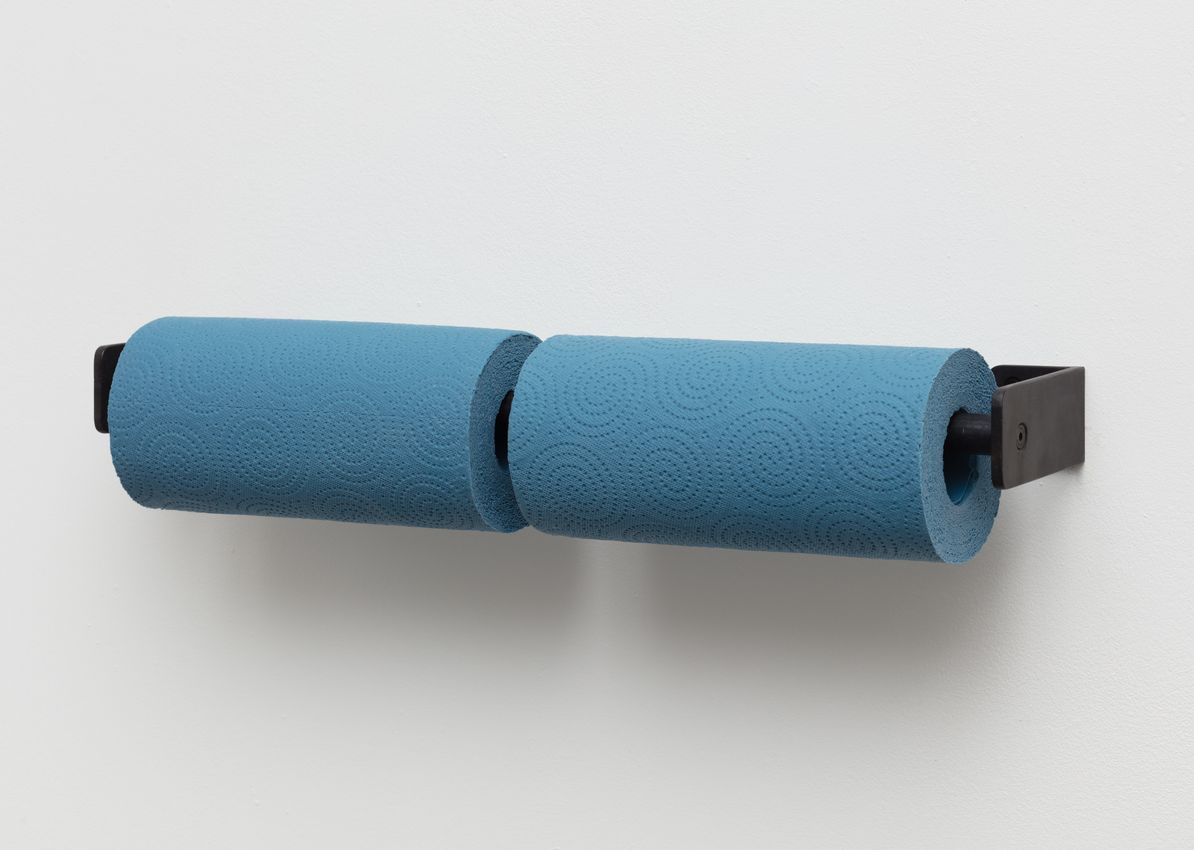
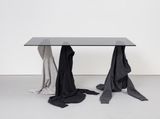
Prem Sahib uses objects, installations, and performance to explore themes of queer intimacy and desire. The artist’s work utilises a language of formal minimalism, often extracting details from the architecture and spaces that gay communities use to meet, and re-presenting them in sparse yet potent installations.
Bodies Together
Sahib’s work evokes a sense of intimacy that is usually hidden from the public, especially when referencing cruising locations, queer club culture, or the Internet. The material of the artist’s work is drawn from these spaces—steel furniture from a nightclub in Berlin, tiles from a bathhouse, the sparse benches in a locker room. These materials become autobiographically charged, recreating the atmosphere of Sahib’s memories and desires. As Sahib explains, ‘It’s about shared social space and what that means, or spaces where bodies convene and maybe where there are ideological ideas present in the materials.’
DJ and club culture are an integral part of Sahib’s personal history, and have seen the artist collaborate with artists George Henry Longly and Eddie Peake on their regular club night, Anal House Meltdown.
In Me Time (2014), Sahib lays a field of resin condensation on anodised aluminium, replicating the look of a fogged-up bathroom mirror—perhaps the evidence of a covert sexual encounter. The trace of the body is a common thread throughout Sahib’s work, in which subtle intimations of queer bodies inhabit saunas, techno clubs, leather bars, and public toilets. In the artist’s own words, these spaces allow ‘you to lose yourself, escape societal constraints, or simply to fuck.’
Descent
In one of the artist’s most ambitious installations, Sahib took over the Southard Reid gallery in Soho, London to enact Descent, a multi-part series of exhibitions that took visitors through the spaces of a claustrophobic subterranean club, the cul-de-sac where Sahib grew up, and an ambiguous domestic room. DESCENT I. People Come & Go (2019) challenged the notion of ‘safe spaces’ for queer gathering, including unresponsive performances from half-stripped men in a red-light steel labyrinth. The slipperiness and multiplicity of identity is considered in DESCENT II. Cul-de-Sac (2019), which features footage from a drone slowly traversing Sahib’s childhood street. Sahib mingles this with audio of drunken fights and snippets of their late father playing the flute. DESCENT III. Man Dog (2020) presents as its centrepiece an obsidian mirror converted into a speaker that plays audio of an American man verbally abusing the artist on Chatroulette, a cam site commonly used by gay men for the purpose of masturbating online.
Throughout this series, Sahib incorporates elements that sit in choreographed relationship with each other. The artist creates a complex network of queer associations and subversive connections that speak to intimacy, longing, and community, but also to the alienation of queer experience.