Press Release

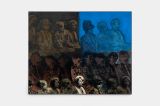
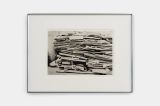
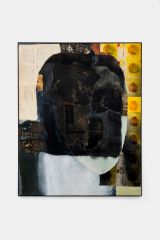
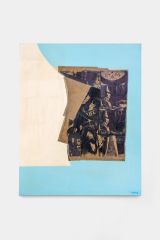
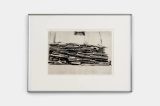
By Hollis Goodall: Among the least-fragile-seeming of women one might meet, Kimiyo Mishima remained anxious. She fought back her fears of drowning in the garbage heap produced by human culture and the overload of information from piles of newspapers, magazines, flyers, or samples by memorializing these triggering items first as collages and, from 1971 forward, as delicately formed ceramic sculptural reproductions of trash.

Growing up in Osaka, a city heavily bombed by the Americans during World War II, Mishima lived through terror and came of age amid the postwar destruction. Many artists finding their direction in the postwar ruins incorporated rubble into their artworks, whether they were painting, sculpting, or arranging flowers. Mishima’s early career works consisted of painting and collage, the latter, a more affordable alternative to painting, set her on a path of studying the leftover fragments of daily life. One can see her sense of space and balance in these early works that brought her immediate attention. Though curators and critics recognized the value of her work, they also had trouble placing it within a gallery setting, and so called it “graphic art”, until the world caught up with her. She became a prize-winning participant in the Independent Fine Arts Society exhibitions, claiming her first awards in 1961 and 1963.

Mishima was a woman of her own will from an early age, encouraged by her father to pursue interests in dance, physical science, and drawing. She was equally pushed by her mother to conform to Japanese society by being a proper wife. Forced into a marriage at age 19, she soon ran off with her painting teacher Shigeji Mishima, who was active in Gutai Art Association circles. They would spend their lives together and, exhibiting her works publically from 1954 onwards, Kimiyo Mishima would become a foremost artist.

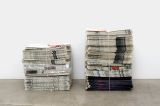
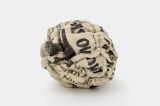
Mishima felt revulsion toward a culture of temporary fulfillment—newspapers once read instantly became useless, and vending machine cans were purchased, their contents chugged, and the cans immediately tossed. She strove in her art to convey the fragile state of the environment through precise replication of these forms of breakable trash, created by silk-screening and inpainting thin sheets of clay she rolled out with an udon noodle roller. That was one of her early technological discoveries from 1971.

Counterbalancing her morbid fascination with garbage, Mishima was drawn to a variety of texts and graphic design from international sources. She was exposed early to European and American newspapers because her now-husband enjoyed reading in French and English. As she matured in her career, artist grants allowed her to travel mainly to New York and Paris, where she stuffed her suitcase with garbage that she found on the street. That was what most interested her.

Though the superficial message of her work, that the world is drowning in trash, is clear in her rendering of trash into seemingly permanent, though nerve-wrackingly fragile, clay sculptures, over her long life a deeper dimension gained increasing importance. The newspaper pages she kept often featured stories that grabbed her attention, whether about current politics, art exhibitions, music or theatrical events, or celebrities and fashions of the moment. These collected moments of her life stand as a diary that continued to grow in breadth until shortly before she died. Mishima hoped that viewers of her work understood how each piece captured a moment when the public’s attention, and her own, was trained on people, things, or events that inspired, attracted, or terrified them.

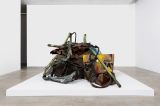
Mishima remained attuned to societal change and continually experimented with her work, perfecting her techniques while also incorporating materials that evoked the passage of time. She added plastics and metal to later sculptures, as well as burned slag from garbage processing facilities, which she treated as the ultimate recycled material, and she mixed clay with volcanic ash to combine disparate eras within the material itself. There is always a conceptual payoff to studying Mishima’s use of materials as part of her expression of passing time.

We are fortunate to see at Nonaka-Hill Gallery a span of Mishima’s work from various points in her life, comparing her techniques and materials from her early and late careers, seeing the continuum of her talent, and reading into what she thought and what she faced over her seventy-plus years as an artist.

Read More

Installation Views

Selected Works

Loading...
About the Artist

Kimiyo Mishima was a pioneering Japanese contemporary artist celebrated for her hyperrealistic ceramic sculptures of newspapers, cardboard boxes, and other ‘breakable printed matter’. Her witty, critical artworks transform everyday throwaways into fragile monuments, compelling viewers to reconsider the value and permanence of information and consumer waste.

View Artist Profile

Also Exhibiting at Nonaka-Hill

About the Gallery

Nonaka-Hill is a contemporary art gallery in Los Angeles with a focus on Japan, founded in 2018 by Rodney and Taka Nonaka-Hill.

Rodney was a partner at Marc Foxx Gallery, Los Angeles and previously worked with Jay Gorney Modern Art in New York. Taka has worked as an art director in the Japanese fashion industry.

Designed by architect Linda Taalman, the gallery is located inside a strip mall, featuring a floor to ceiling glass storefront facade, breaking away from ‘white cube’ gallery design. Above the front entrance, the gallery has maintained the original Best Cleaners signage of the former tenants. Inside, two main exhibition spaces are divided by a central corridor which resembles a traditional Japanese tokonoma area. The gallery’s rear viewing room displays additional artworks and ikebana.

View Gallery Profile
Address
720 N. Highland Avenue
Los Angeles
United States
Opening Hours
Tuesday – Saturday
11am - 6pm
(1)
Los Angeles 720 N. Highland Avenue
Nonaka-Hill
720 N. Highland Avenue, Los Angeles, United States
+ 1 323 450 9409
http://www.nonaka-hill.com

Opening hours
Tuesday – Saturday
11am - 6pm
The art world in focus