Hamilton’s own 1956 collage, Just what is it that makes today’s homes so different, so appealing?—which he made for the Whitechapel show, This is Tomorrow—became so enormously influential that it has been labelled the ‘first genuine work of Pop’. Satirising American materialism around contemporary Adam and Eve figures, it incorporates comics, words, and consumerist images that anticipated the subject matters of Andy Warhol, Roy Lichtenstein and Claus Oldenburg. When asked what ‘pop art’ should be Hamilton famously exclaimed: ‘Popular, transient, expendable, low-cost, mass-produced, young, witty, sexy, gimmicky, glamorous, and Big Business.’
Hommage à Chrysler Corp (1957), showed Hamilton’s brilliant draughting skills for design, preceding the styles of Willem de Kooning and Tom Wesselman by creating a ‘desirable’, fetishistic image that subtly blended car parts and a female body using minimal, fragmented outlines.
Two other important works from this period were Towards a Definitive Statement on the Coming Trends in Menswear and Accessories (1962), showing President Kennedy in an abstracted space helmet, and Interior II (1964), based on a still from a Douglas Sirk film. Here, again, a woman is depicted in a reconstructed, brightly coloured lounge surrounded by multiple disjointed perspectives and various collaged consumer items.
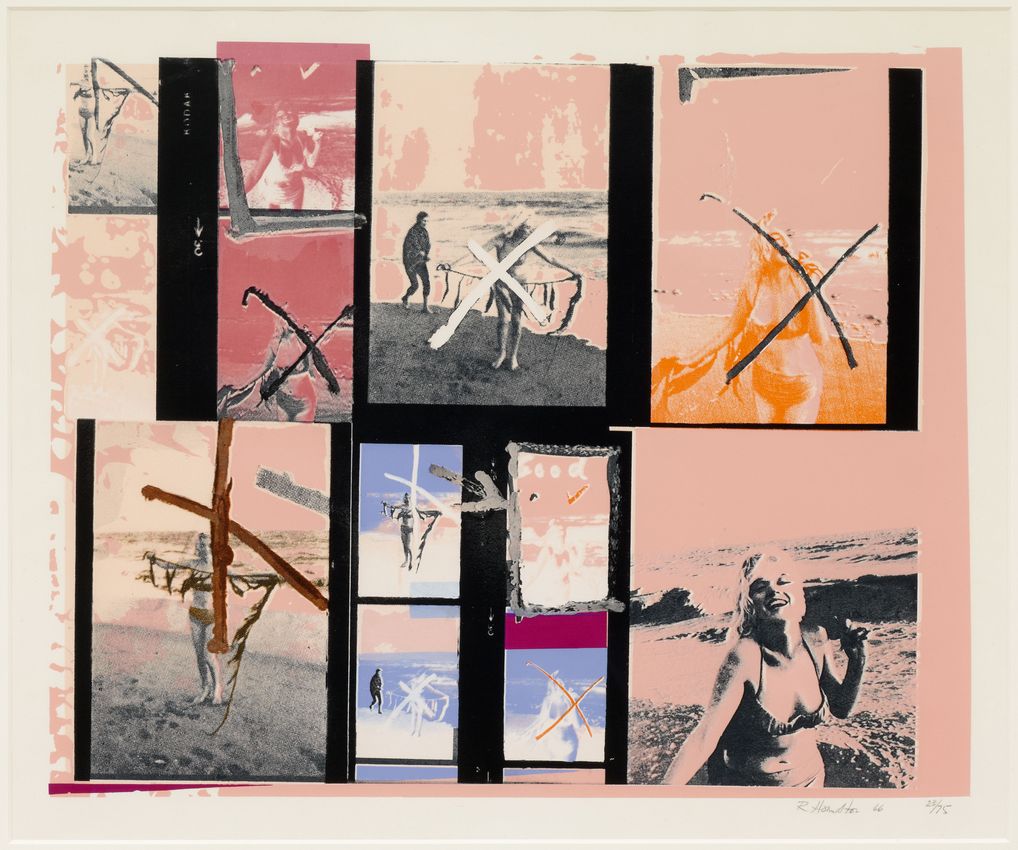
Hamilton had a wide range of interests that he presented in his art, from left-wing politics shown in works such as The Orangeman (1990); The Citizen (1981—3); and Kent State (1970), to advanced computer technologies as in his Five Tyres Remoulded (1972). A gifted writer, his essays were collected and published in the anthology, Collected Words 1953—82.
Hamilton was also a personal friend and interpreter of Marcel Duchamp, and in collaboration supervised the publication of The Green Book (1960) and the reconstruction of The Large Glass (1965—66). He also collaborated with Duchamp to screen print on glass a detail of seven ascending and descending ‘masculine’ cones, in Sieves (1971).