





SERGE NAJJAR
Serge Najjar’s approach to photography is intuitive. It derives from his passion for modern and contemporary art. He easily references Kazimir Malevich’s “Architectons”, Josef Albers’ abstract compositions, Robert Mangold and Ellsworth Kelly, and also Lygia Clark, Aurélie Nemours, Frank Stella and Sol Lewitt. The graphic approach of the Russian Avant-garde and, specifically, Alexander Rodchenko catches Najjar’s interest early on his career: deciphering the image and its construction will come to guide the structure of his future endeavours.
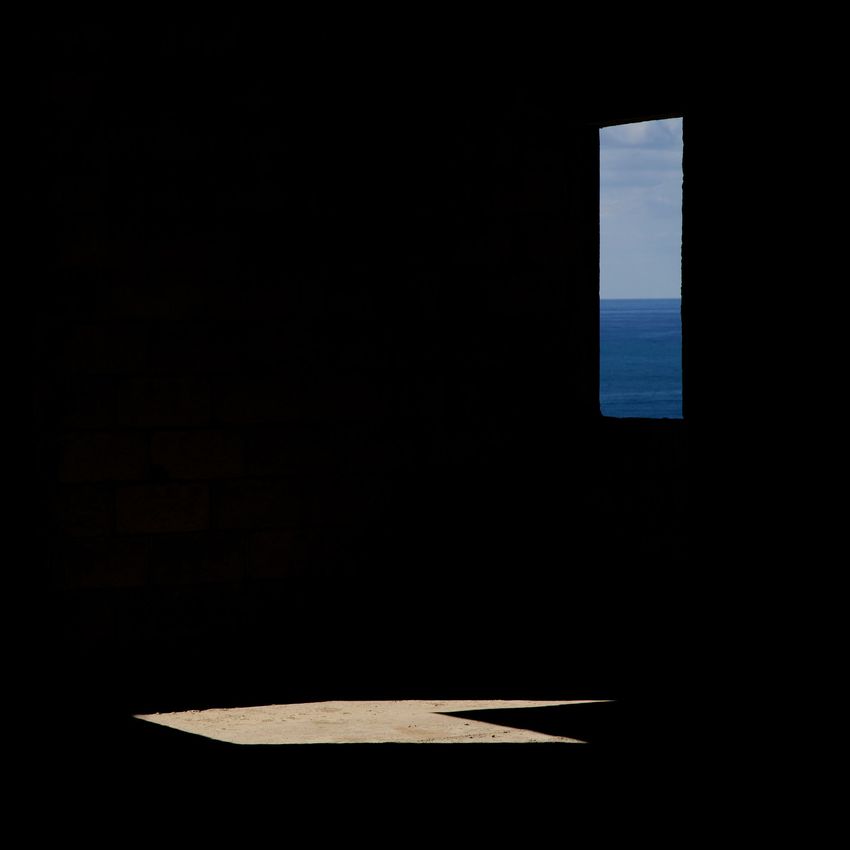
Serge Najjar’s pictures place the viewer within a world where reality and fantasy meet. They capture the passing of time, or a space where the transient disposition of man would inhabit ideal radical constructions. Motionless variations on a theme, the photographs engage in a dialogue, complete each other or not, but always create a singular space that is inhabited by the onlooker within the space they are presented in.
In a sort of backward movement, Najjar uses photography in the digital age while adhering to an approach that embraces the formal rigour better known from analog photography. Always on foot across the city, the photographer tracks down architecture, surfaces and “ordinary” shapes which when seen from unusual angles appear as surreal figures. One click and the concert of the outdoors is frozen into evidence.
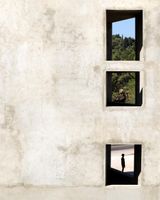
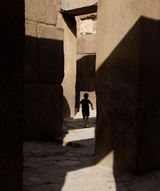
Shadow and light, passerby, subject, worker; thus architecture and man stay on the edge of abstraction. This is where we find the formal language of the photographer. By appropriating the principles of capture of immediate reality, where direct photography is only possible thanks to the distance of the subject, and the photographer too.
Whether colour or black and white photographs, Najjar’s body of images forms a coherent sum that emerges instantly, without mediation, as a dance between flatness and depth. Careful, calm, without outcry, the photographer plays with elements that are readily available. Shadows become geometric sculptures; three dimensional shapes morph into planes. Perspectives tilt, the image is constructed, reality is cut, riffled through and rebuilt by the lines that surround us.
Text courtesy Galerie Tanit.







Explore and Follow Artists Shaping Contemporary Art
A respected voice in contemporary art discourse.
Focusing on ambitious storytelling and insightful art-world commentary. Ocula Magazine publishes in-depth interviews, critical essays and timely analysis on the artists, exhibitions and ideas driving the global art world.
Learn more about Ocula Magazine
Showcasing the best of the art world.
Ocula partners with galleries from around the world to highlight their artists, artworks and exhibitions. Gallery membership is by application and invitation, with each member vetted by an independent panel.
Learn more about Ocula Membership
Specialises in the sale of major artworks.
Led by a team with deep ties to the world’s leading auction houses, galleries and collectors. Ocula’s advisory team offers bespoke services to high-net-worth clients from around the world who are looking to acquire the best of contemporary and modern art.
Learn more about our team and services