



TAO AIMIN
b. 1974Tao Aimin (b. 1974 in Hunan) lives and works in Beijing. A Hunan native who maintains an emotional distance towards her adopted home of Beijing, Tao Aimin approaches the lives of rural Chinese women with a combination of empathy and anthropological curiosity. With eloquent inarticulacy, she gives voice to their unexpressed and undocumented experiences, which are increasingly at risk of being forgotten. Incorporating found objects, painting, calligraphy, printmaking, video, and installation, her works move fluently between elite and popular culture and between the languages of traditional and contemporary art. They are bold and sensitive meditations on the issues of artistic authorship and self-representation, labour, embodied knowledge, and collective memory.
Since 2005, Tao Aimin has created a series of works from wooden washboards that she has collected in the hundreds on repeated visits to the countryside. They have been fractured and deformed by repeated and prolonged exposure to the elements. Once household necessities, they have now been largely supplanted by modern technology, a fate shared by the culture of the women who used them. For the artist, these washboards are the only material evidence of the women’s toil: ‘I am concerned with the circumstances of women in different eras. Washboards—these “artefacts” submerged for years in water—are symbols of the women of a different time, a river of life witnessed by countless women in history.’
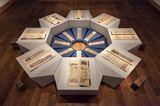
These washboards form the installation Women’s River (2005), a multivalent metaphor for resilience, continuity, and transience. Many of the women who owned the washboards are illiterate and possess no visual records of themselves. Tao Aimin paints their portraits on the washboards, which are in a sense their only self-portraits. In Women’s Book (2005), she collects washboards into albums, turning them into wordless storybooks and their physical fractures into the signs of an inarticulate language. In Washed Relics (2006, 2014), she strings the washboards together with fishing lines into wall-size suspended displays that recall archaeological relics and anthropological specimens in museums. Constituted by mundane and personal objects of anonymous women, these installations are counterpoints to the monumental and universalising estrangements of language and culture by contemporary male artists, most notably Xu Bing’s Book from the Sky series.
More recently, Tao Aimin has used washboards not directly as found objects, but rather as printing blocks to create rubbing impressions on xuan paper. She thus engages the traditions of calligraphy, woodblock prints, and epigraphic studies. In Women’s Book (2005), she collects such rubbings into classical string-bound volumes and inscribes them in Nüshu, a syllabic script invented by women of Jiangyong County in Hunan to transcribe their local dialect. With these counterfactual artefacts, Tao Aimin posits an alternative literate tradition—unfamiliar to us not because it is fictive or imaginary, but because it has been suppressed and confined to the margins.
Tao Aimin graduated from the Fine Arts Department of National Huaqiao University, Fujian in 1999 and an Assistant Lecturer training course in the Mural Painting Department of the Central Academy of Fine Arts in 2001. She has previously exhibited at the World Art Museum of China Millennium Monument (2005, 2006, 2011), National Art Museum of China (2009), Today Art Museum (2008, 2010), Sakshi Gallery (2009), and INKstudio (2014). She has received a Newcomer Award at the 2006 Chinese Contemporary Art Document Exhibition, a nomination for the Xiao Shufen Award from the Wu Zuoren International Art Foundation, and a nomination as Art China Artist of the Year in the Installation and Multimedia category (2009). Her works can be found in the collections of Yanhuang Art Museum and Chengdu Modern Art Museum, among others.
Courtesy INKstudio






Explore and Follow Artists Shaping Contemporary Art
A respected voice in contemporary art discourse.
Focusing on ambitious storytelling and insightful art-world commentary. Ocula Magazine publishes in-depth interviews, critical essays and timely analysis on the artists, exhibitions and ideas driving the global art world.
Learn more about Ocula Magazine
Showcasing the best of the art world.
Ocula partners with galleries from around the world to highlight their artists, artworks and exhibitions. Gallery membership is by application and invitation, with each member vetted by an independent panel.
Learn more about Ocula Membership
Specialises in the sale of major artworks.
Led by a team with deep ties to the world’s leading auction houses, galleries and collectors. Ocula’s advisory team offers bespoke services to high-net-worth clients from around the world who are looking to acquire the best of contemporary and modern art.
Learn more about our team and services