





ZHANG HUAN
b. 1965, ChinaZhang Huan is an internationally acclaimed performance artist, sculptor, painter, and photographer whose rigorous practice examines the body, memory, spirituality, and socio-political histories.
Education
Zhang Huan received a B.A. from Henan University, Kaifeng, in 1988, and an M.A. from the Central Academy of Fine Arts, Beijing, in 1993.
Early Performance Practice
In the early 1990s, Zhang emerged as a central figure in Beijing’s East Village, a community of avant-garde artists redefining contemporary art in China. His early performance works probed the limits of the body and its relationship to the environment, often under extreme conditions. Angel (1993), his first major performance at the National Art Museum of China, used fake blood and dismembered doll parts to evoke the 1989 Tiananmen Square crackdown and the violence of China’s one-child policy; the exhibition was shut down shortly after opening.
12 Square Meters (1994), performed in a public latrine in Beijing, saw Zhang sit motionless for hours, his naked body covered in honey and fish oil, attracting swarms of flies that he later drowned by immersing himself in a nearby pond. The work powerfully confronted viewers with the physical realities of poverty and marginalisation. Other performances from this period include To Add One Meter to an Anonymous Mountain (1995), in which Zhang and friends lay naked atop a mountain summit, temporarily “raising” its height, and To Raise the Water Level in a Fishpond (1997), a poetic collective action involving rural labourers.
New York Years (1998–2006)
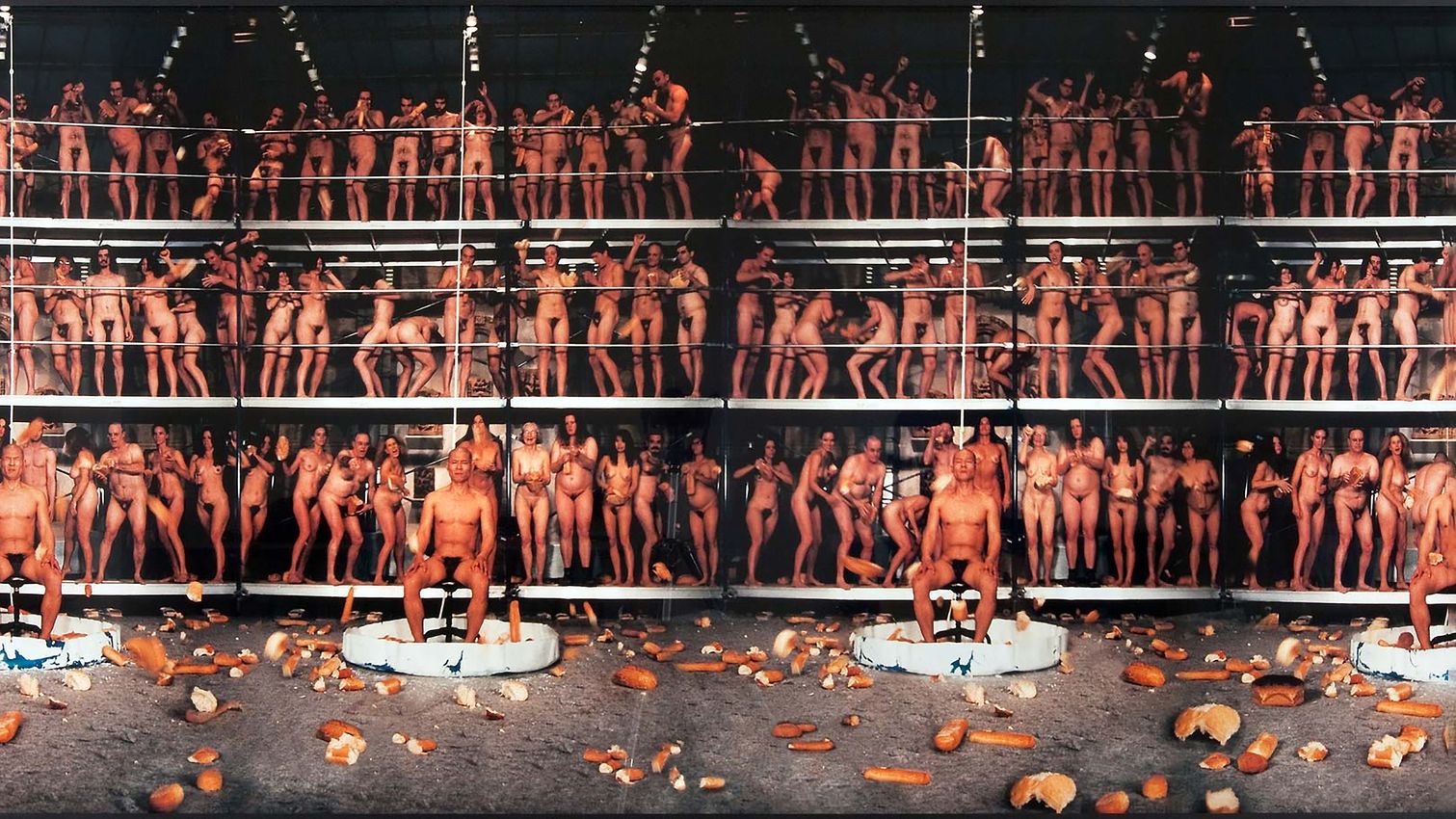
In 1998, Zhang relocated to New York, where his performances expanded in scale and began addressing themes of cultural displacement, immigration, and identity. Pilgrimage—Wind and Water in New York (1998), presented at MoMA PS1, saw the artist lie naked, face down on a traditional Chinese bed covered in ice and surrounded by tethered dogs. For My America (Hard to Acclimatize) (1999) at the Seattle Art Museum, 54 naked participants threw stale bread at Zhang from atop scaffolding—an allegory of assimilation and cultural disjuncture. In My New York (2002), performed for the Whitney Biennial, Zhang donned a suit made of raw meat and walked barefoot through the city handing out white doves.
During this period, Zhang participated in major international exhibitions including Inside Out: New Chinese Art (Asia Society and P.S.1, New York, 1998), the Yokohama Triennale (2001), and the Whitney Biennial (2002), establishing his global reputation.
Return to China and Ash Works
In 2006, Zhang returned to China, established Zhang Huan Studio in Shanghai, embraced Buddhism, and shifted toward more contemplative practices rooted in Chinese cultural traditions. A defining material of this period is incense ash collected from Buddhist temples near his studio, which he regards as a deliverer of the human spirit. Separating the ash by colour and texture, Zhang developed a method for using it as pigment, creating grisaille compositions that depict historical scenes, anonymous faces from archival photographs, and Buddhist imagery.
The ash paintings explore memory, spirituality, and collective experience, their fragile, time-laden presence underscoring themes of impermanence and transience. His Memory Door series combines low-relief carvings with drawing elements, similarly addressing the role of memory in preserving the past. The Poppy paintings (from 2010) juxtapose vivid colour with motifs of skulls and decay, referencing cycles of life, death, and rebirth, as well as the historical legacy of opium.
Zhang’s ash sculptures include monumental Buddha figures that slowly disintegrate over time. Sydney Buddha (2015), presented at Carriageworks during Sydney Festival, comprised two five-metre-tall Buddha sculptures—one in aluminium, the other formed from 20 tonnes of temple ash that gradually dispersed over the exhibition’s duration. His Hermitage Buddha installation was exhibited as part of In the Ashes of History at the State Hermitage Museum, St Petersburg (September 2020–April 2021).
Collections
Zhang Huan’s work is held in major public collections worldwide, including The Museum of Modern Art, New York; The Metropolitan Museum of Art, New York; Solomon R. Guggenheim Museum, New York; Centre Georges Pompidou, Paris; Fondation Louis Vuitton, Paris; San Francisco Museum of Modern Art; Museum of Fine Arts, Boston; National Gallery of Australia, Canberra; Denver Art Museum; Yale University Art Gallery; and Storm King Art Center, among many others.
Exhibitions
Zhang Huan’s most recent solo exhibition, Ash Paintings and Performances at Pace Gallery‘s 125 Newbury space, New York (6 March–11 April 2026), marked his first solo presentation in New York in over a decade. Curated by Arne Glimcher, the exhibition featured never-before-seen filmic documentation of iconic performances from the 1990s and 2000s alongside ash paintings and works from the Memory Door series.
Other significant solo exhibitions include Ordinary Life at the University of Kentucky Art Museum, Lexington (19 August–20 December 2025); In the Ashes of History at the State Hermitage Museum, St Petersburg (2020–2021); Sydney Buddha at Carriageworks, Sydney Festival (8 January–22 March 2015); Looking East, Facing West: The World of Zhang Huan at Frederik Meijer Gardens & Sculpture Park, Grand Rapids (2013); Ash Paintings and Memory Doors at the Art Gallery of Ontario, Toronto (2012); and Q Confucius at Rockbund Art Museum, Shanghai (15 October 2011–29 January 2012).
Selected group exhibitions include Human, 7 Questions at Leeum, Samsung Museum of Art, Seoul (2021); Awakening: Art in Society in Asia, 1960s–1990s, presented at National Gallery Singapore (2019), Museum of Modern and Contemporary Art, Gwacheon (2019), and The Museum of Modern Art, Tokyo (2018); Art and China after 1989: Theater of the World at Solomon R. Guggenheim Museum, New York (2017); and 15 Rooms at Long Museum, Shanghai (2015).
Ocula | 2026

Works at Gary Tatintsian Gallery


Works Elsewhere





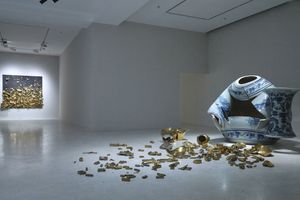
Zhang Huan in Ocula Magazine





Explore and Follow Artists Shaping Contemporary Art
A respected voice in contemporary art discourse.
Focusing on ambitious storytelling and insightful art-world commentary. Ocula Magazine publishes in-depth interviews, critical essays and timely analysis on the artists, exhibitions and ideas driving the global art world.
Learn more about Ocula Magazine
Showcasing the best of the art world.
Ocula partners with galleries from around the world to highlight their artists, artworks and exhibitions. Gallery membership is by application and invitation, with each member vetted by an independent panel.
Learn more about Ocula Membership
Specialises in the sale of major artworks.
Led by a team with deep ties to the world’s leading auction houses, galleries and collectors. Ocula’s advisory team offers bespoke services to high-net-worth clients from around the world who are looking to acquire the best of contemporary and modern art.
Learn more about our team and services