





Sydney Contemporary: Bridging the Gap

Sydney Contemporary (13–16 September 2018). Courtesy Sydney Contemporary. Photo: Jacquie Manning.
Carriageworks remains Sydney Contemporary’s quiet ace. Its vaulted industrial skeleton and generous light make a persuasive case for the fair before a single work comes into view. The scale helps too: this is an art fair that remembers human attention spans. With just over 80 galleries in 2018, the aisles—bisected by a slightly jarring strip of electric-blue carpet—felt brisk rather than punishing, the white booths sitting comfortably within the old rail sheds’ rusted steel and brick.
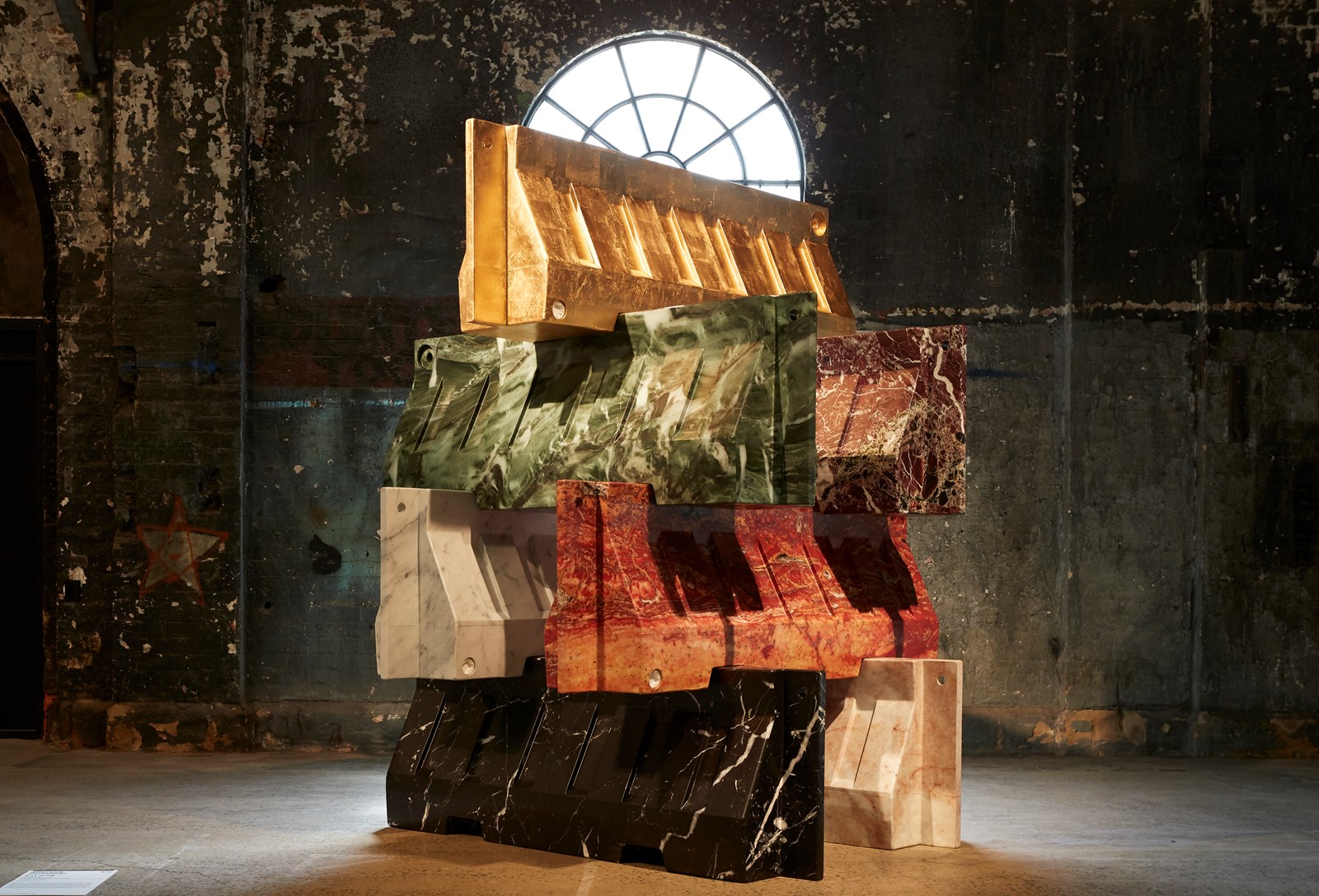
The fair’s curated sectors did much of the heavy lifting. Installation Contemporary, overseen by Nina Miall, threaded 24 works through Carriageworks’ nooks and vistas: Patricia Piccinini’s The Field (2018), with its genetically tweaked blooms and tender woman–creature pairing, pulled visitors into a speculative future, while teamLab’s two-screen digital work Gold Waves (2017) bathed them in proprietary digital sublime. Nearby, Alex Seton’s installation The Golden Calf (2018)—polyethene road barriers masquerading as marble and gold—offered a wry reminder of the economic and social barricades that still frame the supposedly open terrain of art fairs.
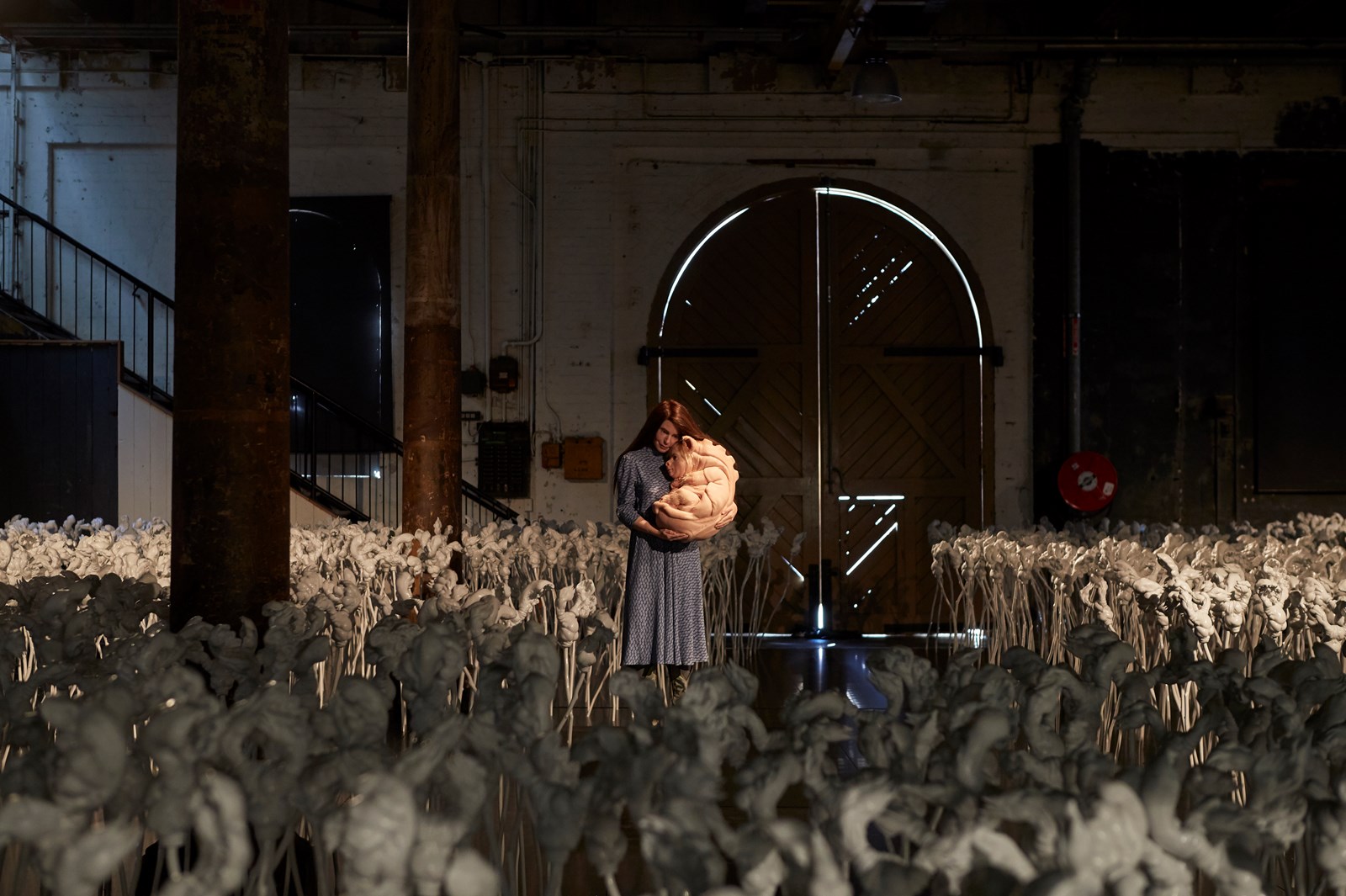
Also forming part of Miall’s curatorial program were installations by Nyapanyapa Yunupingu, Abdul Abdullah, and Brook Andrew, situated together with Ron Adams’ text-based work Choices (2016) in a dedicated space that allowed for quiet contemplation within the bustle of the fair. Yunupingu’s group of untitled paintings created in 2012 demonstrate an altogether different take on the bark painting tradition practiced in her northeast Arnhem Land, Northern Territory. Created with a paint pen, repetitive marks are rendered on clear acetate plastic: intimate, rhythmic, and resolutely her own.
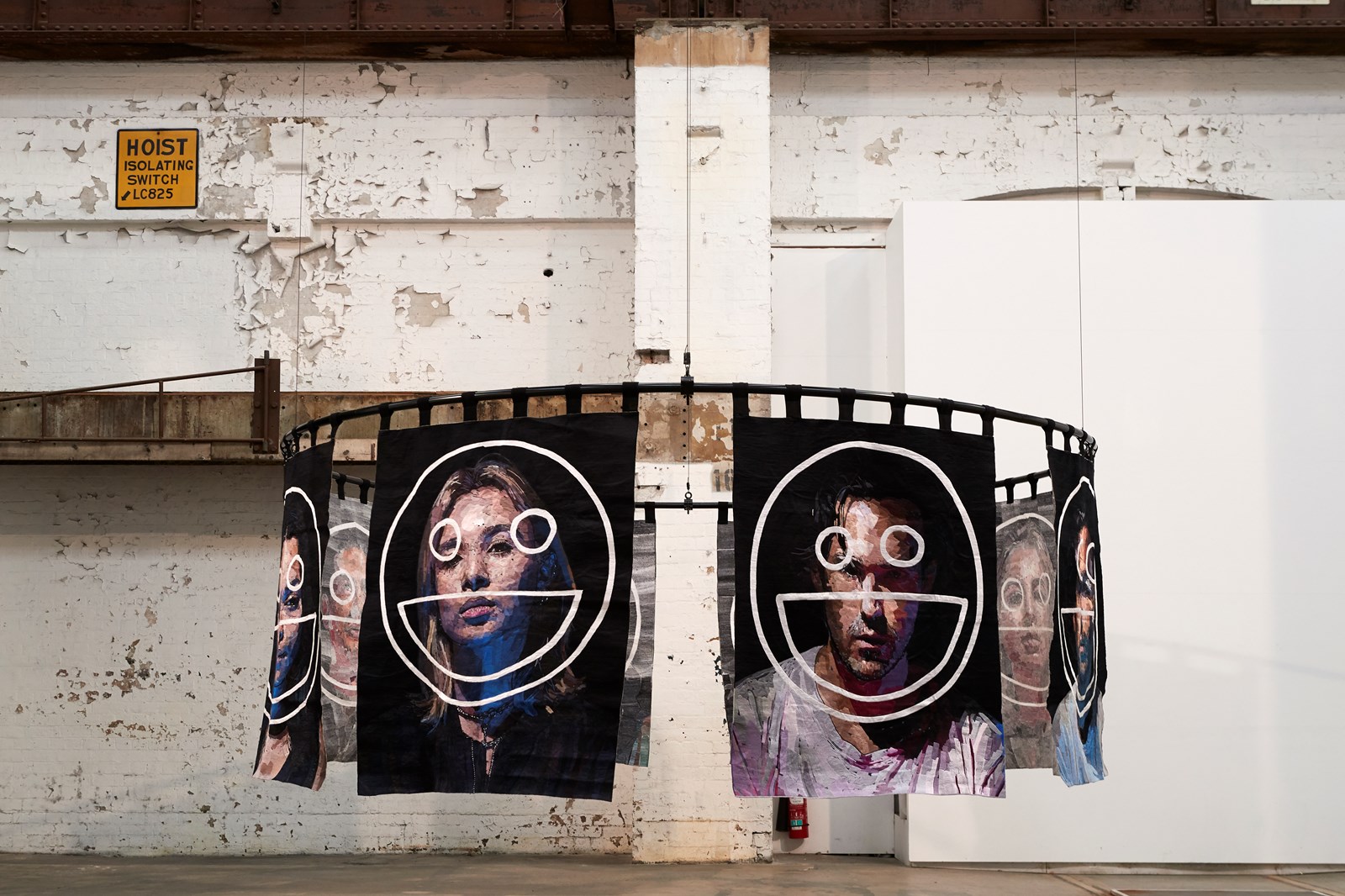
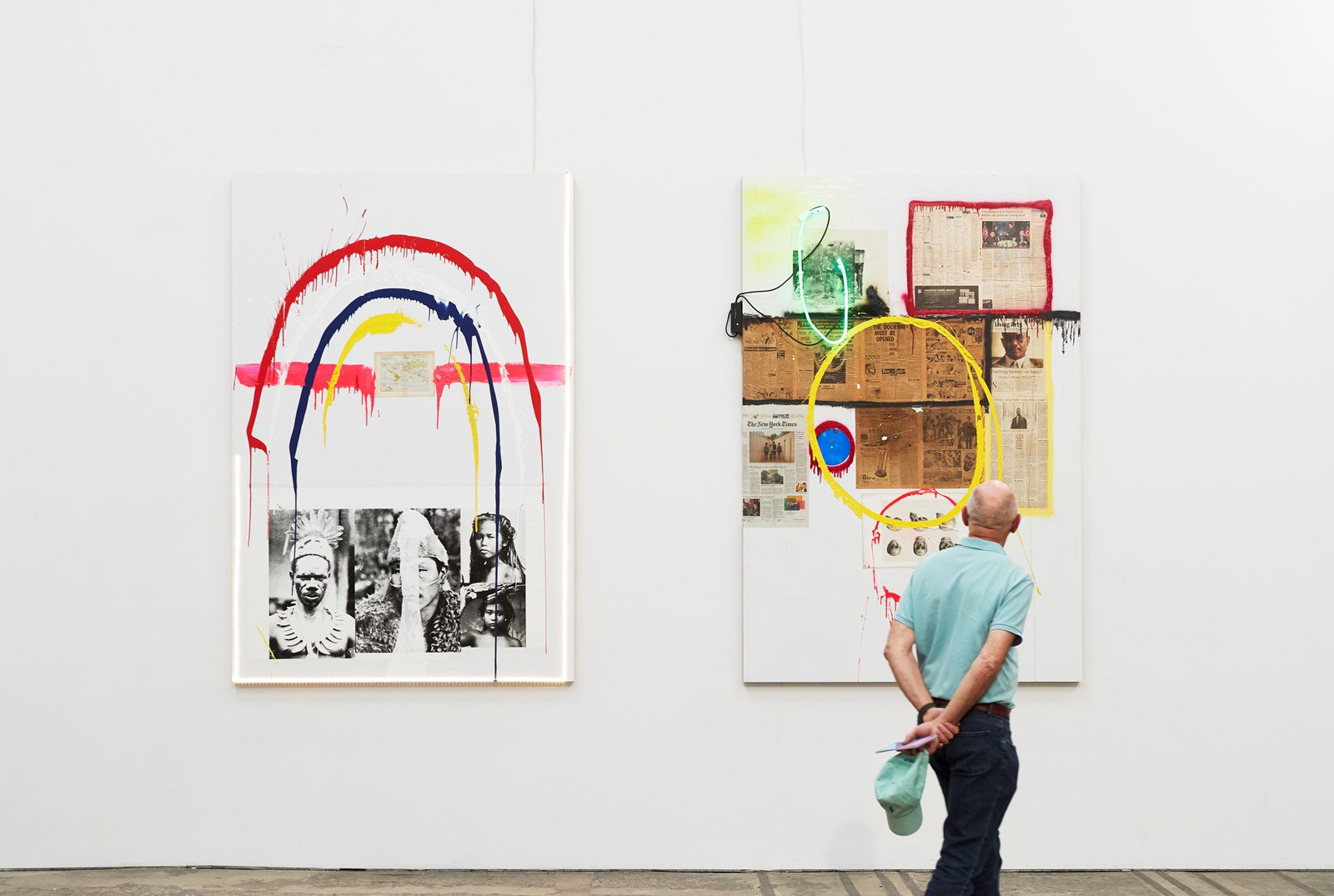
Abdullah’s remarkable Call me by my name (2018) comprises a set of embroideries suspended from a ring, each depicting a frontal portrait of a solemn youngster overlaid with the graphic lines of a smiley emoji, alluding to a reductive form of written language as well as the façades we use to deflect and defend criticism. Brook Andrew—a Wiradjuri artist with mixed European ancestry, who was recently announced as artistic director of the 2020 Biennale of Sydney—showed a diptych titled Rainbow across the world I & II (2018), in which archival images and newspaper clippings are overlaid with gestural strokes of paint and in one instance a loop of neon and strips of wood. The work continues Andrew’s exploration of personal and institutional archives to bring visibility to forgotten stories and upend dominant narratives of the world.
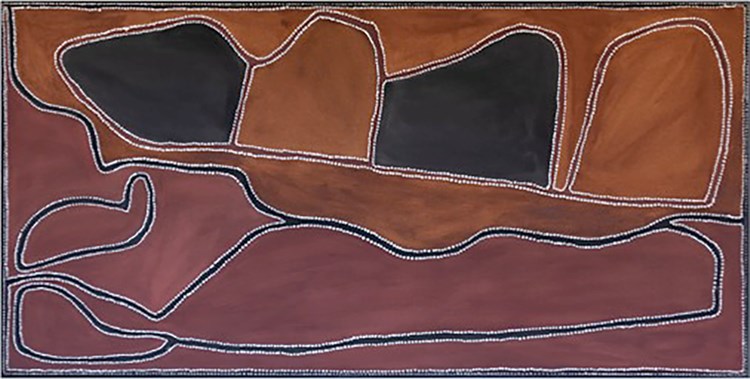
Importantly, the presence of First Nations artists registered across booths and sectors. D’Lan Davidson’s stand, with John Mawurndjul‘s bark painting Ngalyod – The Rainbow Serpent (1999) reportedly placed with an offshore buyer for around AUD140,000, felt buoyed by the artist’s concurrent Museum of Contemporary Art Australia survey I am the old and the new (2018). Tim Klingender Fine Art juxtaposed early bark painting by Mathaman Marika with Rover (Juluma) Thomas’ Frog Hollow Country (1988) and a small, pulsing work water dreaming with seated woman (water dreaming at Kalipinypa) (1972) by Johnny Warangkula Tjupurrula, whose dotting technique helped define Western Desert painting. Elsewhere, Utopia Art Sydney showed strong works by Emily Kame Kngwarreye and Yukultji Napangati, while Clifton Mack‘s paintings at Chalk Horse and Robert Fielding‘s photographs and videos at Blackartprojects underlined the breadth of contemporary Indigenous practice.
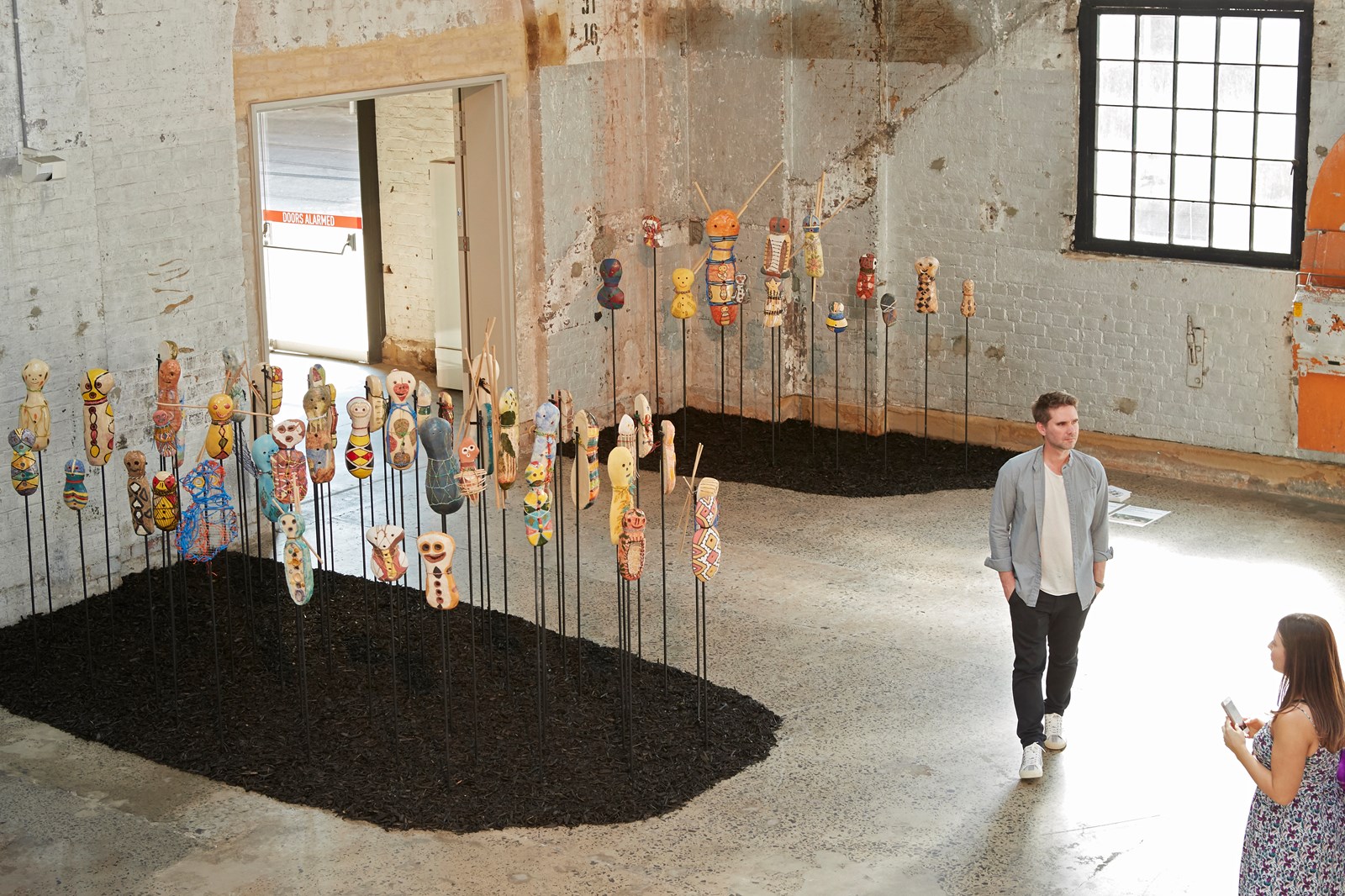
In Installation Contemporary, Yhonnie Scarce presented a haunting work based on her research into the lingering aftermath of British atomic testing carried out on Indigenous land during the 1950s and 60s, which features hand-blown glass bush fruits in hospital cribs before wallpaper printed with an image of graves. Also among the installations was Girringun Aboriginal Art Centre’s presentation, Bagu of Girringun (2018), timber figurative sculptures made by artists of the Girringun region of far north Queensland.
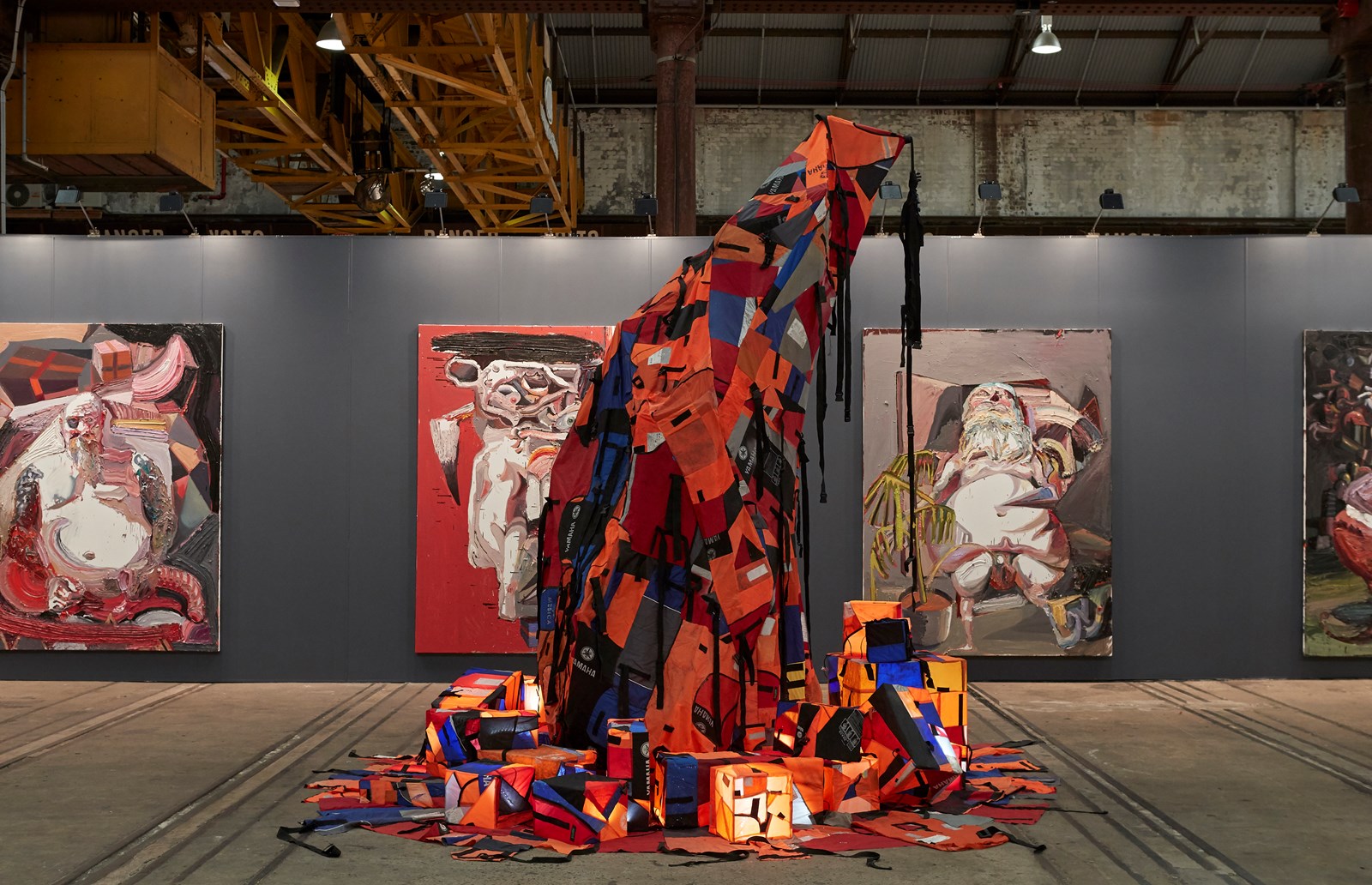
Most of Australia’s major commercial players turned up with confidence. At Tolarno Galleries, Ben Quilty’s lurid, lumbering Santas in the presentation The Bottom Feeders (2018)—drunk, naked, ravenous—loomed over a Christmas tree assembled from discarded lifejackets, staging masculinity and the refugee crisis as twin moral hangovers. Sullivan+Strumpf’s stand folded ceramics, sculpture, and gestural painting into a dense salon, punctuated by Dawn Ng’s crisp text works Pinball (2017) and Missing Things (2017). On Sarah Cottier Gallery’s booth, Gemma Smith’s ostensibly white paintings rewarded patience: subtle shifts of colour only fully appeared when you gave them time, an almost impolite demand in a fair context.
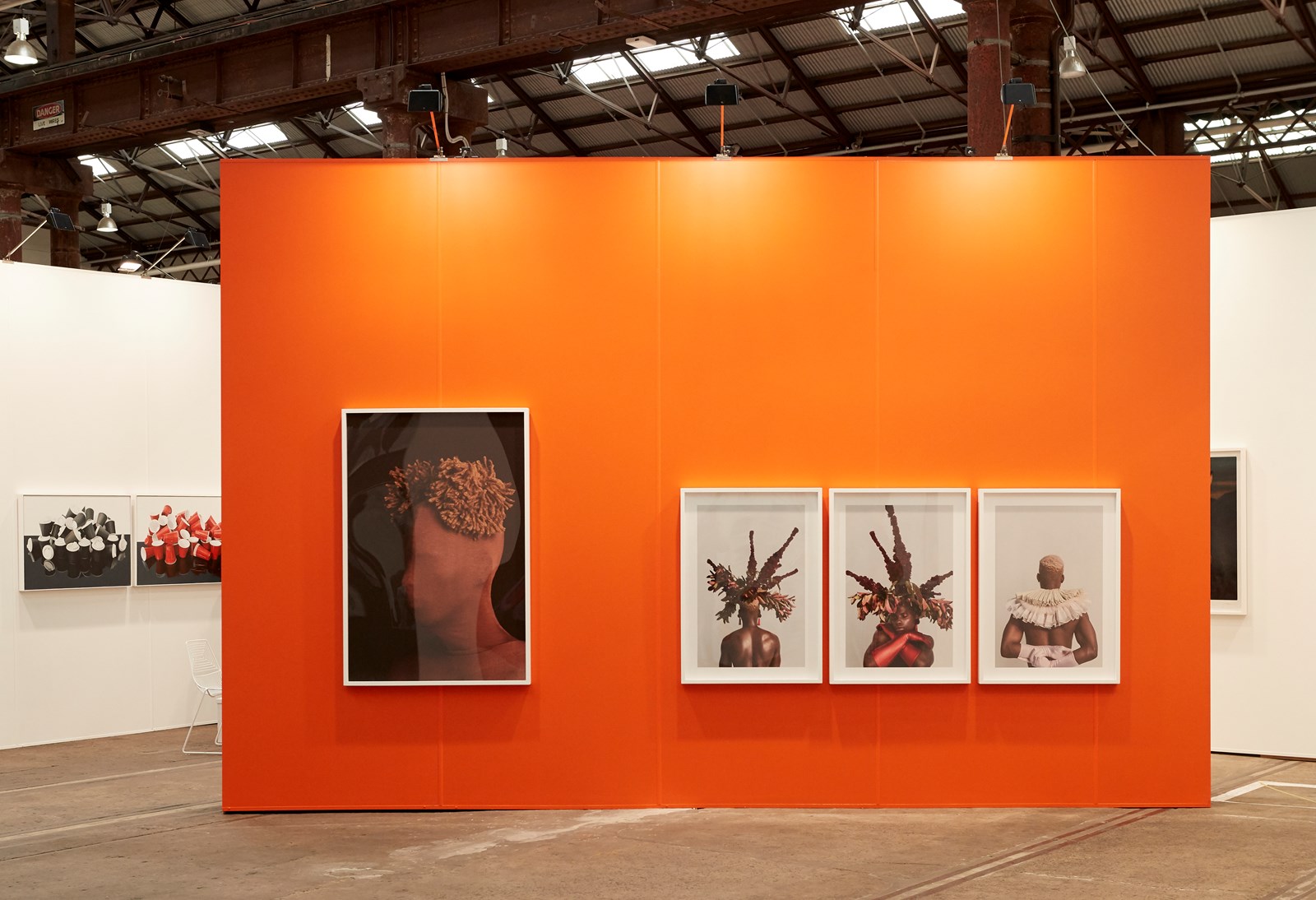
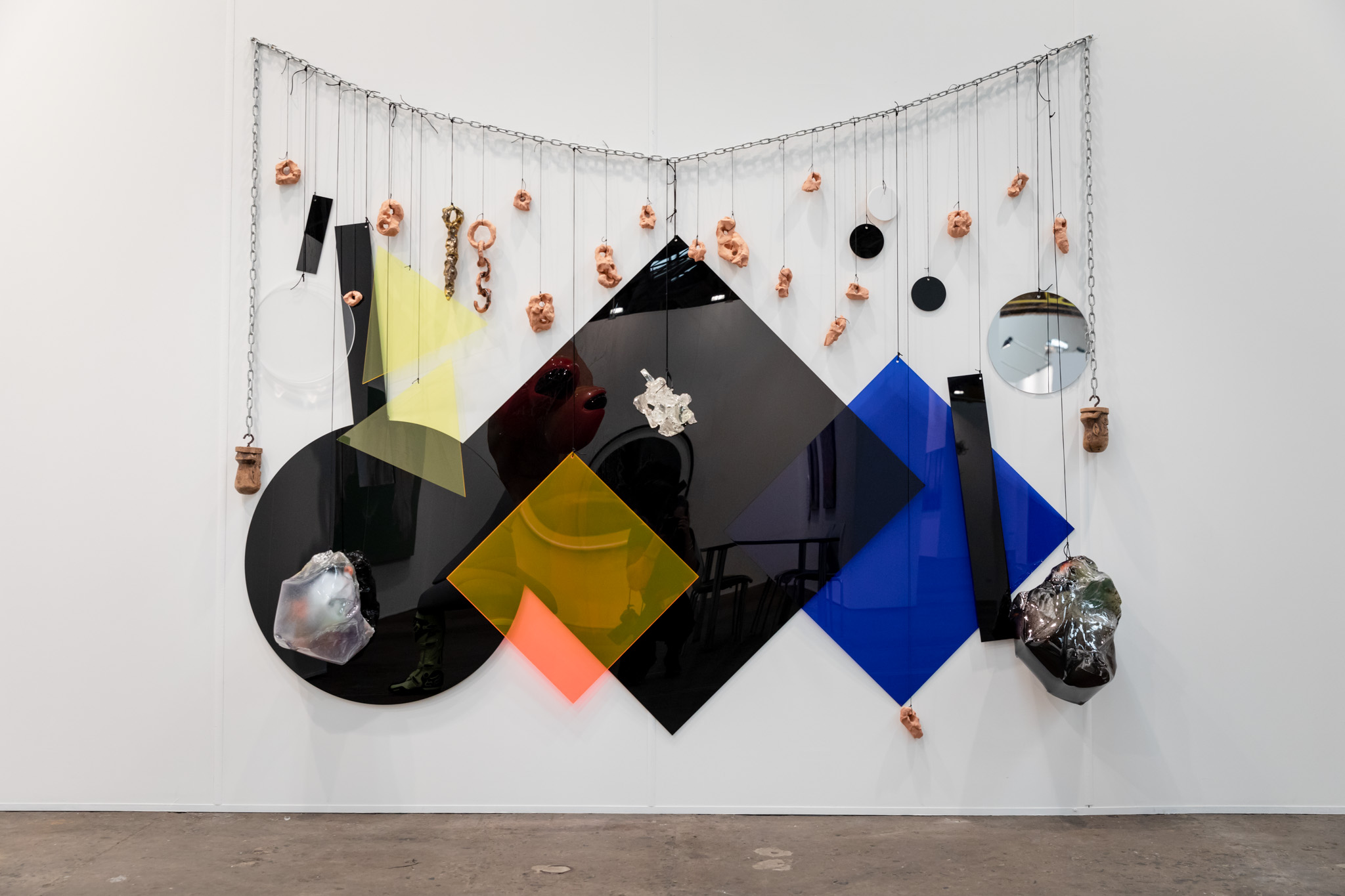
Colour did strategic work elsewhere. THIS IS NO FANTASY dianne tanzer + nicola stein coated one wall blood orange, a bold frame for Nigerian photographer Lakin Ogunbanwo’s images of men in ceremonial headwear, which sat alongside works by Michael Cook and Petrina Hicks. Roslyn Oxley9 Gallery mixed Mikala Dwyer’s hanging sculpture Wall Necklace (2018)—a chain of Perspex, bronze, ceramic, and other objects swaying in the booth’s air—with Isaac Julien’s photographic Green Screen Goddess Triptych (Ten Thousand Waves) (2010) and Michael Parekowhai’s modest wall-hung sculpture Over the Rainbow (2015), a lone figure in bowler hat and overcoat turned towards the wall as if refusing the spectacle.
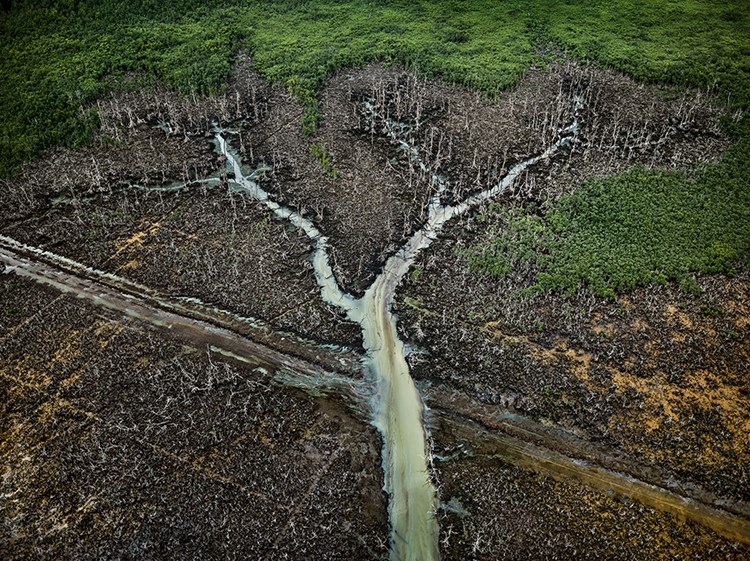
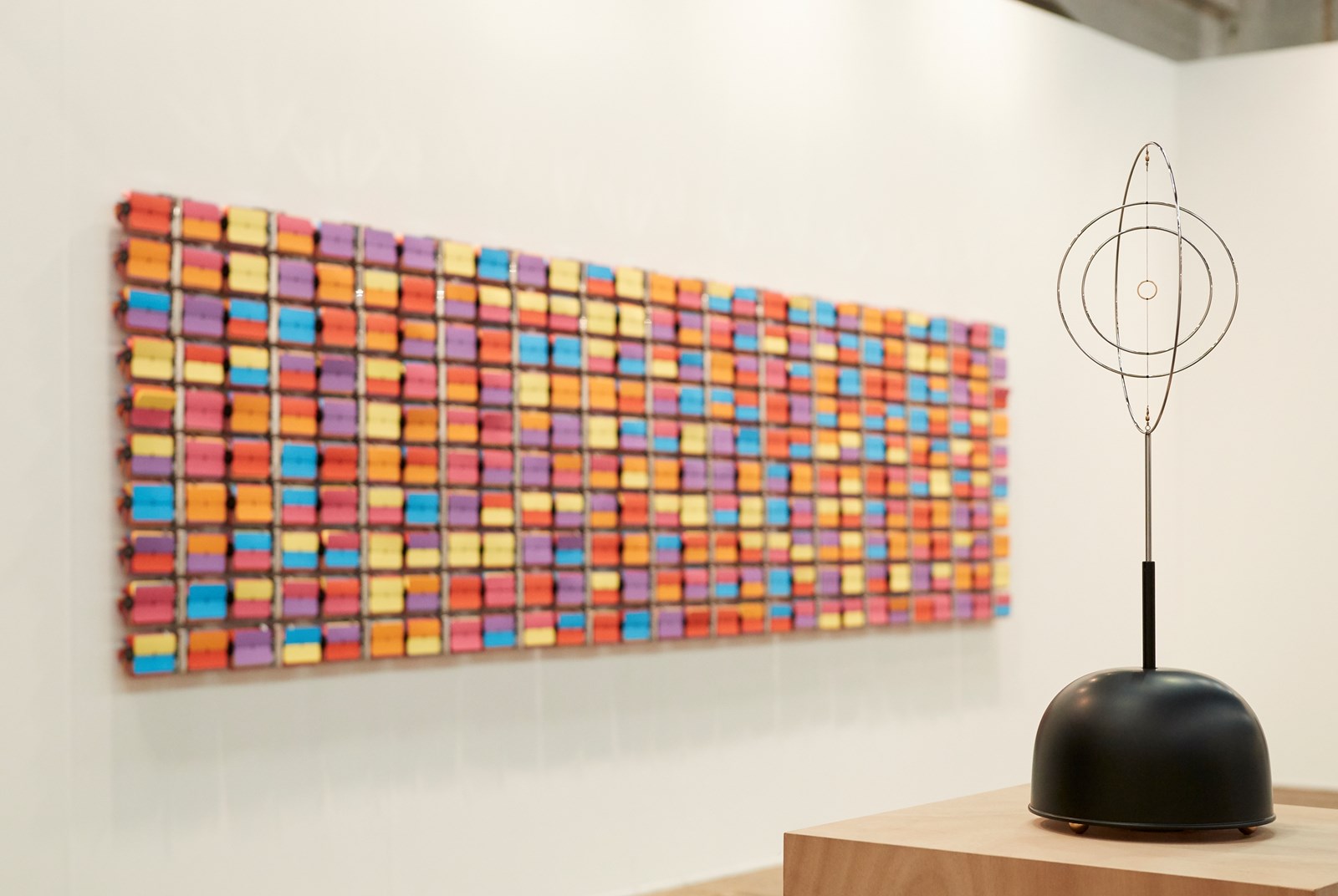
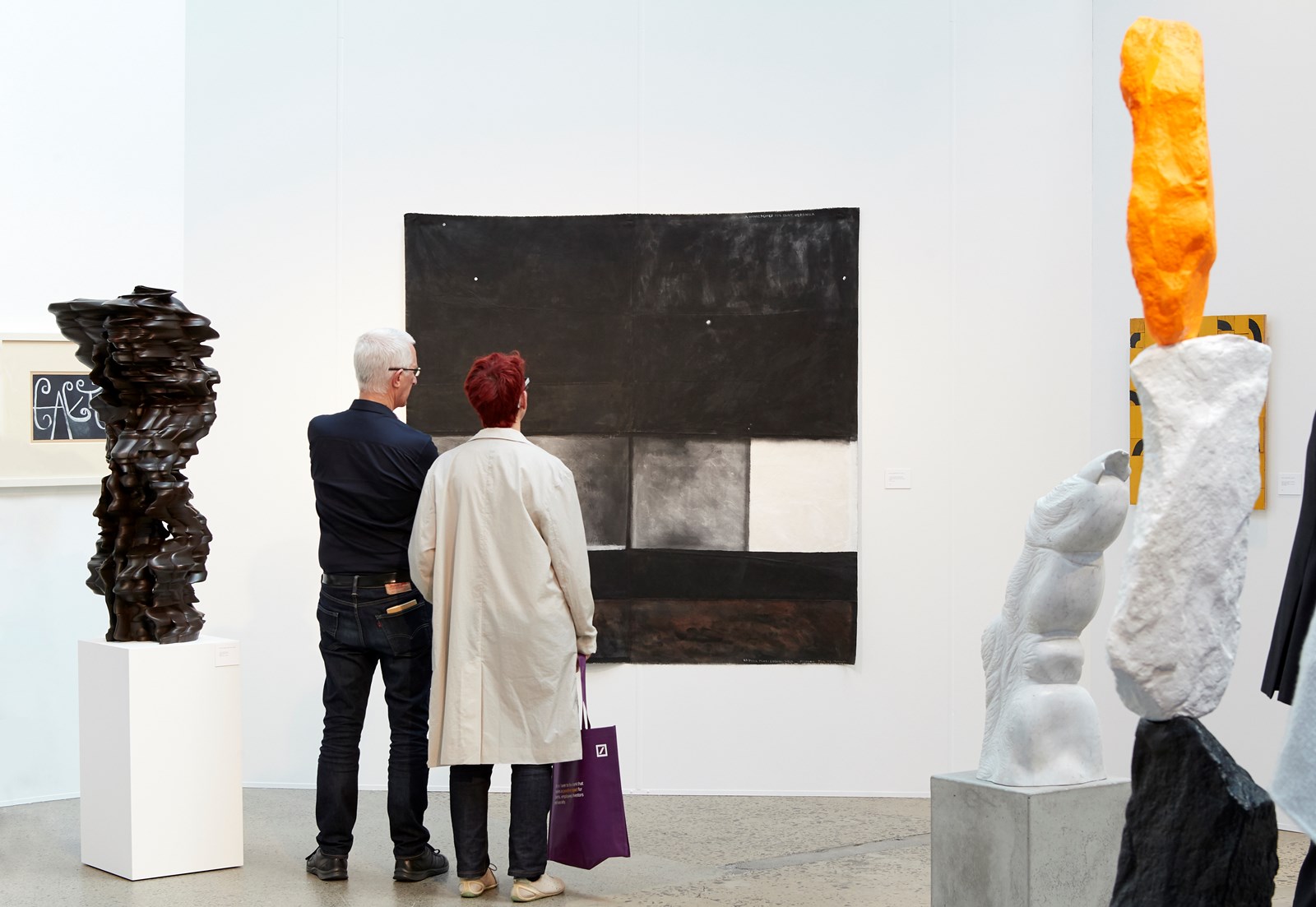
International galleries were present, but lightly. Sundaram Tagore Gallery paired Edward Burtynsky’s chromogenic image Oil Bunkering #2, Niger Delta (2016) with Miya Ando’s quiet metallic abstractions. Kyoto’s COHJU Contemporary Art offered a cross-section of Japanese practices, while Flowers Gallery showed Ken Currie’s haunted portraits and SMAC Gallery brought Kate Gottgens’ paintings of white South African suburbia. From across the Tasman, Starkwhite’s booth combined Rebecca Baumann’s Automated Colour Field (Variation 8) (2017) with kinetic sculptures by Len Lye—Rotating Harmonic (1959) and Roundhead (1961, authorised reconstruction)—plus works by Michael Zavros and Seung Yul Oh, giving the stand the feel of a compact, time-based micro-museum. Gow Langsford Gallery lined up global names—including Tony Cragg’s twisted forms and Ugo Rondinone’s painted stone-and-steel sculpture black white orange mountain (2016)—around a genuine showstopper: Colin McCahon’s large, unstretched painting A Handkerchief for St Veronica (1973).
Unstretched and inscribed “Kaipara Flat – Looking West”, A Handkerchief for St Veronica looked almost nonchalant on the fair wall, as if it had wandered in from a museum storage rack and stayed. Having already appeared at Art Basel in Hong Kong (2018), its continued availability begged a blunt question: why are the institutions and collectors not willing to take on a work of this magnitude? Several dealers noted the relative absence of curators on the floor, even as the fair’s press material suggested otherwise.
Pace Gallery’s attendance offered one answer to Sydney Contemporary’s ambitions. Whitney Ferrare, senior director of Pace Hong Kong, described the booth as an attempt to translate the gallery’s longstanding institutional relationships into new conversations with private collectors. Works by James Turrell, David Hockney, and Zhang Huan—each with recent Australian museum exposure, from Turrell’s retrospective and Skyspace at the National Gallery of Australia to Hockney’s print exhibition and career survey, and Zhang Huan’s monumental Sydney Buddha (2015) at Carriageworks—made the strategy explicit: international heavyweights routed back through local institutional memory.
Reported sales of around AUD21 million suggest a fair on solid footing, especially when set against the staggering wealth of Australia’s richest individuals. Yet there remains a gap between the adventurous programming of public institutions—take the Museum of Contemporary Art Australia’s presentation of Sun Xun (2018), for example—and the buying habits of many private collectors. Sydney Contemporary, with its mix of serious First Nations work, canny international offerings, and a venue that flatters art rather than swallowing it, is positioning itself as the bridge. Walking out of Carriageworks, you had the sense that the infrastructure is now in place; what remains to be seen is whether the city’s collectors are willing to cross.
1 Catalogue text, courtesy of Deutscher and Hackett. See: https://www.deutscherandhackett.com/auction/11-aboriginal-oceanic-art-auction/lot/water-dreaming-kalipinya-1972
Main image: Sydney Contemporary (13–16 September 2018). Courtesy Sydney Contemporary. Photo: Jacquie Manning.


A respected voice in contemporary art discourse.
Focusing on ambitious storytelling and insightful art-world commentary. Ocula Magazine publishes in-depth interviews, critical essays and timely analysis on the artists, exhibitions and ideas driving the global art world.
Learn more about Ocula Magazine
Showcasing the best of the art world.
Ocula partners with galleries from around the world to highlight their artists, artworks and exhibitions. Gallery membership is by application and invitation, with each member vetted by an independent panel.
Learn more about Ocula Membership
Specialises in the sale of major artworks.
Led by a team with deep ties to the world’s leading auction houses, galleries and collectors. Ocula’s advisory team offers bespoke services to high-net-worth clients from around the world who are looking to acquire the best of contemporary and modern art.
Learn more about our team and services