



Press Release

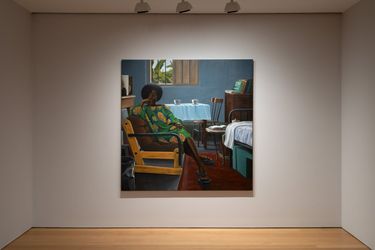
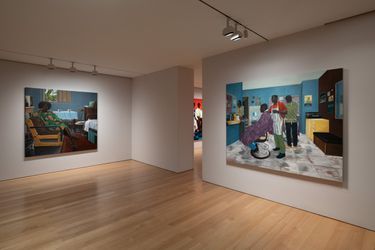
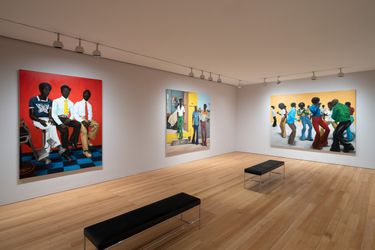
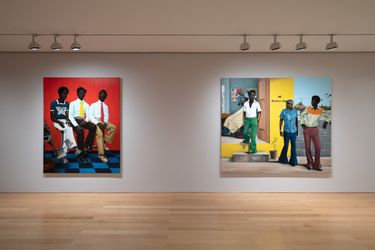
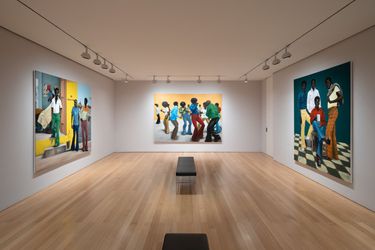
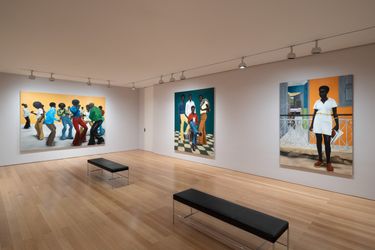
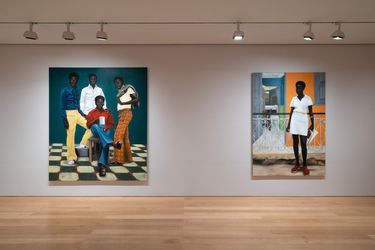
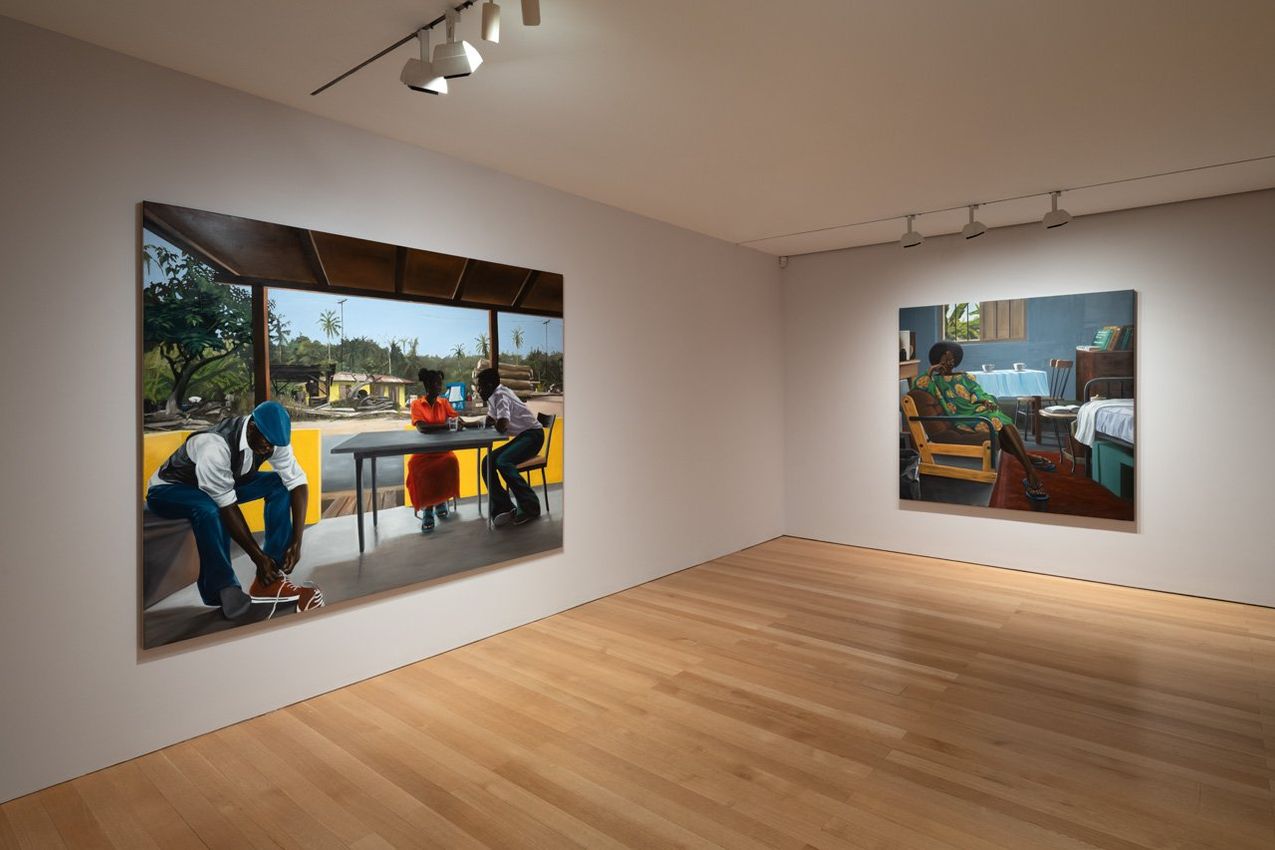
Peter Uka: Remembrance is the artist’s first solo exhibition in New York, NY. Born in 1975 in Nigeria’s Benue State and based in Cologne, Germany, Uka paints large-scale portraits and group scenes that draw inspiration from childhood memories, including 70s-era fashion and hairstyles, wallpaper patterns, and dance moves. Elucidating the richness and joyfulness in both the solitary and shared moments of Black life, the artist offers a counternarrative to outmoded perceptions of both his home country and non-Western culture at large. A text by artist and curator Folakunle Oshun accompanies the exhibition.

Peter Uka: Remembrance
By Folakunle Oshun

Checkered tiles in barbershops, bell-bottom trousers, afro hairstyles, and vibrant colours are just some of the recurring elements that constitute the compositions of Peter Uka’s paintings. Born in Nigeria in 1975, the painter who was initially trained as a sculptor at the Yaba College of Technology, has made his presence felt on the international contemporary art scene with several exhibitions across Europe and now, a first solo exhibition at The FLAG Art Foundation in New York.

Peter Uka’s larger-than-life paintings reference the modernist/post-independence era in Nigeria and draw from everyday life events he encountered as a child in the 70s and 80s. Based in Cologne, Germany, since 2008, Uka has created a unique aesthetic vision that meshes real-life compositions (painted from pictures with staged props and backgrounds), those channeled from memory, and a flirtation with nostalgia. He uses these techniques and inventions to further articulate his depictions of a surreal past. The tensions within a post-independence society attempting to find its identity by breaking with Western ideals, and at the same time aspiring to the fashion and technology of an imposed modernity, can all be felt in his paintings.

The themes in Uka’s work may be perceived as another painterly expression of Blackness–taking into consideration global tensions surrounding the issues of racial equality. Still, a conversation with the multi-talented artist reveals deeper roots linked to his migration from Nigeria to Germany and a longing to connect with home. Place, time, identity, and memory are some of the factors that define his practice irrespective of his chosen medium.

A visit to his studio reveals more uncompleted or abandoned paintings than finished ones. Does this suggest a form of fractured memory, or does the artist, like many others, give up on a piece that just doesn’t come out right? Whatever the case, it is evident that Uka i is keen on recreating scenarios precisely as he remembers them, or sometimes, as he imagined they looked. Like his Nigerian female counterpart Njideka Akunyili Crosby, whose work reconnects with Nigeria’s more recent past, Uka’s paintings equally rely on draftsmanship and composition.

Considering the dearth of museums and archival institutions in Nigeria, it is critical to evaluate the consistency of creatives in music, theatre, film, and visual arts who recreate memories of different periods in the history of the newly-formed federation. In the case of Uka, we must consider his artistic agency and creative freedom to highlight certain elements in compositions that he considers more important or memorable than others. An example is the artist’s tendency to finely render the heads of his figure while leaving the hands and feet unfinished. This approach to painting can be juxtaposed with indigenous carving techniques, which, based on Yoruba philosophy, prioritize a figure’s head “Ori.” In these carvings, the head is represented proportionately as one fourth of the entire body and is given more detail and prominence. It can be assumed that Uka picked up this approach when he moved from Benue State, located in the middle belt area of Nigeria, to South Western Nigeria at age fifteen. His technique, which is drawn from the Yoruba philosophical canon, goes beyond the aesthetic value the head may possess and is more vested in the conception of the head as the purveyor of destiny, and thus a sacred vessel that receives more attention in the art-making.

Uka had his first encounters in art cutting stencils and making stamps for his father’s workshop, whose primary occupation was writing and painting images on signs for commercial lorries that ferried produce and other goods across the country. The influences of printmaking and signwriting are evident in Uka’s paintings, specifically his use of bright colours, a common feature in the lorry-painting business. It becomes impossible to disassociate the nomadic character of the artform practiced by the Uka’s father from the contemporary practice of the artist whose high-demand paintings traverse the globe. From one generation painting indigenous proverbs and moralistic quotes on lorries—in an attempt to differentiate and beautify the vehicles—to the next generation piecing together fragments of memories, Uka establishes a continuum in Nigerian art history that refreshingly take a non-photographic gaze on the past in an attempt to better understand the present. The artist has evolved this rigid technique, mainly involving cheap gloss or car paint, into a more sophisticated method using traditional oil paint.

Titled Remembrance, Uka’s exhibition at FLAG showcases a nonlinear selection of the artist’s work and includes a series of paintings that highlight some of the artist’s most robust aesthetic, philosophical, and conceptual leanings, which border on recollection and the reconstruction of childhood experiences.

Read More

Installation Views

About the Artist

A rising star of contemporary painting, Peter Uka’s meticulously rendered canvases provide a view into the past, as the artist paints scenes from his childhood growing up in a newly independent Nigeria.

View Artist Profile Peter Uka contemporary artist
About the Gallery

The FLAG Art Foundation is a renowned non-profit contemporary art institution situated in the heart of New York’s Chelsea Art District, established in 2008 by prominent art patron Glenn Fuhrman. The museum occupies the 9th floor of the Chelsea Arts Tower at 545 West 25th Street, New York, and is recognised for its cutting-edge exhibitions and bold programming, making it a much-visited destination for anyone interested in contemporary art.

View Gallery Profile
Address
545 West 25th Street
9th and 10th Floors
New York
United States
Opening Hours
Wednesday–Saturday: 11am–5pm
(1)
New York 545 West 25th Street, 9th and 10th Floors
The FLAG Art Foundation
545 West 25th Street, 9th and 10th Floors, New York, United States

Opening hours
Wednesday–Saturday: 11am–5pm
The art world in focus