Lee Krasner (1908–1984) and Jackson Pollock (1912–1956) met as emerging artists in New York in the winter of 1941. They married in 1945 and moved to Springs, Long Island, where they remained entwined personally, artistically, and professionally until Pollock’s untimely death. While Pollock’s reputation historically eclipsed Krasner’s, today, both artists’ practices are rightly recognized as central to the innovations of art from the mid-20th century onwards. This exhibition continues and amplifies this reevaluation, on their own terms and in dynamic relation to each other.
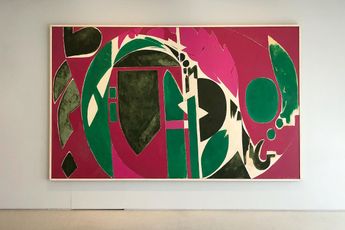
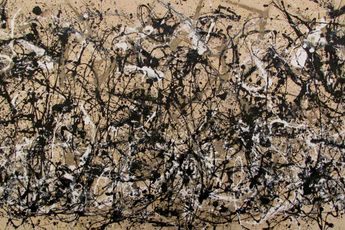
Drawing its subtitle, Past Continuous, from a 1976 painting by Krasner, the exhibition traces parallel lives and practices—forged first by lived experience, then shadowed by memory. Krasner, born in Brooklyn to Jewish immigrant parents from what is now Ukraine, and Pollock, raised in Los Angeles and the American West, brought specific geographies and inheritances into a shared artistic context. Their early paths traced distinct strands of American modernism that would ultimately converge in the rupture known as Abstract Expressionism, a movement that valued the translation of inner feelings into dramatic visual action. In the wake of World War II, artists asked why art mattered and what it could be. For Pollock, his breakthrough was the “drip” technique, a radical mode of painting that flourished in a condensed but prolific period. Krasner’s varied practice was typified by ceaseless explorations of abstraction, often cued by her abiding interest in the possibilities of nature and color.
Krasner and Pollock: Past Continuous is the first major New York presentation devoted to either artist in more than 20 years. Featuring over 120 works, it is the first exhibition to look at the full arc of their careers together.


The Metropolitan Museum of Art (The Met) is one of the world’s most well-loved landmark museums located on Fifth Avenue along Central Park’s Museum Mile in Manhattan, New York. Renowned for its monumental Beaux-Arts architecture and encyclopedic collection, it also presents an exceptional showing of contemporary art.

A respected voice in contemporary art discourse.
Focusing on ambitious storytelling and insightful art-world commentary. Ocula Magazine publishes in-depth interviews, critical essays and timely analysis on the artists, exhibitions and ideas driving the global art world.
Learn more about Ocula Magazine
Showcasing the best of the art world.
Ocula partners with galleries from around the world to highlight their artists, artworks and exhibitions. Gallery membership is by application and invitation, with each member vetted by an independent panel.
Learn more about Ocula Membership

Specialises in the sale of major artworks.
Led by a team with deep ties to the world’s leading auction houses, galleries and collectors. Ocula’s advisory team offers bespoke services to high-net-worth clients from around the world who are looking to acquire the best of contemporary and modern art.
Learn more about our team and services