



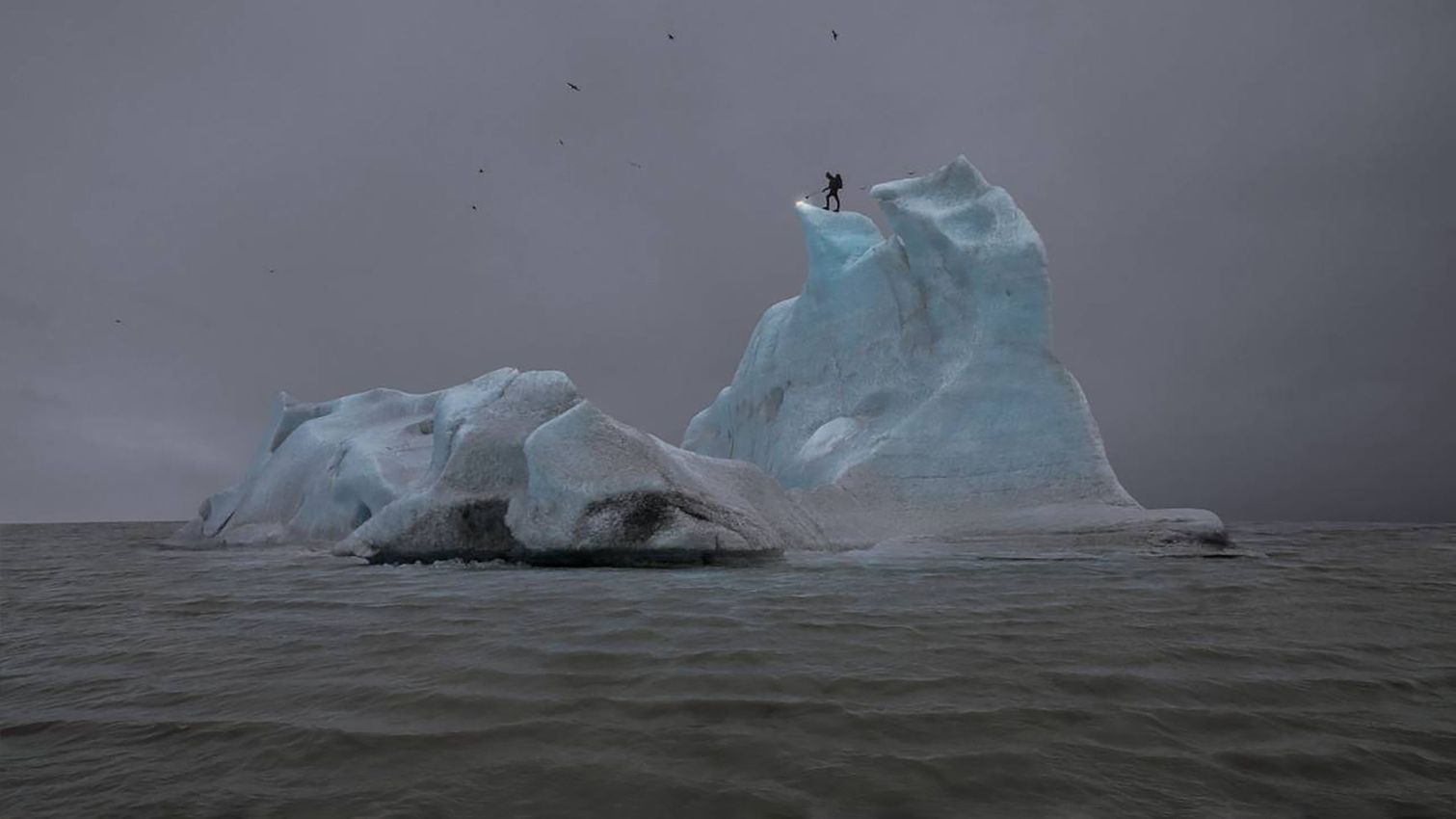
A core concern of French-Swiss artist Julian Charrière is how human beings inhabit the world and how the world, in turn, inhabits us. The comprehensive solo exhibition at Museum Tinguely presents photographs, sculptures, installations and new video works that deal with our relationship to Earth as a world of water—a liquidity that covers most of our planet with seas, lakes and ice, both habitat for a myriad of organisms and host to circulatory systems critical for the stability of our climate.
Unfolding over three floors, the exhibition Midnight Zone engages with underwater ecologies, from the influential local presence of the Rhine to distant oceans, exploring the complexity of water as an elemental medium affected by anthropogenic degradation. Reflecting upon its flow and materiality, profundity and politics, its mundane and sacral dimensions, the solo show acts as a kaleidoscope, inviting us to dive deep.
In_Midnight Zone_, Julian Charrière invites visitors to think and feel with water: as atmosphere, memory, movement and kin. Drifting between deep-sea descent and cryospheric suspension, the exhibition unfolds as an immersive reflection on fluid worlds—not the sea as surface, but as substance, where boundaries dissolve. The artist considers this not only as a space to be entered, but as a world we can sink into and move within—becoming porous to its pressures, its depths, its dreams.
The exhibition brings together a series of elemental investigations—earlier works alongside major new commissions that trace Charrière’s long-standing exploration of environmental thresholds. Unfolding over three floors, the exhibition’s focus is on water not as a motif, but as a medium: the material through which histories sediment, crises unfold, and forms change state. The title refers to the bathypelagic zone of the ocean, where sunlight vanishes and vision fades.
In _Albedo _(2025), filmed beneath the arctic ocean between icebergs, the gaze shifts again. This time, the viewer follows water as it slips between solid, liquid, and vapor—a choreography of phase change unfolds in real time. Rather than rendering melting as catastrophe, the film resists the sublime, offering a study in flux, in atmospheres and absences. It reveals the sea as a kind of thought: unbounded, destabilizing and impossible to contain. The camera floats, reframes, releases. There are no fixed perspectives—only drift, suspension, dispersal.
Museum Tinguely is located on the banks of the Rhine in Basel. Opened in 1996, it was designed by Ticino architect Mario Botta and houses the world’s largest collection of works by the fascinating Swiss artist Jean Tinguely (1925–1991), a key pioneer of international post-war art.

A respected voice in contemporary art discourse.
Focusing on ambitious storytelling and insightful art-world commentary. Ocula Magazine publishes in-depth interviews, critical essays and timely analysis on the artists, exhibitions and ideas driving the global art world.
Learn more about Ocula Magazine
Showcasing the best of the art world.
Ocula partners with galleries from around the world to highlight their artists, artworks and exhibitions. Gallery membership is by application and invitation, with each member vetted by an independent panel.
Learn more about Ocula Membership

Specialises in the sale of major artworks.
Led by a team with deep ties to the world’s leading auction houses, galleries and collectors. Ocula’s advisory team offers bespoke services to high-net-worth clients from around the world who are looking to acquire the best of contemporary and modern art.
Learn more about our team and services