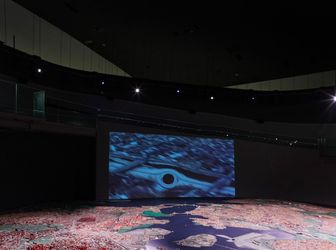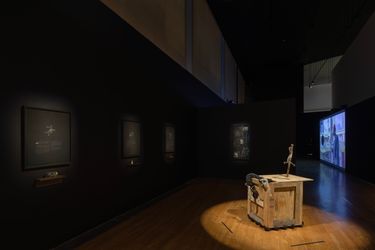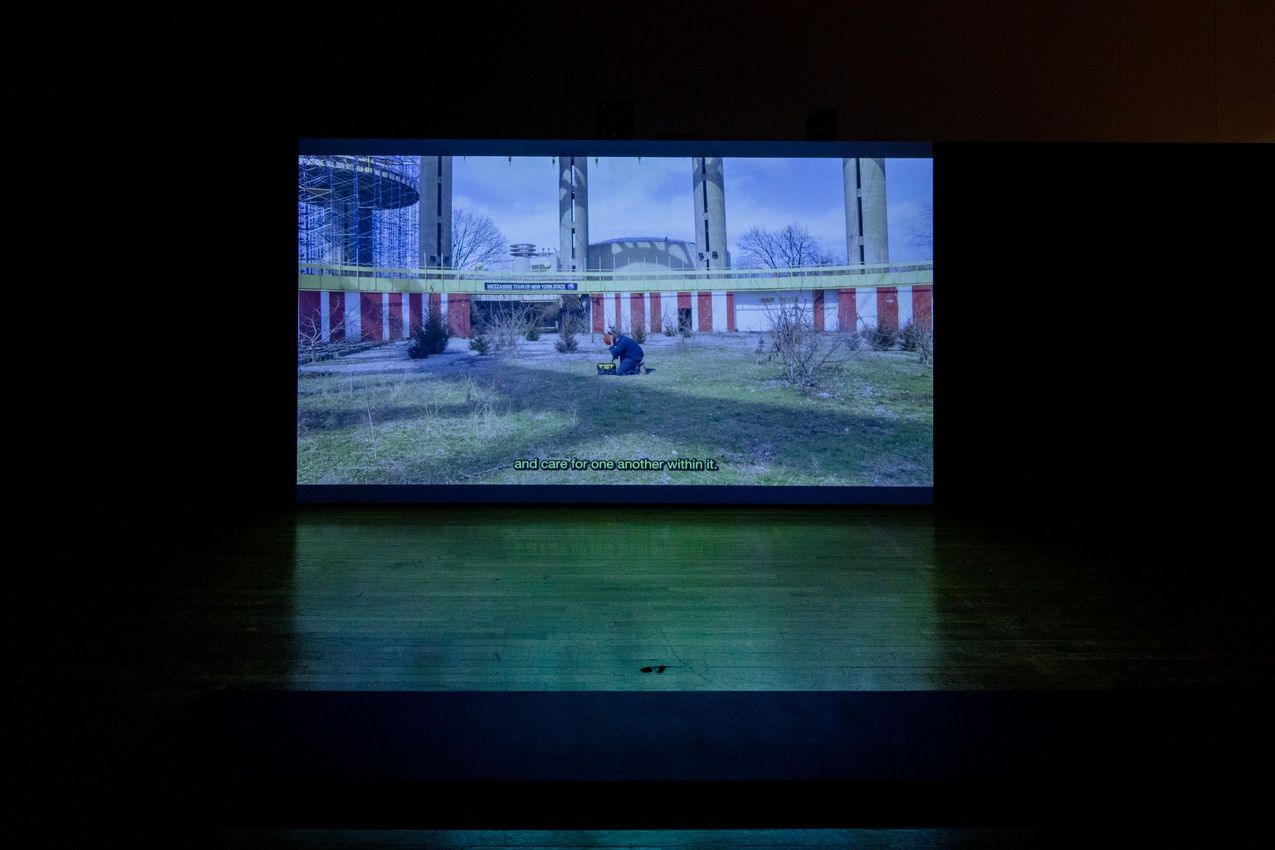
In 9999, Cameron A. Granger uses the framework of video games and magic to imagine an alternative method of liberation for Black communities from the compounding effects of racist urban planning. In early role playing video games, due to low computer processing capacity, 9,999 was the numerical damage limit done to a character that could be registered on screen. Yet sometimes, additional damage continued to accrue off-screen – incapacitating, yet unseen. Granger takes this concept of the concealed yet relentless harm, and applies it to the cumulative corrosion of segregative design, environmental racism, and gentrification.]
To make sense of the convoluted legacies of systemic injustice, Granger visualizes the wounds left by structural violence through “black holes” that rip the city’s fabric. His films, prints, and sculptures create a video game-like narrative that provides puzzles, tips, and charms that aid in deciphering these black holes. In diagnosing the root cause of the issue, Granger proposes that the black holes are the result of a spell cast by nefarious, hidden forces. To break the curse, he speculates what might be possible if the black holes could be used as portals to share knowledge.
Seeking answers, Granger turns to stage magicians, root workers, and conjurers. His work references Black magicians such as Henry “Box” Brown (1815-1897) whose performances alluded to his 1849 self-emancipation via mail, and Benjamin Rucker aka Black Herman (1892-1934) whose magic acts and conjuring remedies built a massive following in the 1920s among Black communities. Granger also draws on the practice of conjuring, invoking remedies for locating harm’s source, protecting, and healing. Additionally, he calls upon the Haitian folklore of zombies, originally mythologized as the spirits of enslaved laborers trapped to haunt plantations in their afterlife. Granger reconceptualizes their spirits as a unified force reemerging from the grave to aid in liberation.
Sourcing wisdom from Black forebears whose knowledge helped their communities self-emancipate, heal, and thrive, Granger offers a collective vision of empowered futurity. In a dimly lit gallery that mimics the digital landscape of a video game, Granger creates a narrative where memories of and knowledge from Black ancestors provide clues, methods, and tools that once pieced together, may reveal the key to break free.
Cameron A. Granger: 9999 is curated by Sarah Cho, Assistant Curator.


Queens Museum is an important New York cultural centre, hosting an important contemporary art programme. Situated within Flushing Meadows–Corona Park, Queens, New York, it is dedicated to championing its surrounding community, whilst engaging with contemporary art globally too.

A respected voice in contemporary art discourse.
Focusing on ambitious storytelling and insightful art-world commentary. Ocula Magazine publishes in-depth interviews, critical essays and timely analysis on the artists, exhibitions and ideas driving the global art world.
Learn more about Ocula Magazine
Showcasing the best of the art world.
Ocula partners with galleries from around the world to highlight their artists, artworks and exhibitions. Gallery membership is by application and invitation, with each member vetted by an independent panel.
Learn more about Ocula Membership

Specialises in the sale of major artworks.
Led by a team with deep ties to the world’s leading auction houses, galleries and collectors. Ocula’s advisory team offers bespoke services to high-net-worth clients from around the world who are looking to acquire the best of contemporary and modern art.
Learn more about our team and services