





Canada’s Artists and Museum Workers Demand End to ‘Political Pressure’ over Palestine Exhibition

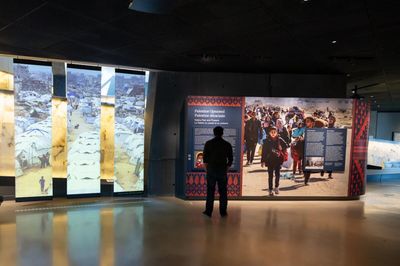
Palestine Uprooted: Nakba Past and Present, which opened on 27 June, explores “the human rights violations related to the ongoing forced displacement and dispossession of Palestinians”. Courtesy Canadian Museum for Human Right.
Canadian artists, museum workers and civil and religious groups have issued a public statement demanding the protection of curatorial independence at the country’s Museum for Human Rights (CMHR), following several weeks of controversy surrounding an exhibition on Palestinian displacement at the government-funded institution.
The statement, signed by 112 organisations including the Visual Arts Alliance, which represents artists, curators, museums and galleries across Canada, the Royal Canadian Academy of Arts, Amnesty International Canada and Independent Jewish Voices, calls for the museum to remain steadfast in its “evidence-based curation” and for an end to “political interference” in its work.
It continues: “Since its opening, the exhibition has been the subject of organised campaigns calling for political intervention, public condemnation, and institutional consequences for the museum and its leadership, including against its CEO, Isha Khan.
“We are deeply concerned by efforts to pressure the CMHR to alter, discredit, or distance itself from a professionally curated exhibition through political and public pressure rather than through established scholarly and curatorial processes.”
Born in controversy
According to the museum’s website, Palestine Uprooted: Nakba Past and Present, which opened on 27 June, explores “the human rights violations related to the ongoing forced displacement and dispossession of Palestinians”, using art, text and video testimonies to “reveal enduring patterns of loss and resistance”. The show’s name is a reference to the Nakba—or “catastrophe” in Arabic—a mass displacement and dispossession of Palestinians which took place during the 1948 Arab-Israeli war.
In an interview with The Canadian Press in late June, Canada’s minister of identity and culture, Marc Miller, urged CMHR to reconsider the language used in Palestine Uprooted in relation to the current conflict in Gaza, and described the exhibition as “born in controversy”.
He told the national news agency: “There are some words in there that are regrettable. Not identifying Hamas as a terrorist organisation is, I think, a failure. And not clearly stating that, for example, Hamas intended to kill Jews is, I think, an unfortunate error in curation and should be rectified.”
His comments came after concerns were raised about the exhibition by several prominent Jewish organisations, including the Centre for Israel and Jewish Affairs, which represents Jewish federations across Canada. In June the organisation called for the government to intervene at CMHR, and to “hold the museum’s leadership accountable for failing its own standards of curation, for a lack of consultation, and even engaging extreme political activists in developing the exhibit”.
A spokesperson for CMHR told Ocula that the organisation appreciates the recent statement of support, remains open to feedback regarding Palestine Uprooted and stands by its curatorial process.
“Our role as a museum is to help people understand our world through the lens of human rights,” the said. “The violation of the human rights of Palestinians is not a matter of opinion; it is real, it is documented, and it is ongoing.”
Difficult histories
Among signatories of the statement was Canada’s Union of National Employees (UNE). According to Béla Gyarmati, chief shop steward for the UNE’s Local 50773 branch, which represents workers across many departments at CMHR, its members have been “on the receiving end of a significant volume of public backlash” since the opening of Palestine Uprooted.
“This has taken a real toll on staff who were simply doing the job they are trained and entrusted to do: presenting complex, difficult history with care and professional rigour,” Gyarmati told Ocula.
Gyarmati pushed back against efforts to “silence” and “discredit” the exhibition, which he said underlined the need for Palestinian-Canadian voices to be heard, and for the museum to acknowledge all suffering, including when histories are uncomfortable or contested.
He said: “Our members believe strongly that museum staff should be able to do this work without their professional judgment being second-guessed or politicised from outside the institution. Critique of a museum exhibit is a normal and healthy part of public life, but there’s a difference between critique and organised pressure campaigns aimed at forcing an institution’s hand.”
A spokesperson for the Visual Arts Alliance echoed Gyarmati’s sentiment. They told Ocula that, for the artists the organisation represents, curatorial independence is not an abstract principle, but the condition under which their works appear in public.
“When a professionally curated exhibition can be altered, discredited, or pulled back because of political pressure rather than through established scholarly and curatorial processes, every artist and every institution that shows art is impacted,” the spokesperson said.
The organisation noted that the criticism and debate surrounding Palestine Uprooted is “legitimate”, but urged those who disagree with the exhibition to visit and “engage with it in the spirit of learning and respectful dialogue”. They added: “The independence of public museums protects everyone, including those who disagree with any given exhibition.”
A spokesperson for the minister of identity and culture told Ocula that the topics covered in the exhibition are “important” and “deserve a place in public education and discourse, including museums”.
“The federal government has never dictated programming at Canada’s national museums, and it never will. Decisions about exhibits and programming belong to the institutions themselves, not to government,” they said.
Accuracy and interpretation
Earlier today, CBC reported that philanthropist Gail Asper, whose father Israel Asper founded CMHR, intends to pause funding for the museum citing concerns around the exhibition’s accuracy.
“If it’s so small that you can’t include the truth, then you need to either not do it or you need to expand it,” she told the Canadian national broadcaster. “To me, [the exhibition] brings the curatorship into disrepute.”
Tension surrounding Palestine Uprooted began shortly after the show was announced in late 2025, and reached a crescendo ahead of its opening when protestors gathered outside the space. Five days earlier, Mark Berlin, reportedly the museum’s only Jewish board member, resigned his post and later described the show as a “one-sided, unbalanced interpretation of Israeli history, Zionism, and the Arab-Israeli conflict”.
A CMHR spokesperson told Ocula: “Focusing on Palestinian Canadian experiences of forced displacement in this one exhibit does not detract or minimise experiences of Jewish people who were displaced and who have also faced human rights violations, which our galleries also share stories about. Telling the stories of one community in no way negates the experiences of another.”








A respected voice in contemporary art discourse.
Focusing on ambitious storytelling and insightful art-world commentary. Ocula Magazine publishes in-depth interviews, critical essays and timely analysis on the artists, exhibitions and ideas driving the global art world.
Learn more about Ocula Magazine
Showcasing the best of the art world.
Ocula partners with galleries from around the world to highlight their artists, artworks and exhibitions. Gallery membership is by application and invitation, with each member vetted by an independent panel.
Learn more about Ocula Membership
Specialises in the sale of major artworks.
Led by a team with deep ties to the world’s leading auction houses, galleries and collectors. Ocula’s advisory team offers bespoke services to high-net-worth clients from around the world who are looking to acquire the best of contemporary and modern art.
Learn more about our team and services