
Press Release

When Eunnam Hong talks about her work with me her reference points are novels and, especially, movies, not paintings. And this makes perfect sense because, even if hers are not exactly narrative paintings, they are constructed like scenes in a story. Yet when I look at her work, I still find myself thinking intensely about painting.

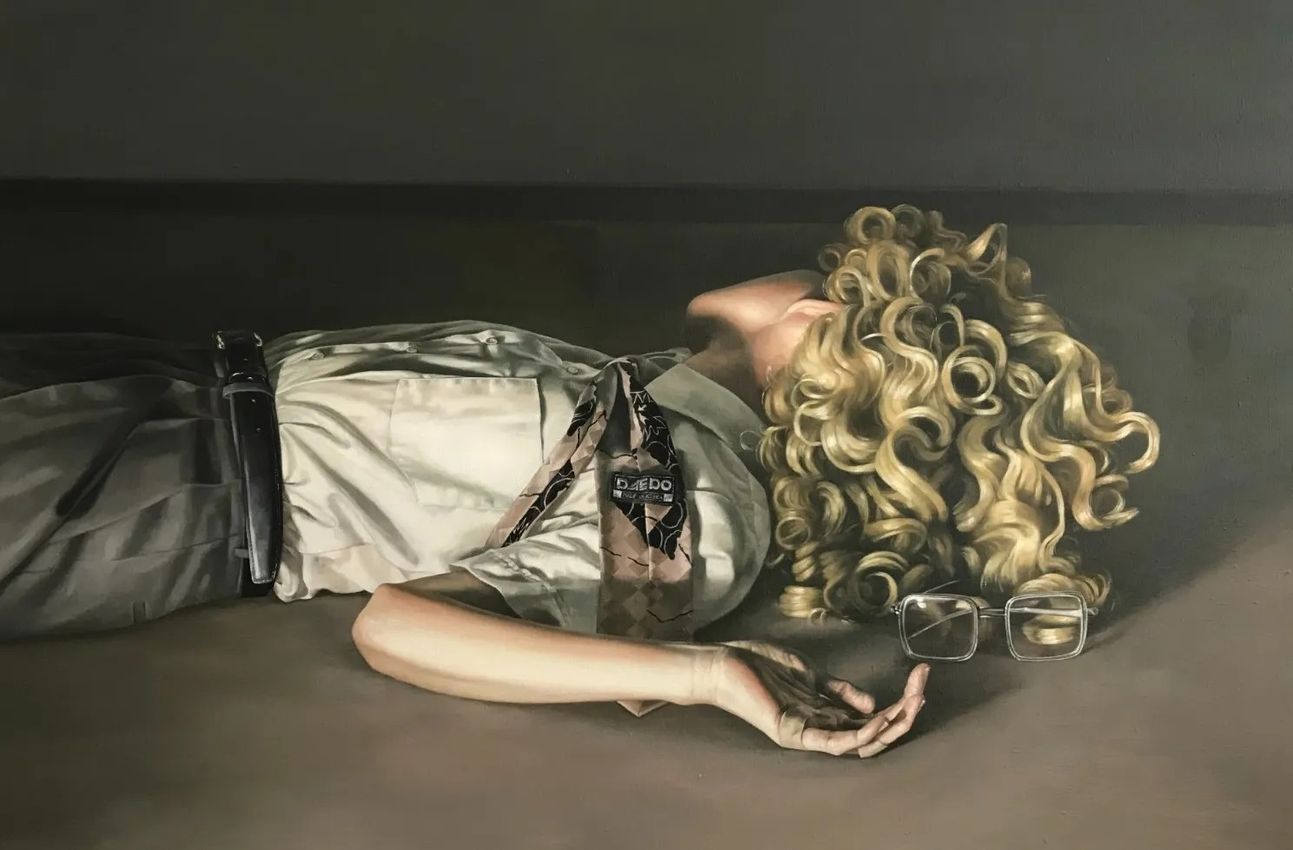
My explanation of the apparent contradiction is this: Painting is a larger and more inclusive art than we are used to imagining it is, and – contrary to the demands of certain theorists – it can encompass means used equally by other arts without sacrificing its aesthetic specificity. In Hong’s case, this means that while her works can give exquisite pleasure to anyone who appreciates the innate beauty of a painter’s touch – something “precious in itself,” as (you may recall) the dying writer Bergotte in Marcel Proust’s The Captive finds a certain patch of yellow in Vermeer’s View of Delft – that is hardly the totality of their appeal. Even when Hong paints a simple still life, it’s more than an exercise in color, form, and volume. There are other aspects in play: overtones of allegory or symbolism, for example. Especially in the figure paintings that are Hong’s main preoccupation, there are aspects of composition and detail comparable to the efforts of a set designer or costume designer on a film set. She uses these details both to shape the overall look or mood of the painting and to show the viewer what the work is about.

And what is it about? My immediate answer would be: the multiplicity of the self. When I first encountered Hong’s work, I saw in it parallels with figurative Surrealism. The “surreal” element in her paintings is, of course, the multiple manifestations of the same figure – her own, though I would no more think of these paintings as self-portraits than I would, say, the photographs in which Cindy Sherman plays all roles. The point is not the artist’s self-reflection, which is averted by the artifices of costuming and mise-en-scène that bring the work into the realm of explicit fiction. It is the question of how malleable on the one hand, stable on the other, the self can be. The paintings entertain the idea that a single person may embody many existences, many personae at once, perhaps embodying different stages of life simultaneously. But the paradox is that what makes this multiplicity surreal rather than essentially formal – as in some of Alex Katz’s paintings, such as, for instance, The Black Dress (1960, Museum Brandhorst, Munich), in which the painter’s wife Ada appears, always in the black dress of the title, five times standing and once seated – is the convincingly dimensional everyday space in which Hong places her figures. The almost-realism of Hong’s style lends her depictions of the plural self an eerie overtone that is far removed from the matter-of-factness conveyed by the modernist flatness of Katz’s work.

And yet – are Hong’s repeated figures really “the same?” They wear the same absurd wig, anyway, its copious blond ringlets in evident contradiction to the wearer’s Asian features, and the same oversized eyeglasses. As for their faces, we don’t see much; but what we do see looks identical. Or almost: Am I wrong to imagine that in Shiitake Mushroom (2025), the woman facing us looks older than the one sitting catty-corner to her? Is this a mother-and-daughter scenario? I keep changing my mind. What’s clearer to me is that in other paintings, the figures – I was about to say, __the characters – are described as of different ages, or perhaps just as pretending to be of different ages, by their costumes.

And they are costumes, not simply clothes, just as the settings are sets: temporary makeshifts that give the impression of a place – of an office, for instance – without hiding that the “place” is a fabrication. Populating these sets, these seemingly identical figures assume their roles, become distinguishable. In Snakes, 2026, for example, the three women seen through the wide doorway are dressed as if high school students – two of them wearing pleated skirts that seem to shout “cheerleader,” one sporting a varsity jacket – while the pair in the foreground wear outfits that are grown-up takeoffs on the younger women’s looks, one more businessy, the other a kind of glammed-up blue-collar look. (The title Snakes, by the way, refers to the plant seen in the background, a sansevieria or snake plant. As I learned from Wikipedia, “Sansevierias have frequently been used as a set decoration in many films and TV shows, both in Hollywood and internationally, since at least the 1930s, including Being John Malkovich_, Blue Velvet, Duck Soup, Groundhog Day, Homegrown, The Paper, and These Final Hours_.” I told you Hong has an eye on cinema.)

Snakes seems to meditate on the idea that age, and one’s role in life, might be assumed identities, exchangeable like clothes. It’s a resonant idea, though the manipulability of identity has its limits. I know it would take more than the Patti Smith T-shirt and Doc Martens I wore in my twenties to bring me back to my state of mind or body in those days. But if I tried to do that, you’d certainly see me differently, for better or worse. Besides, I still carry that skinny, awkward guy around with me somewhere, and sometimes I think he shows through my present self the way my T-shirt might show through a moth-eaten old sweater. The painting provokes me to question my own sense of self, and that’s part of what convinces me that in painting it, she must have been questioning her own.

Yes, these paintings put me in a strange mood of questioning. But I never question them as painting. They’re too full of things that are precious in themselves for me to doubt them. Let just one example stand for so many others: Look at Shiitake Mushroom – a painting that’s full of bravura passages, certainly, in the rendering of the two women’s clothing (even though there’s something funny about their wearing such frilly, flouncy outfits for the mundane task of cutting up mushrooms). But the most breathtaking passage, to my eye, is the least conspicuous: At the bottom, underneath the table, the knees glimpsed through the sheer white tablecloth. The control of shading and the subtlety of suggestion are extraordinary. No need to search for its meaning. This kind of painting is its own justification.

– Barry Schwabsky

Courtesy Mendes Wood DM

Read More

Also Exhibiting at Mendes Wood DM

About the Gallery
Mendes Wood DM was founded in 2010 by partners Felipe Dmab, Matthew Wood and Pedro Mendes with the intent to exhibit international and Brazilian artists in a context conducive to critical dialogue and cross-pollination. Central to the gallery’s program is a concern for regional difference and individuation while fostering cosmopolitanism and collaboration. Inspired by a belief that artistic practices broaden the scope of human agency and have the power to both touch and change the world, Mendes Wood DM cultivates a program premised on conceptualism, political resistance and intellectual rigor.
View Gallery Profile
Address
47 Walker Street
New York
United States
Opening Hours
Tuesday - Saturday
10am - 6pm
(1)
New York 47 Walker Street
Mendes Wood DM
47 Walker Street, New York, United States
+1 212 220 9943
http://www.mendeswooddm.com

Opening hours
Tuesday - Saturday
10am - 6pm
The art world in focus