Gagosian is pleased to announce an exhibition of recent work by Georg Baselitz at the 555 West 24th Street gallery in New York. Conceived and designed by the artist and curated by Richard Calvocoressi, Meine Schule is Gagosian’s first presentation of Baselitz’s work since his death in April, and includes his last completed paintings; his last sculpture, Strawinsky (Stravinsky, 2026); and a second late sculpture, 1965 (2024). The November show marks more than twenty-five years of collaboration between the gallery and the artist. Larry Gagosian, in his foreword to the exhibition’s catalogue, notes that the works on view cap a remarkable sixty-year career and represent “a creative goldmine.
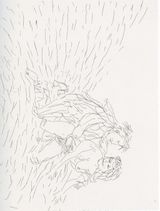
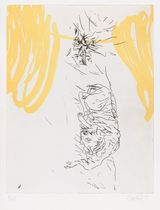
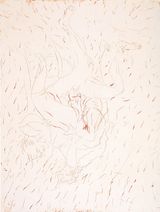
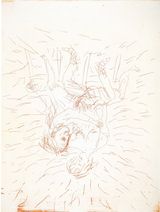
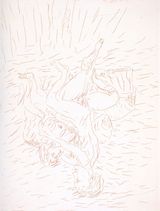
Two paintings from the series Meine Schule carry echoes of Baselitz’s earliest memory, from the 1940s, of the schoolhouse in Deutschbaselitz, Germany, where his father was a teacher and where the family lived during the war. Meine Schule, die Jungs (My School, the Boys) and Meine Schule, die Mädchen (My School, the Girls) (both 2026)—neither of which has been previously exhibited—depictschoolchildren standing before a banner emblazoned with the Nazi slogan Ein Volk, Ein Reich, EinFührer (One People, One Empire, One Leader) that was hung on the outside of the school building onoccasions such as Adolf Hitler’s birthday. This final allusion to Baselitz’s roots, which echoes the ideaof an artistic ‘school,’ brings his creative life full circle. In the other paintings on view, the artist renderssimple, inverted images of himself and his wife, Elke, in fine, ink-like black lines on lush goldengrounds, adding, in the artist’s words, “a misplaced Willem de Kooning” to each composition in theform of a cluster of colorful impasto brushstrokes.
“These pictures are not literary, not stories, they are not political, not doctrinaire, not ideological,they are not idiotic statements or whatever,” Baselitz declared with characteristic brio. “What theyare is a provisional line drawn between past and present, with something added!” The paintings arealso closely related to those exhibited in Eroi d’Oro at Fondazione Giorgio Cini in Venice (May 6–September 27, 2026), which Baselitz characterized as a summation of his artistic activity.
Strawinsky, the last sculpture that Baselitz arranged to be completed, is a large, seated figure inbronze with a white patina. Its form is derived from the artist’s marionette and set designs for a 2025production of Igor Stravinsky’s Faustian melodrama Histoire du Soldat (The Soldier’s Tale) at theSalzburger Marionettentheater, Austria. Baselitz rendered his designs in cardboard and foil, adoptinga stark, expressive style that resonates with the protagonist’s antiheroic status. In Strawinsky, thefigure’s sturdy trunk—the sculpture’s primary components were cast from carved wood—stands uprightwhile its head and limbs appear in a state of collapse, reflecting the character’s eventual demise. Thework also recalls Wilhelm Lehmbruck’s poignant sculpture Seated Youth (1917) in the collection of theNational Gallery of Art, Washington, DC.
Another monumental bronze figure, 1965, has the same highly tactile finish as Strawinsky but a darkcoloration. It refers to A. R. Penck’s painting Ohne Titel (Freundesgruppe) (Untitled [Group of Friends],1964–65), in which the artist portrays himself and Baselitz—it is this figure specifically to which thesculpture alludes—alongside filmmaker Jürgen Böttcher and dissident singer-songwriter and poetWolf Biermann.
The exhibition is accompanied by a catalogue featuring a text by the artist; an essay on Baselitz’s early years by Richard Calvocoressi; a text on the artist’s golden paintings by poet and scholar Rod Mengham; an essay on the final sculpture by art historian, writer, and curator Sergio Risaliti; and an elegy by curator and art historian Sir Norman Rosenthal.
An additional tribute to Baselitz by Calvocoressi appears in the Fall 2026 issue of Gagosian Quarterly.

In the 1960s, Georg Baselitz emerged as a pioneer of German Neo-Expressionist painting. His work evokes disquieting subjects rendered feverishly as a means of confronting the realities of the modern age, and explores what it is to be German and a German artist in a postwar world. In the late 1970s, his iconic ‘upside-down’ paintings, in which bodies, landscapes, and buildings are inverted within the picture plane ignoring the realities of the physical world, make obvious the artifice of painting. Drawing upon a dynamic and myriad pool of influences, including art of the Mannerist period, African sculptures, and Soviet era illustration art, Baselitz developed a distinct painting language.


A respected voice in contemporary art discourse.
Focusing on ambitious storytelling and insightful art-world commentary. Ocula Magazine publishes in-depth interviews, critical essays and timely analysis on the artists, exhibitions and ideas driving the global art world.
Learn more about Ocula Magazine
Showcasing the best of the art world.
Ocula partners with galleries from around the world to highlight their artists, artworks and exhibitions. Gallery membership is by application and invitation, with each member vetted by an independent panel.
Learn more about Ocula Membership

Specialises in the sale of major artworks.
Led by a team with deep ties to the world’s leading auction houses, galleries and collectors. Ocula’s advisory team offers bespoke services to high-net-worth clients from around the world who are looking to acquire the best of contemporary and modern art.
Learn more about our team and services