







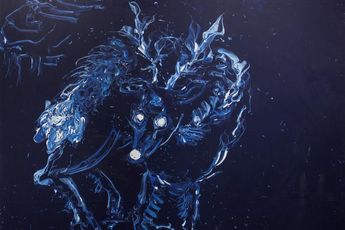
Over the Australian summer, cult Chinese artists Yangjiang Group will present a new multi-site work commissioned by 4A Centre for Contemporary Asian Art. Actions for Tomorrow will take over both the public and private areas at 4A in addition to a one-night only participatory performance and garden party at the Chinese Gardens of Friendship in Sydney. The exhibition was one of only four major international projects featured in the first wave of the Art Basel Crowdfunding Initiative. Known for their performative work that invites social action and private reflection for audiences through expanding the boundaries of traditional Chinese calligraphy, this will be the group’s first time in Australia.
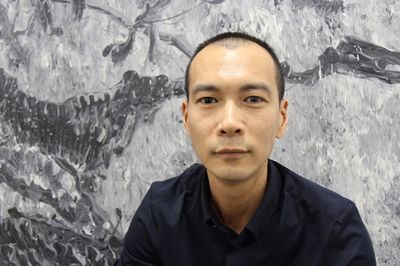
Stella Rosa McDonald met with member Zheng Guogu on a recent site visit to Sydney to discuss the politics of handwriting, the Group’s ideology, the symbolism of the Chinese Garden and the importance of getting drunk.
Does the Yangjiang Group “perform” commonplace activities such as meeting, eating, drinking and gambling or are you just enthusiastic eaters, drinkers and gamblers? What, if any, are the boundaries between art and life?
The Yangjiang Group is a way of life. In particular the way we use calligraphy as a medium to challenge the traditional notion of calligraphy apart from its usual context in everyday life. Everyone is an artist in their own right and everyone is entitled to create a way of life that they can enjoy. The creation of art is a desire for a better everyday life.
Can you talk about the politics of calligraphy in China, for example the introduction of simplified characters in Mainland China in place of traditional script?
Traditionally calligraphy is a form of social status. For example if you’re working for the government, you have to have perfect handwriting. It would be rare for someone in a government position to have bad handwriting. In a modern society we mostly use computers so it doesn’t require you to have the skill to write calligraphy and I think its better that way. Calligraphy becomes, as it used to be, a medium of artistic expression that gives ordinary people an outlet for artistic expression. It no longer has the social significance it used to.
Modified script was implemented in the Qing dynasty and the Song dynasty, as well as in China today, so I see it as part of continuity in Chinese history in which language is always evolving. Those in power introduced the simplified Chinese characters deliberately; it served a special need in time. Lots of people in Mainland China were uneducated and the traditional script is complicated for ordinary people. It was socially liberating for many people.
The critic Peter Schjeldahl, in describing the word paintings of Ed Ruscha, describes the experience of these works as “a tantalizing standoff in the brain, between looking and reading.” There is something of this visual and cognitive divide in the work of the Yangjiang Group, where writing is often unreadable, written in food, written while drunk or made illegible in other ways. Language exists both materially and conceptually. Can you talk about the Yangjiang Group’s relationship with language?
Other people might see it as junk and may think that we don’t know what we’re doing but for us we are always conscious of our practice. We want to show that there are different ways to use calligraphy as means to express ideas. We want to create a new understanding of the traditional form in a non-traditional setting. Traditional calligraphy restricts expression because of the need to have perfect handwriting. What we do is to challenge this tradition and to bring back the form it used to be, free and without rules. We began to drink when we wrote because traditionally if you were a master of calligraphy the drink enabled your Chi, allowing you to finish the work. I see Chi as not just energy but an ideology as well that transfers between the artist and the audience.
How important is it to be understood when you write in this expressive way, free from traditional rules?
It’s not very important that you understand the meaning of a specific character. It is important for you, as the audience, to understand the creative process of making and have a personal connection to the artwork. It’s not essential for the audience to understand Chinese in order to understand what we are trying to say.
The Yangjiang Group often create alternative social spaces do you think that being drunk is important as an alternative space in this sense?
It’s very important! [Laughs] Because lots of unexpected things happen after drinking and it is a way to escape the boundaries of the everyday. After many years of practice we have realized that if we are drunk enough, to a certain point, we always feel a sense of achievement when we look at our work afterwards because we see it as being a result of being the best we can be. Getting the limit right is the key; sometimes we do have too much.
A lot of people, particularly in Sydney, are familiar with the proposed site of Actions for Tomorrow, the Chinese Garden of Friendship. The gardens are a strange, timeless place where there exists a unique relationship between culture and commerce. It is a fantasy playground where you can hire Chinese dress and play make believe for an afternoon. How did you interpret the site?
We visited the site for the first time this afternoon and we were wondering the same things. How to use the garden as a space? It seems like an idyllic setting for a traditional Chinese scene - an old man doing calligraphy for example. But our challenge is how to contemporize this space.
I see it [the Chinese Garden] as similar to the western concept of a church. People go to church to get peace of mind. The Chinese garden is full of the same symbolic significance as a church - there is a balance created between heaven and earth that allows visitors to absorb the energy of the universe. In Chinese culture the garden is usually privately owned, and is a way to showcase the social class of its owner. Objects and plants are not organized arbitrarily but carefully planted and arranged to express the unique character and status of the owner.
Similar to our practice, these gardens are an alternative space that allow for an escape from your ordinary life. The garden is the same as an artwork. What makes a great artwork that sustains its power for generations to come? It really depends on the Chi of that artwork; if it represents, in some way, the power of the universe then it can sustain itself. This notion of balance applies to both western and Chinese culture.
In China, drinking tea has a cultural significance because it’s not a practice that’s accessible to ordinary people. It is a social practice that, like calligraphy, shows your status. There is a tearoom in the gardens and one idea might be to bring some very good tea from China for people to try and see if the energy of the tea becomes important in that space. One thing that is striking about this garden is the bamboo. In Chinese culture bamboo describes the honesty of a person because the middle part of bamboo is empty, symbolizing that the person has nothing to hide.
Is a cultural context or location important to the work of The Yangjiang Group?
For some artists it is important to have a connection to the place they are making work and to find the history behind it, but for us we believe history is history. We don’t have a selection process in terms of the location or the cultural background of a place, we just respond intuitively to the space.
What remains after you have left?
The best outcome is for the audience to get something out of the work and take it away with them. This means that you as the audience have become part of the work. It is just a moment in life.—[O]

A respected voice in contemporary art discourse.
Focusing on ambitious storytelling and insightful art-world commentary. Ocula Magazine publishes in-depth interviews, critical essays and timely analysis on the artists, exhibitions and ideas driving the global art world.
Learn more about Ocula Magazine
Showcasing the best of the art world.
Ocula partners with galleries from around the world to highlight their artists, artworks and exhibitions. Gallery membership is by application and invitation, with each member vetted by an independent panel.
Learn more about Ocula Membership
Specialises in the sale of major artworks.
Led by a team with deep ties to the world’s leading auction houses, galleries and collectors. Ocula’s advisory team offers bespoke services to high-net-worth clients from around the world who are looking to acquire the best of contemporary and modern art.
Learn more about our team and services