






Unmissable: Kai Althoff at nervi delle volpi in Genoa
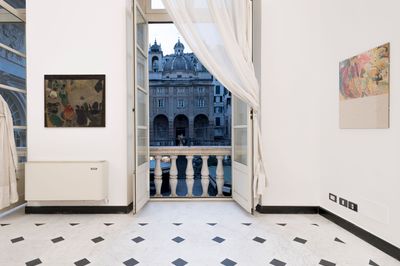
Exhibition view: Kai Althoff, di costole, nervi delle volpi, Genoa (5 October–14 December 2024). Courtesy the artist and nervi delle volpi. Photo: Stefan Korte.

The show lives on the first floor of a 15th-century palazzo, originally erected in the city centre for the 75th Doge of the Republic of Genoa. Formerly municipal offices, the space was chosen by Berlin’s Galerie Neu specifically for Althoff’s presentation and inconspicuously altered to the artist’s specifications.
Althoff’s palette is more muted here than in much of his past work. Yellows turn to browns and whites to greys, as if the paintings have been dirtied by a century of candle smoke in a nearby Baroque church. One work is an exception: a crisp cream clergyman’s robe extends from the whitewashed walls on which the work is hung to illuminate the congregation gathered around him.
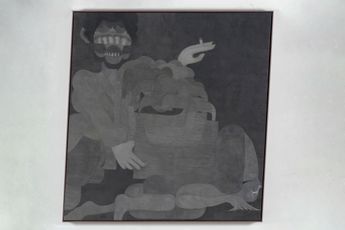
As ever nameless, the works in di costole are also, at least per the accompanying publication, undated. Whilst we might assume the paintings are recently birthed, the impossibility to pin them to a date renders them temporally nomadic; placed by each viewer into their own epoch. There is, in fact, no subject matter that I could see that assigns Althoff’s output to the last 50 years. The most contemporary piece of technology rendered, a record player, is tended by an unkempt-looking and ageless character, who might as easily be a young girl on the verge of adolescence as a woman well into her 50s.

The reason for Althoff’s attraction to Genoa is unclear but Elina, the custodian of the space, recounts a hazy story from the artist’s youth in which he and his brother became separated whilst holidaying in the city. Althoff spent the day wandering the Italian port searching for his sibling’s familiar face, only reuniting with him near Piazza Principe station as night fell. Could this traumatic memory inform the exhibition? The paintings in di costole do feel rooted in youth and loss.
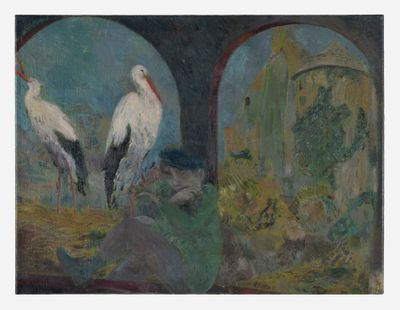
Few of Althoff’s characters seem to eclipse adolescence, but their loosely rendered faces often carry expressions mismatched with the naivety of childhood. In one work a young boy, aged 11 or 12, sits forlornly against a cloister pillar. A pair of white storks and a conical tiled roof place the scene more in the artist’s native Rheinland than in the Italian Riviera, but it’s easy to imagine the young Althoff, lost and demoralised, in a similar pose.
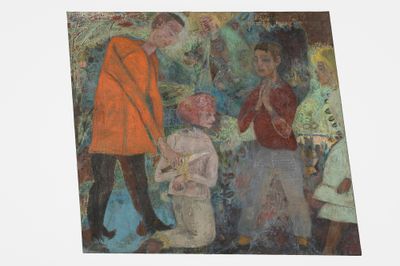
Time spent with the works comes with the realisation that the often-jovial characters which populate Althoff’s paintings live alongside the sinister. In one image, a kneeling boy has his hands and ankles bound. The faces of his captors (or possible saviours?) seem placid at first glance but reveal a morbid blankness on closer inspection. The fate of the boy is ours to imagine, but the scene is decidedly unsettling.
Another work felt particularly pertinent when I visited, on 5 November 2024: the day of the U.S. election. A young girl, flanked by her mother, lifts a rifle from a counter littered with an array of firearms. A not-much-older shopkeeper dotingly supervises in a painting that could reference the lax American gun laws with which Althoff may well be forced to contend at his home in upstate New York.
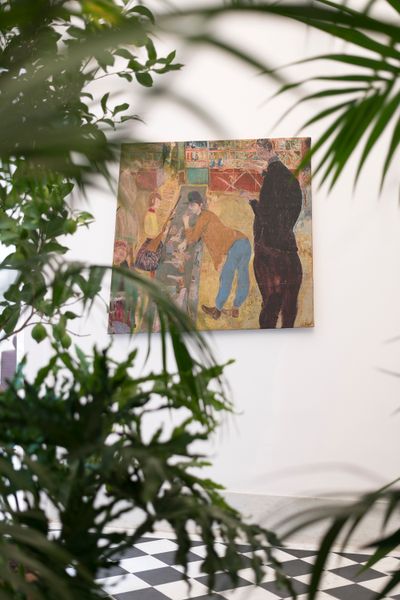
In the gallery, Althoff’s spacial interventions are subtle but omnipresent: antiquated uplighters—original to the former office—cast shadows across the works. A lone Fratelli Levaggi-designed ‘Tre Archi’ chair with a woven cane seat nestles in the corner of one room. In another, a 1950s day bed by Kazuhide Takahama—bought by Althoff in Milan and reupholstered—holds court.
The furnishings are intended for utility and lend di costole a homely domesticity. Althoff is an impeccable host and, alongside these resting places, every visitor is offered a candied fruit from a famed Genovese pasticceria: a reward for long journeys made to Genoa by Althoff’s loyal disciples.
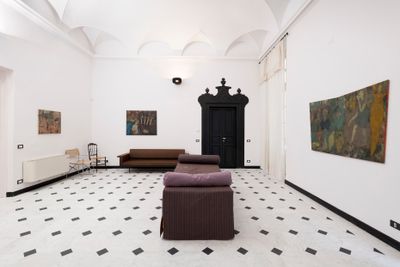
On the day of my visit, the glazed french doors populating the space were largely open and the sounds of the city floated in, past the aged linen curtains—a hangover from the space’s past life—that Althoff specified must be kept original and unwashed. The exhibition feels like an appendage of the street below, as if it’s always been there. If Genoa is a body and its passages ribs, then di costole (translating literally to ‘of the ribs’) could be a vestigial organ; a remnant of times past.
The tales Althoff’s works tell me are no-doubt different from those they would tell the busker in the square below or the proprietor of the flower shop opposite, but that’s what I love most about them. These may be intensely narrativised works but the stories are as much our own as they are Althoff’s. —[O]
Main image: Exhibition view: Kai Althoff, di costole, nervi delle volpi, Genoa (5 October–14 December 2024). Courtesy the artist and nervi delle volpi. Photo: Stefan Korte.
A respected voice in contemporary art discourse.
Focusing on ambitious storytelling and insightful art-world commentary. Ocula Magazine publishes in-depth interviews, critical essays and timely analysis on the artists, exhibitions and ideas driving the global art world.
Learn more about Ocula Magazine
Showcasing the best of the art world.
Ocula partners with galleries from around the world to highlight their artists, artworks and exhibitions. Gallery membership is by application and invitation, with each member vetted by an independent panel.
Learn more about Ocula Membership
Specialises in the sale of major artworks.
Led by a team with deep ties to the world’s leading auction houses, galleries and collectors. Ocula’s advisory team offers bespoke services to high-net-worth clients from around the world who are looking to acquire the best of contemporary and modern art.
Learn more about our team and services