






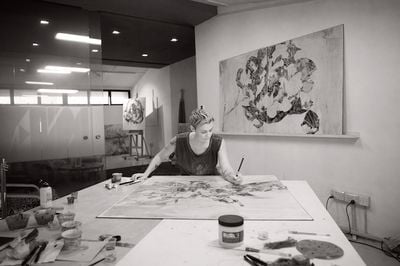

Belinda Fox (b. 1975, Melbourne) is a Singaporean based, Australian artist well known for her lyrical, abstract works that explore the precarious balance in contemporary life between hope and doubt.
Her current exhibition at Chan Hampe Galleries in Singapore is inspired by her time in Singapore and travels to Vietnam and Myanmar. Alongside a series of paintings considering the loss of tradition and the exploitation of the natural environment in the name of human progress, she will be showing a number of ceramic sculptures created in collaboration with Singaporean performance artist and ceramacist Jason Lim.
Ocula is pleased to present a unique conversation between the two artists as they discuss their practice and the process of collaboration for these remarkable new works.
How did this project and collaboration come about?
Belinda: When I first arrived in Singapore I got to see some of Jason’s work whilst visiting the Jalan Bahar Clay Studio, often called the Dragon Kiln. It is quite a unique and historically significant clay studio in Singapore. I thought his work was very interesting. Late last year I approached him to see if he would collaborate with me. I was not expecting him to say yes! But I am very happy he did.
Jason: I was introduced to Belinda through a common friend of ours. I Googled to find out more about her work and found it interesting. I said yes to the collaboration because I see the potential of collaborative work in being good for the soul and also making me work out of my comfort zone.
Have you ever worked in this way before with another artist?
Belinda: Yes I have done many collaborative projects in print and a few in sculpture, however I’ve only ever worked with one ceramic artist before—that is Neville French, from Australia. Ceramics is an infinite world of possibilities and styles so although I have had some experience in ceramics Jason is a totally different artist—therefore it is a totally new adventure.
Jason: I had done many collaborative works in other art forms for example performance art, experimental theater and video. Working with another artist in clay is a first for me.
What do you aim to achieve for this project? For example is there anything new you are trying, or exploring?
Belinda: Personally I wanted to work with Jason as he uses ceramics sculpturally, so the connection to my sculptural works/the ceramics and my drawing was a nice idea that I wanted to explore. His organic forms also instantly appealed and I could see some very interesting work between us unfolding. On another level I wanted to also work with an artist from my current home city of Singapore. I felt it was important to be more present within my community. Working with Jason not only allowed me to be more immersed within my cultural surrounds, but we worked on some totally new ceramic techniques too.
Jason: Through the discussions that we had, I gradually understood what Belinda was looking for in the visual language of the pieces. I had streamlined the possibilities and marked out certain less explored areas in my own ceramics practice. One of the challenges, for example, was to create large works for Raku firing. We also had to explore various types of clay and glazes to achieve what we had in mind for each work.
Conceptually what will this work be about? And where is it being shown?
Belinda: I invited Jason to collaborate with me as part of my solo exhibition at the 2015 Sydney Contemporary Art Fair where I was representing Arthouse Gallery from Australia. But we will also be showcasing our collaborations in Singapore in January 2016 at Chan Hampe Galleries.
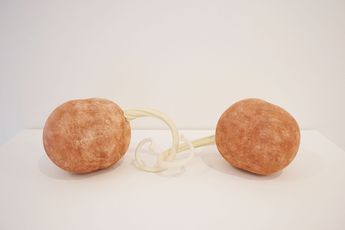
My Sydney show was called Balancing the World, and the paintings, sculpture and this ceramic collaboration endeavored to explore the tenuous balancing act we currently traverse in society with our environmental predicaments and the ongoing anxiety of traditions and progress; the pressures on our habitat, animal extinctions, depleting resources, incessant progress and rampant consumerism. The cost to the earth and human soul is under great strain at present. The work creates a series of precarious forms, balancing acts that are terribly close to collapse, beautifully fragile, burdened, however in the guise of perfect acrobatics.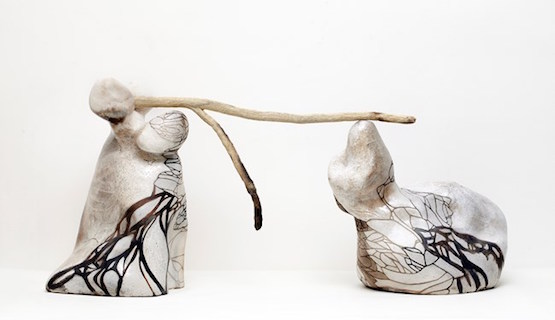
I work with and interpret Balancing the World in the most direct way possible. In the recent past, I have spent a lot of time in contemplation and mediation, seeking to strike a balance between my personal world with those in the real and in virtual spaces, from outwardly expressed emotional spaces to the inner spiritual spaces. Working in collaboration, especially with someone I had met for the first time, is also about creating a balance between two individuals where the egos have to be compromised and negotiated.
Working in ceramics is a laborious and time consuming and has a high risk factor of things not working out in the kiln – what is it about this medium that engages you both?
Belinda: For me the interaction with ceramics is not the laborous and high-risk side. Jason has an enormous amount of work to do for this project. We both share the anxieties if it does not work of course but the technical expertise of the ceramicist cannot be underestimated. It is a very difficult medium to master.
The hardest part for me is feeling confident enough to work on another artist’s forms. It is very confronting to be in that position – not wanting to destroy or lessen another artist’s work. My job is to add another element, to extend the dialogue, connect and strengthen what the artist puts in front of me. And as I do not know very much about ceramics this can be rather hard. But that tension and anxiety is also a great privilege. I try to honor the artist’s work as much as I can.
But why do I like working in ceramics? – I love the ancient tradition of ceramics, it is at the heart of our civilized world, and I love its endless possibilities. There is something everyone can connect with in ceramics – because it has always been central to our lives for utilitarian reasons, for storage, for beauty. If a ceramic art piece is good enough it connects us to this primal instinct and raises it beyond.
That is pretty cool. Mind you there are a lot of bad ceramics too….
Jason: I had chosen to work with clay as a medium because of the directness of the material. What I think and how I feel is directly transmitted from my mind in my thoughts through my hands. The processes are laborious indeed but they are also meditative and therapeutic. When joy is derived from the processes, it becomes meditative to me. When it becomes meditative, I learn to let go of the laborious processes. I tried at some point in our conversations to hint to Belinda that we might not get what we wanted from the firing and that we had to accept what comes out of the kiln and let go of our expectations. We had very little time for experimentation and revision to get exactly what we wanted and so could not expect perfect results. This is my personal approach in working with clay.
Can you tell us a bit about yourself and perhaps your favorite past project as an artist?
Belinda: I am a Singapore based Australian interdisciplinary artist. For many years my work has explored notions of hope and doubt, the human predicament of our ability to be amazing and awful—often in the same action.
I have worked on so many amazing projects, I am very lucky to be able to work full time as an artist and collaborate with amazing people and visit wonderful places. Last year I was invited to make a mild steel sculpture ‘Extract’ in Shanghai at Urban Arts Projects. This was an incredible, innovative and very challenging project for me. I am very proud of the final outcome.
Jason: I use to tell people that Singapore is too small a country to be inspired for making art. For that reason, I had in the past, enjoyed taking up residencies and working in different countries, immersing myself in different cultures and environments to create varied bodies of works. But ironically, my latest breakthrough in my ceramics practice comes from working at the Dragon kiln in Singapore. In this series, Landscape Studies (Assembled series), all elements used to create each sculpture were found remnants from the wood kiln and nearby surroundings, for example, discarded kiln bricks and molten nails from the firebox. These were used to compose small yet intimate sculptural works inspired by Chinese ink landscape paintings.
Is there something unique about being in Singapore that international audiences might not know? The challenges, the positives?
Belinda: It is very expensive! Singapore is still a young art market so it is a great place for young artists. They can become part of history if they play their cards right! For an expat artist it is an amazing place to show your work to an international community. Singapore is a hub of people coming and going from all over the world. I have never had such a broad collector base since moving to Singapore. This is very exciting and I think something unique to Singapore. It is truly an international place.
Jason: Singapore is a young migrant country with limited traditions and cultural baggage. This lack of traditional burden in the arts allows artists a lot of freedom for creativity and innovation.
Working with another artist is very brave; many artists would not allow another person to work on their creations. How is this for you? What can an artist gain from this experience?
Belinda: Collaboration is hard work. It is not for the faint hearted! But it never fails to be challenging - ones limits and boundaries are always pushed and broadened. This makes great art if both artists are willing to work together! So working with another artist requires a great deal of trust, commitment, faith and compassion. It is also a great privilege for another artist to welcome you into their creative world. It makes you see how unique each of us are in how we create, and how to interact within each other’s world can often be difficult at first. But I really love the intimacy that can result in a good connection between artists. And without each other that artwork could never be made. This is a great experience. It is why I like to do it.
Jason: I believe in having faith and trust in a person when my intuition tells me all is good. Through the process of talking and sharing, I hope to build a friendship beyond this collaboration. I may not be the easiest person to have a conversation with but I hope my actions speak louder than words. —[O]
Main image: Belinda Fox in her studio. Photo credit: www.lilreddotfolks.com



A respected voice in contemporary art discourse.
Focusing on ambitious storytelling and insightful art-world commentary. Ocula Magazine publishes in-depth interviews, critical essays and timely analysis on the artists, exhibitions and ideas driving the global art world.
Learn more about Ocula Magazine
Showcasing the best of the art world.
Ocula partners with galleries from around the world to highlight their artists, artworks and exhibitions. Gallery membership is by application and invitation, with each member vetted by an independent panel.
Learn more about Ocula Membership
Specialises in the sale of major artworks.
Led by a team with deep ties to the world’s leading auction houses, galleries and collectors. Ocula’s advisory team offers bespoke services to high-net-worth clients from around the world who are looking to acquire the best of contemporary and modern art.
Learn more about our team and services