






For Tomashi Jackson, Painting Is the Present You Can Change
Ocula spoke with the artist on her thoughts five months into the second Trump administration, how unexpected caregiving work renewed her painting practice, and art’s capacity to catalyse change. Save to My Ocula
History’s spectres seep into Tomashi Jackson’s surfaces, but it’s for their resonance in the present that she summons them. As protests against immigration raids erupted across her hometown of Los Angeles, Jackson remarked on art’s historic capacities, citing artist Alfredo Jaar whose Studies on Happiness (1979–1981) gave Chileans a covert voice during the Pinochet dictatorship. Echoing Jaar’s tacit probing of abuses of power and their human imprints, Jackson’s research into civil rights rulings—starting with Sweatt v. Painter, 1950, the first successful federal case to challenge university segregation—taught her equitable treatment under the constitution is not a given.
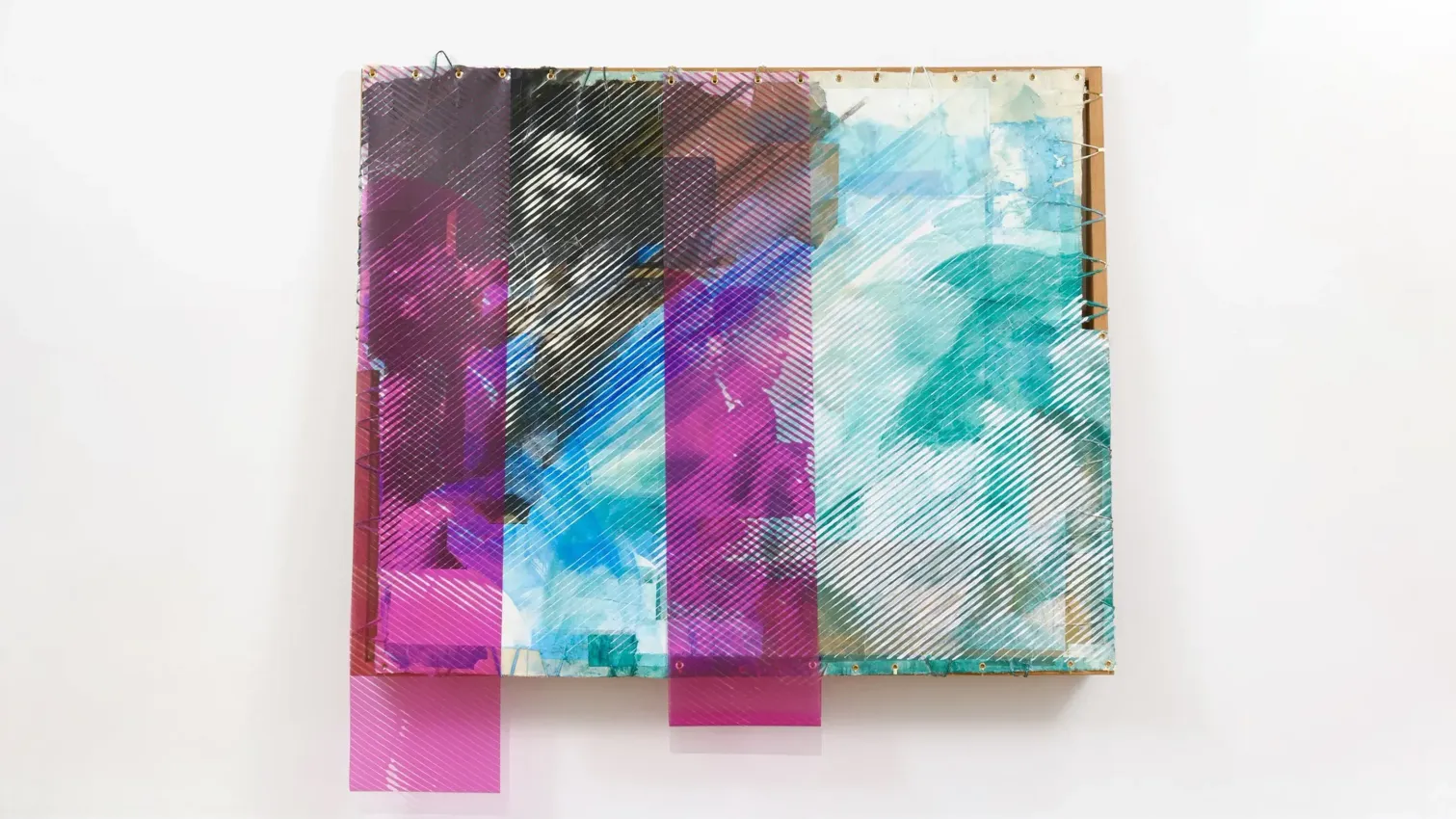
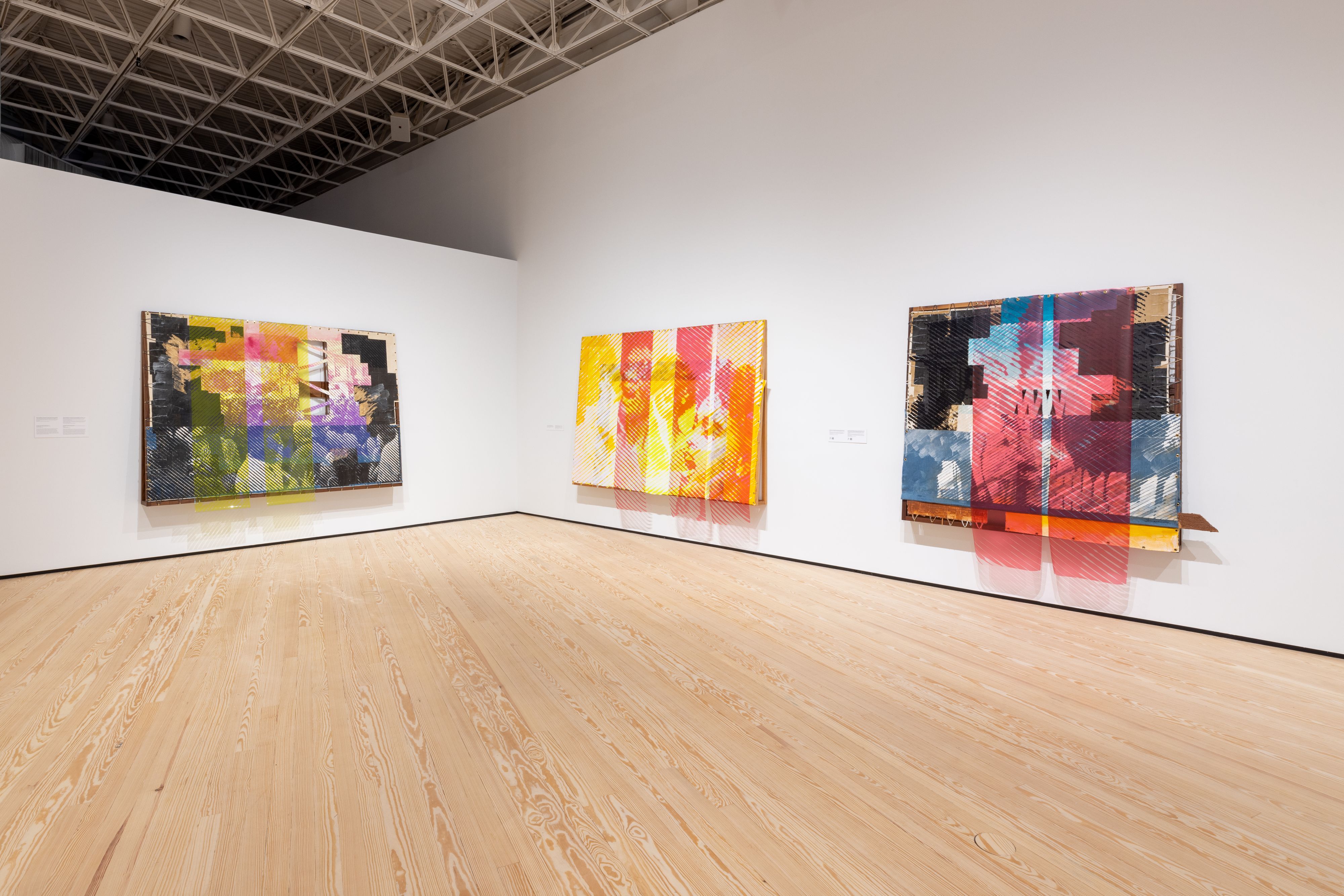
‘This oppressive interference has always been present,’ Jackson told Ocula. ‘For some, it was at lower frequencies. Now it’s turned up.’ Milestones towards a realised American democracy loom in Jackson’s paintings, spanning the past decade in her mid-career survey, Across the Universe, at Contemporary Arts Museum Houston. Halftone lines and crosshatches shroud layered vignettes denoting moments of progress and decline, all swallowed by grids applying Josef Albers’ colour theory—that perception of shade is relative—to express the arbitrary value assigned to skin.


EZ: Your work deals with American history informing the present. What’s the reality like in the U.S. now?
TJ: My home base now is in Cambridge, Massachusetts, near where the Tufts student and Fulbright fellow was violently taken into ICE custody. People being snatched off the street takes me back to what I learned from Alfredo Jaar and his Studies on Happiness. During the Pinochet dictatorship, Jaar walked around Santiago de Chile with military police in the street, carrying a sign saying, ‘are you happy?’ People are given the option to either answer yes or no, or take a piece of candy. They can take the candy and place it into the slot that affirms yes or no.
This was during an era when it was dangerous to speak. People were not allowed to gather more than three at a time and were being taken from the street in broad daylight. Chilean artist friends of mine, who have a muscle memory of this oppressive political regime, recently told me they never expected to feel that here.
EZ: How is this reflected in your work in Across the Universe?
TJ: An early work, Dajerria All Alone (Bolling v. Sharpe (District of Columbia))(McKinney Pool Party) (2016), looks at the history of school desegregation and education in the United States and collapses it with current events, where Black adults and children are being taken and abused by police. The notion of humanism has always been selective here, always as a nation. This oppressive interference has always been present. For some, it was at lower frequencies. Now it’s turned up.


EZ: Your research into legal history started with Sweatt v. Painter. Can you take us back?
TJ: In 2015, I was awarded travel grants from Yale to study law through art. I chose Houston because it was the site of the first successful case against university segregation, argued by Thurgood Marshall. That case proved ‘separate but equal’ was inherently unequal. I wanted to visualise this history, but my plans changed after Sandra Bland died in police custody near Prairie View College—another site I’d planned to visit.
Instead, I worked at Project Row Houses, where Rick Lowe and Ryan Dennis gave me a studio. I recorded people reading texts like Josef Albers’ Interaction of Color [on how perception of colour is relative to nearby shades] because librarians told me they do not keep images of Black communities. All the work in my show reflects my curiosity about public issues I don’t fully understand. My research methodology involves archival work and conversations with people who have memories of these events.
EZ: Is painting a way to archive what wasn’t documented?
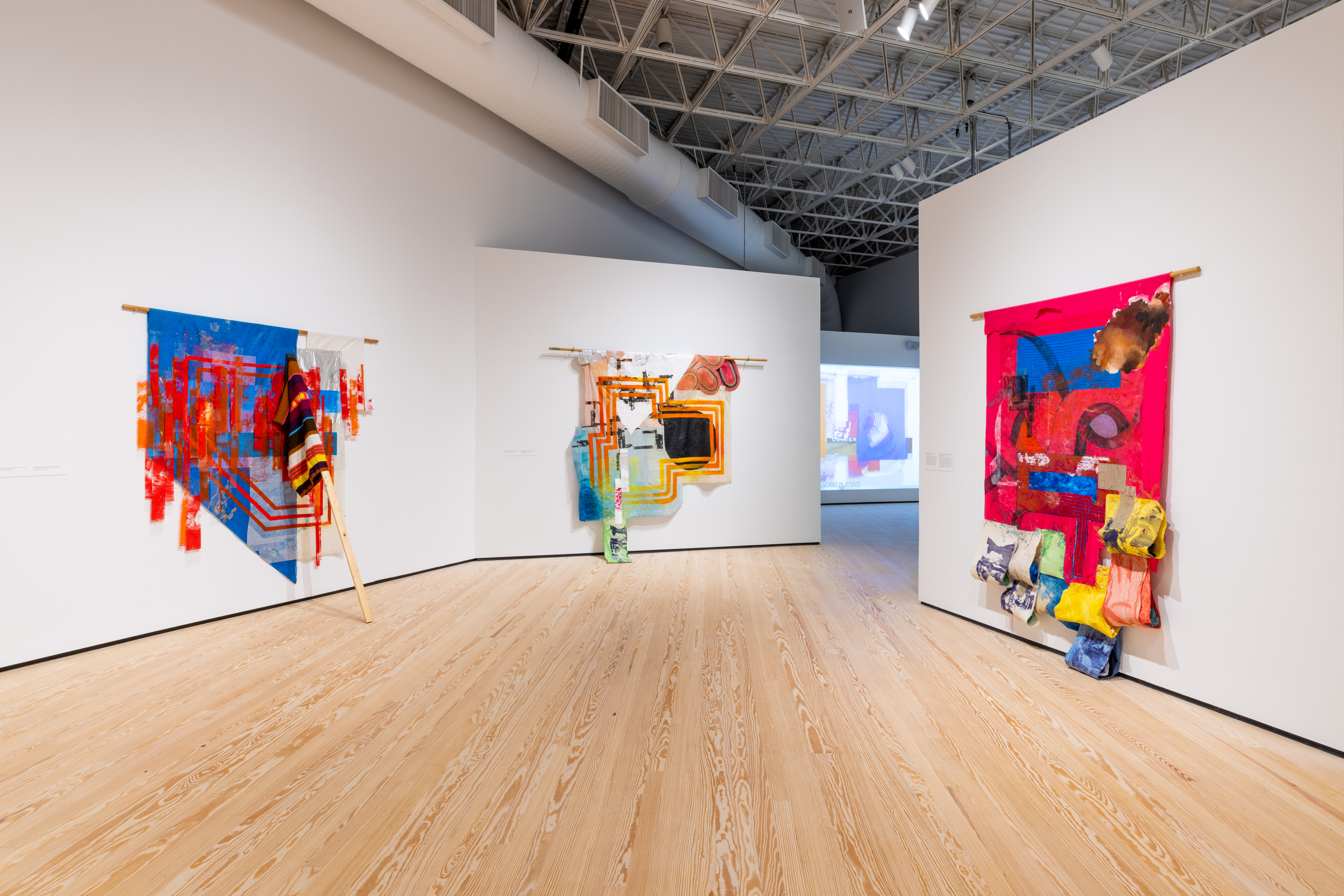
TJ: For sure—as a way to archive and make something new. That’s been a driving force since childhood. The paintings in this exhibition aren’t just rectangles or squares; the surfaces that excite me most challenge me to figure out how to hang, preserve, and stretch them—how to share them. The physical labour of making these things helps me understand the relationships between past and present. Then one thing just leads to another. The physical labour of making them is also comforting: it’s the present that I can change.


EZ: Your paintings almost appear like small murals, which were prominent in Los Angeles, where you grew up. What’s your interest in the built environment?
TJ: Moving to the East Coast in 2010, I was rethinking muralism as we entered an era of urban renewal, where a painting is often sandblasted once the building changes hands. Local architecture and communities that had been intact my entire life were suddenly changing too.
EZ: You then enrolled at MIT’s School of Architecture for an MS in Art, Culture, and Technology—what prompted the shift?
TJ: I wanted to be in a place where artists could have conversations with engineers, architects, scientists, and technologists and contribute sculptural solutions for problems in the built environment. I actually would’ve loved to have been solely focused on galleries, but I just couldn’t.
My thesis ended up being focused on informal economies, specifically Black women’s labouring bodies, offering to care for and shield babies, or elderly people. It was based on my experience in New York—all these women did this domestic work in public.
Then I applied to MIT’s Building Technology programme thinking the goal was to become a lifer, working on solutions with research groups. But the faculty I needed to work with wasn’t there. They couldn’t accept me. So I became a caregiver for families in the neighbourhood out of necessity.
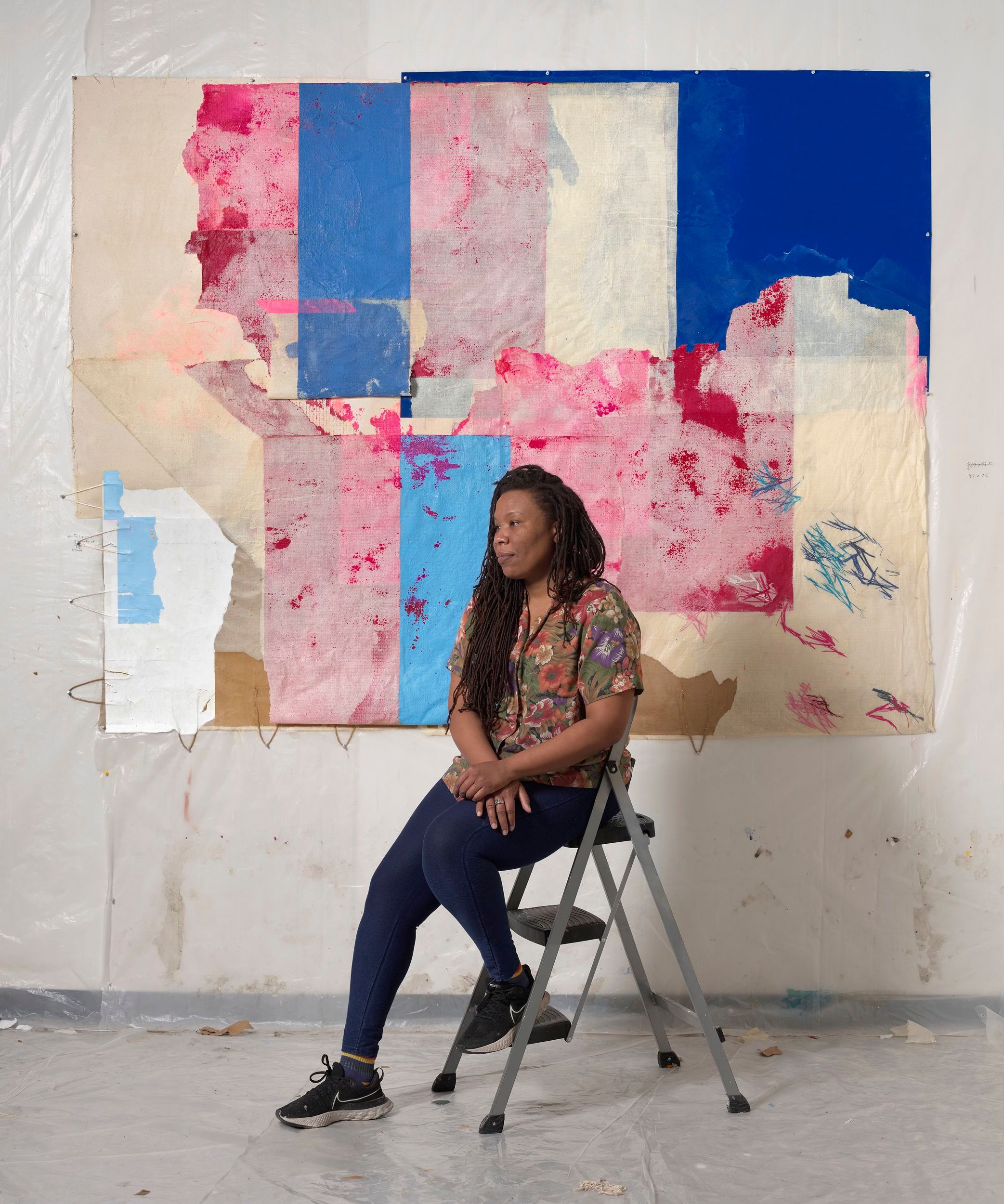
EZ: How did you find your way back to painting?
TJ: For a couple of months, I was very sad and accepted that maybe this was as far as I would go. And then people from the local church taught me how to knit. I found it calming and soothing—my hands had something to do. I was so nervous and anxious. It was practical at first, but I found I was getting excited about colour—this desire to see them interact was not dormant. Everything else was and I didn’t know if there was anything else anymore. I was counting rows. I was creating on the fly in the studio.
For a while I thought I was never gonna paint again. I feel like you might relate to the experience of competing to get somewhere where you really want to be—for me, that started when I was 12, testing and interviewing for private schools. I was pleased I was no longer running for a certain place.
While taking care of these children, I started painting again—portraits of myself and other domestic workers, who wouldn’t speak to me when I was an art student. I ended up with a bedroom full of paintings and a strong desire to be with people who took painting seriously again.
EZ: Have you always believed in art’s capacity to enact change?
TJ: Yes, absolutely. The value of practice is not what happens at a gallery or in public space at this one time—it’s cyclical. It’s what I call a robust and productive practice. Sometimes the work is super public, sometimes it’s meant to be private, so discreet; sometimes you learn, at others, you teach.
The mural that I painted in Los Angeles before I left for school, I have since met children who grew up in that neighbourhood out in the world. One of them ended up being a student at Yale when I was a guest critic there. And when they found out that I painted that mural, they burst into tears. —[O]
Tomashi Jackson: Across the Universe is on view at Contemporary Arts Museum Houston from 30 May 2025 through 29 March 2026.




A respected voice in contemporary art discourse.
Focusing on ambitious storytelling and insightful art-world commentary. Ocula Magazine publishes in-depth interviews, critical essays and timely analysis on the artists, exhibitions and ideas driving the global art world.
Learn more about Ocula Magazine
Showcasing the best of the art world.
Ocula partners with galleries from around the world to highlight their artists, artworks and exhibitions. Gallery membership is by application and invitation, with each member vetted by an independent panel.
Learn more about Ocula Membership
Specialises in the sale of major artworks.
Led by a team with deep ties to the world’s leading auction houses, galleries and collectors. Ocula’s advisory team offers bespoke services to high-net-worth clients from around the world who are looking to acquire the best of contemporary and modern art.
Learn more about our team and services