



Czech Pavilion at Venice: Curator Hana Janečková on the Giraffe in the Room
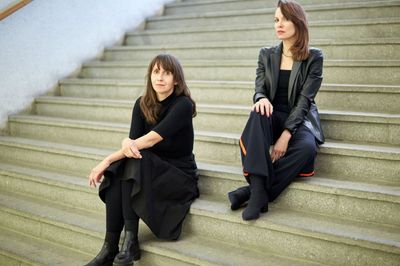
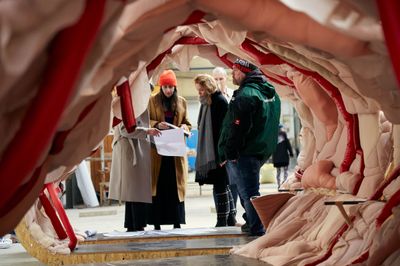
Left to right: Eva Koťátková and Hana Janečková. Photo: Aleksandra Vajd.

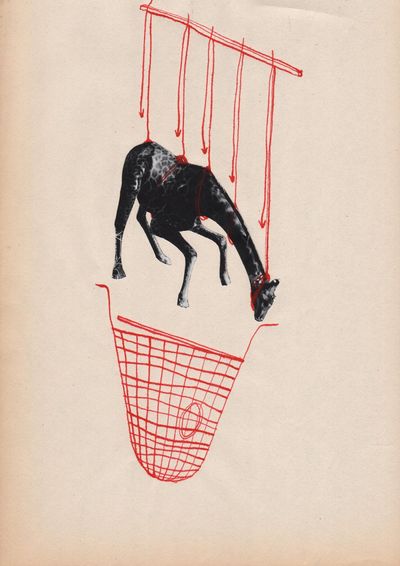
Koťátková’s works are the result of her collaboration with the multimedia performance duo Himali Singh Soin and David Soin Tappeser (Hylozoic/Desires), collective Gesturing Towards Decolonial Futures, educators, children, and older people who were Lenka’s contemporaries. The artist asked them to retell Lenka’s story in their words from memory or imagination, which Hylozoic/Desires composed into a sound piece that plays in the tunnels. During the exhibition, performers also interact with models of a giraffe’s legs, circling a small hole that has been made in the cement floor.
The pavilion is curated by Hana Janečková, Associate Professor of Contemporary Art at the Centre for Audiovisual Studies at the Academy of Performing Arts in Prague. Janečková and Koťátková have previously worked on Animal Touch: Art, Labour and Emotion (2021), a collection of critiques on human-animal relations by 15 writers.
In the following edited excerpt, from an interview between Lyah Benarroch, a Certificate Student at The New Centre for Research & Practice (TNC), Janečková discusses the key elements of the Czech Pavilion. The interview was conducted as part of TNC’s Hyper Annotation 3.0, a series of conversations with artists, curators, and art professionals during the pre-opening days of the 60th Venice Biennale.
How does the exhibition connect to the main theme of the Biennale, ‘Foreigners Everywhere’?
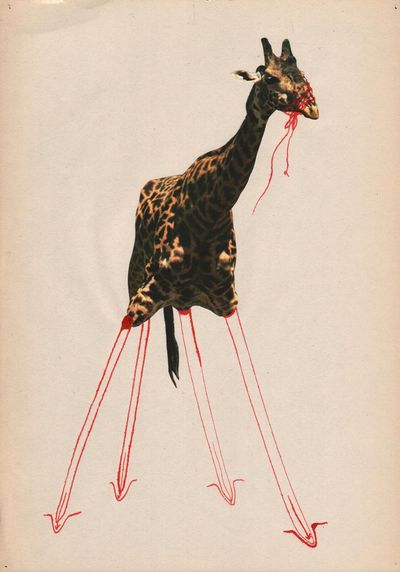
HJ: This project tells the story of the giraffe Lenka, who was captured in Kenya in 1954. She was transported to Czechoslovakia as the first Czechoslovak giraffe in a Czech Zoo. The giraffe lived only two years, then she died of pneumonia. Her body was donated to the National Museum, where she was a museum exhibit for 44 years.
We were interested in the foreignness of her body—what does she stand for as a national building artefact? What does it mean for this animal to becomes a national symbol in the National Museum? What happens to these artefacts after their service [is over] is that they are removed from the exhibit and they live this endless life in the archives because [their bodies are] scientifically valuable.
So she’s protected against being completely destroyed or buried. There is an ongoing theme of foreignness that feeds into this idea of national identity. What does it mean to belong? How do we build this relationship of belonging, especially in relating to the national, to the natural world? She was a main symbol in the most important Czech museum.
The story goes that she went through autopsy when they were preparing the exhibit; there’s an urban legend that her body was released into public sewage and the whole upper part of the most important, historical part of Prague had to be closed for two days because of the smell. We found this metaphor incredibly powerful because of the idea of the body leaving and turning into a body of water and entering the ecosystem. This brings in the idea of ‘foreigners everywhere’ and this body that is evaporating, which we can breathe in.
How did you start working on this story of the giraffe?
HJ: I did a very big publication project with Eva that concerns the Anthropocene and animals [Animal Touch (2021)]. Eva works with storytelling, and she did a huge exhibition [How many giraffes are in the air we breathe? (2021), Nottingham Contemporary, U.K.], where she asked people to contribute to the exhibition in a form and talked to people who lived when Lenka was exhibited. We went through the national film archive in Prague to trace the remnants of the story. From that kind of collection, we started to build a narrative—what happened to Lenka, but also a general mapping of the histories of animal acquisitions from the countries of the Global South. So that’s very important. It’s the politics of and stories of animal acquisitions from the Global South because this is something that is not researched and looked at in Czech history. A lot of the Czech public denies any connection to colonialism. And for us, it was very important to start to open this idea of natural extraction as part of a western colonial project and our complicity with it as Czechoslovakia was a former state that Lenka was imported to.
Can you tell us more about the collaboration with the audio work?
HJ: Eva is very interested in radical pedagogy. Many of the workshops and pedagogical practices that are part of the project have been inspired by Gesturing Towards Decolonial Futures, which is a Canadian-based international collective, a radical pedagogical collective. We wanted to open this collaborative framework to as many kinds of ideas about belonging or nationhood.
That’s especially why we selected Himali Singh Soin and David Soin Tappeser to compose the overall sound. What you hear in the tunnel is an outcome of 20, 30 workshops that Eva did with children and older people. She went to retirement homes and talked to people who remembered Lenka, and she asked them to retell the story differently. What could have been different, how we could imagine a relationship to nature that would be less extractive. The sound is a result of the collection of materials from these processes.
How does this exhibition relate to previous exhibitions of the Czech Republic in the Venice Biennale?
HJ: The last representation we had was in 2019, and it was a very established Czech sculptor [Stanislav Kolíbal]. ... I wouldn’t say that we were making links directly to the history of the previous exhibitions. But for us, for example, this audio that you can hear has remnants of national anthems of all the places that the giraffe travelled through. Kenya, EU, Germany, Czechoslovakia, et cetera.
This national building aspect is extremely important for our project. It is important for us that it should be presented not only to the international public here at the Biennale, but also to the Czech public. The building itself plays a huge part, because of Lenka being the symbol of nation building and the values we stand for as scientific progress. So we try to reverse it in different ways of thinking, bringing storytelling, oral histories, poem sounds, touch; you can see haptic models. We have accessibility in-built in the exhibition. That was really important. —[O]
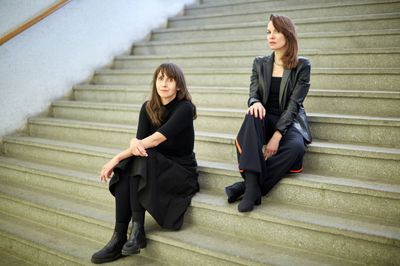
Main image: Left to right: Eva Koťátková and Hana Janečková. Photo: Aleksandra Vajd.



A respected voice in contemporary art discourse.
Focusing on ambitious storytelling and insightful art-world commentary. Ocula Magazine publishes in-depth interviews, critical essays and timely analysis on the artists, exhibitions and ideas driving the global art world.
Learn more about Ocula Magazine
Showcasing the best of the art world.
Ocula partners with galleries from around the world to highlight their artists, artworks and exhibitions. Gallery membership is by application and invitation, with each member vetted by an independent panel.
Learn more about Ocula Membership
Specialises in the sale of major artworks.
Led by a team with deep ties to the world’s leading auction houses, galleries and collectors. Ocula’s advisory team offers bespoke services to high-net-worth clients from around the world who are looking to acquire the best of contemporary and modern art.
Learn more about our team and services