





Marco Tirelli’s Free Associations
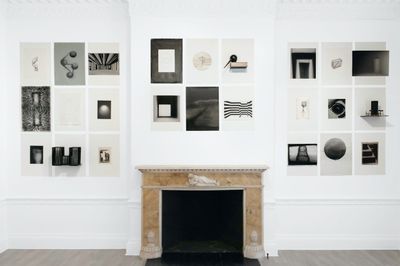
Exhibition view: Marco Tirelli, Cardi Gallery, London (25 June–25 September 2021). Courtesy Cardi Gallery. © 2021 Cardi Gallery. Photo: Eva Herzog.
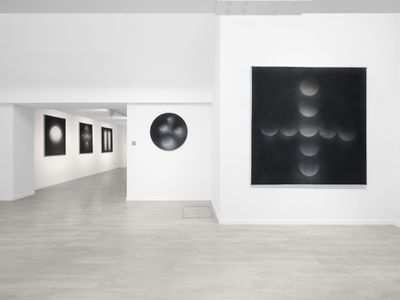
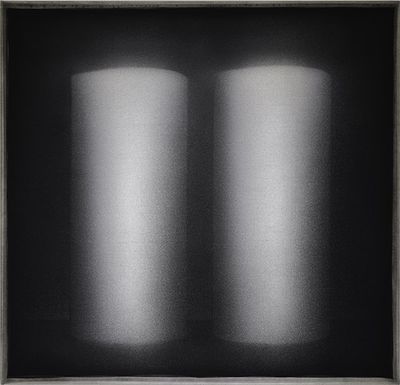
The exhibition begins in the lower ground floor gallery, where five mixed-media paintings on black canvases feature circular, rectangular, and cylindrical motifs rendered in tints of light grey, sometimes hinging on blue.
From afar, Tirelli’s paintings appear monochromatic, but on close inspection, subtle hues appear: yellows, ochres, greens, blues, and more. This effect has been perfected over the years, as the artist worked with gradations of charcoal on paper, later using an airbrush to create tens of thousands of small dots far smaller than those of conventional pointillist paintings.
In an adjacent back wall, 18 large-format black and white photographs documenting geometric shapes in the natural world and everyday life (skies, grass, the sea, rocks, machinery, and so on) create a grid-like effect.
Tirelli initially trained as a set designer at the Fine Arts Academy in Rome and went on to study at the New Roman School between the 1980s and 1990s—a background made evident in the artist’s sculptural objects and assemblages in particular.
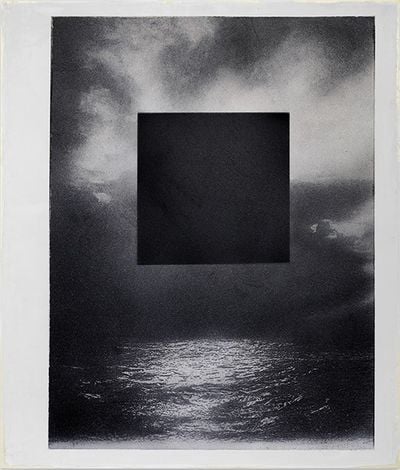
One of the artist’s early influences informing his geometric and dramatic paintings is the late Swiss theatrical designer Adolphe Appia, who championed interpretive use of lighting.
“In this fragmentary constellation of things, multiple references suggest a multitude of meanings that emerge from the artist’s own private experiences.
Throughout his practice, Tirelli has developed a vocabulary spanning geometric shapes and architectural forms, images from the natural world, and objects that include machinery and man-made tools, drawing inspiration from a vast personal archive of objects, sketches, and photographs that capture the daily life of an artist at work—pictures of tables, chairs, plinths—accumulated over decades.
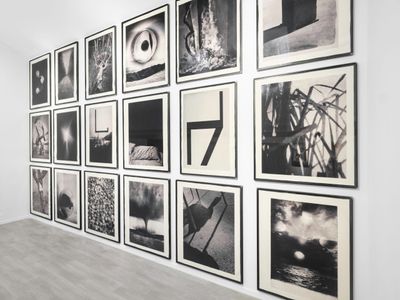
Threaded through these visuals are the influences of Tirelli’s hometowns of Rome and Spoleto: particularly, the light that bathes urban and rural spaces, which speak to the artist’s unique exploration of shadows.
As art critic and curator Francesco Poli observes in Tirelli’s work, ‘the physical object becomes an excuse to cross the border between light and shadow, thus creating a metaphysical relationship with space.’
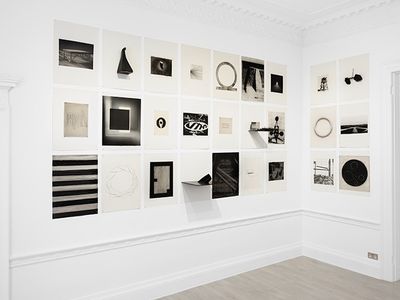
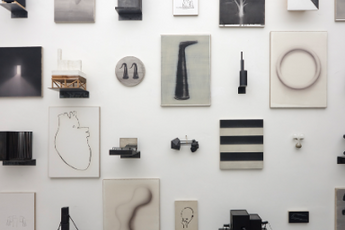
Moving up into the ground floor gallery, works are scaled down as a constellation of smaller drawings and small sculptures mounted on shelves—over two dozen on each wall—form grids.
Among them is a miniature sculpture placed on a metal shelf and assembled from brass and electrical equipment: three mounted stage lights projecting into the windows of two rectangular room-like forms. Nearby, stairs have been carved out from a chalk cube placed atop a wooden lattice plinth.
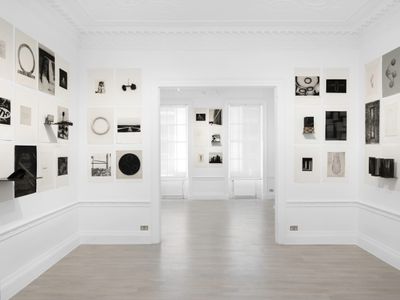
Tirelli’s display of works seems to invite viewers into a constellation of association between shapes and things—what might be the relation between geometry and form, light and dark, what is seen and unseen? Trying to map out a comprehensive view, however, is futile—the experience is immersive and all-encompassing.
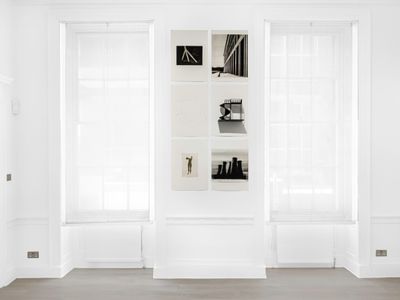
As the artist himself states, he intends ‘to activate echoes in the viewers, by immersing them in an interplay of images, symbols, and allegories, in a game of references and reflections.’
That same feeling is replicated across the two upper floor galleries as works increase in scale, through to the top floor space where a large circular black canvas with chalk drawn circular motifs is divided in half by a mirror, turning the piece into a hybridised sculpture.
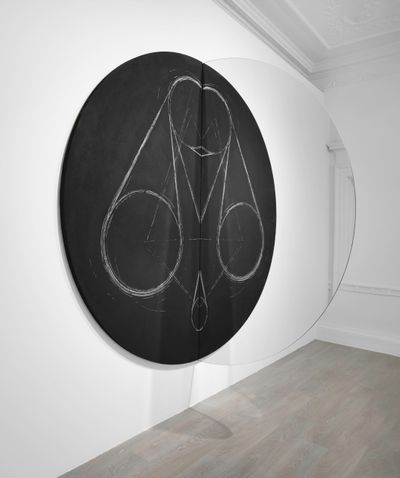
The experience recalls Poli again, in which he describes architecture expanding in Tirelli’s frames, ‘until it disappears in an illusory monochrome that envelops and embraces the viewer, creating an alienating space, a window on perception, a passageway to meditation.’
In this fragmentary constellation of things, multiple references suggest a multitude of meanings that emerge from the artist’s own private experiences. What emerges is a collective realm of free association. —[O]
Main image: Exhibition view: Marco Tirelli, Cardi Gallery, London (25 June–25 September 2021). Courtesy Cardi Gallery. © 2021 Cardi Gallery. Photo: Eva Herzog.




A respected voice in contemporary art discourse.
Focusing on ambitious storytelling and insightful art-world commentary. Ocula Magazine publishes in-depth interviews, critical essays and timely analysis on the artists, exhibitions and ideas driving the global art world.
Learn more about Ocula Magazine
Showcasing the best of the art world.
Ocula partners with galleries from around the world to highlight their artists, artworks and exhibitions. Gallery membership is by application and invitation, with each member vetted by an independent panel.
Learn more about Ocula Membership
Specialises in the sale of major artworks.
Led by a team with deep ties to the world’s leading auction houses, galleries and collectors. Ocula’s advisory team offers bespoke services to high-net-worth clients from around the world who are looking to acquire the best of contemporary and modern art.
Learn more about our team and services