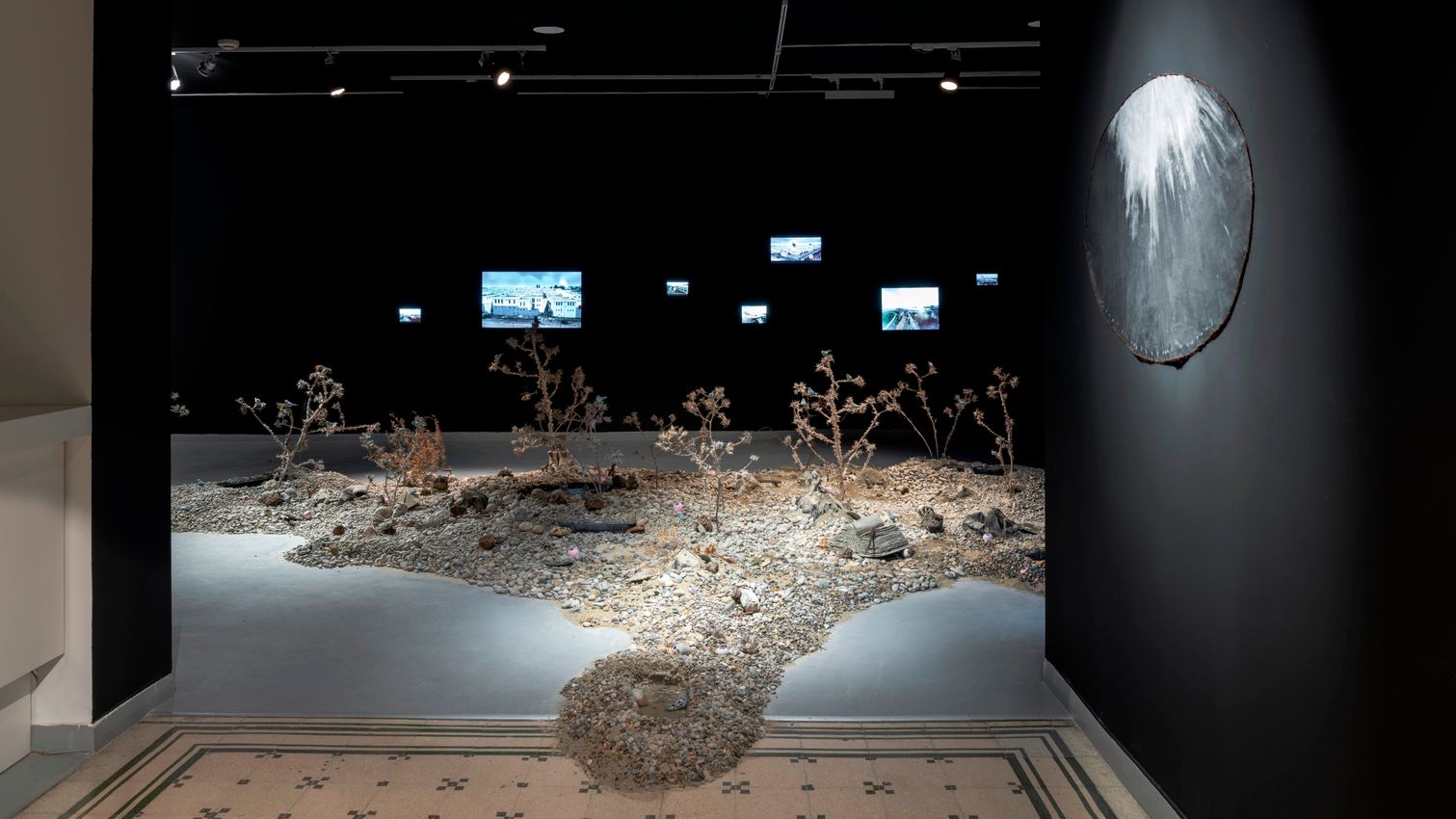
Zilberman | Berlin is delighted to announce a solo exhibition of Azade Köker: Stolon. Köker can be counted among the most remarkable sculptors of her generation. Transcending cultural and geographic boundaries, she addresses subjects ranging from historical and mythological references to issues of the present day. Over the course of several decades, her working materials have evolved from heavy terracotta to delicate paper, from stuffed bodies to empty shells. For this exhibition, the artist has created large installations using paper, wire, and light. They revolve around various questions touching on how relationships emerge, where they lead, and what is transmitted or altered within them. Such pathways intertwine on the micro- as on the macro-scale, in offshoots and nerve tracts, in thoughts and cultural traditions. They reach out in multiple directions. Semantic ambivalences and shifts open Köker’s work up to diverse interpretations. Materials, forms and significances remain in motion and enter into ever-evolving relationships.
Azade Köker borrowed her exhibition title, Stolon, from botany. A stolon is an offshoot of the mother plant that grows, not into the earth, but along the ground. From its nodes grow roots and new stems. The stolon nourishes the young plant until it is mature enough to provide itself with water and light; then dies. Reed corals also build stolon-like webs on the ocean floor, and from these new polyps emerge. Plants like corals remain tied to their place in the earth, yet extend beyond it into their surroundings. For Köker, this suggests associations with notions of sharing, branchings and life in a group. Her exhibition investigates the ambivalence of ties. They support but also grip tight. The word “hold” can mean either of these things. But things that hold are also permeable: a net consists more of holes than of knots or intersections.
Self-definition and gender, work and social ties, the entanglements of human life and nature, all belong to the spectrum of themes that have surfaced again and again in Azade Köker’s work for five decades now. In her early terracotta sculptures, we see the figure of the woman as a recurring motif – abstracted in Frau mit Schleier (Woman with Veil, 1978) and with societal-critical features in Akkordarbeiterin (Woman employed for Piece-Work, 1987), where a female worker’s fragmented body merges with machine-like elements. This sculpture turns our attention to the conditions faced by women recruited in Turkey for firms in West Berlin. Köker has worked with paper since the 1990s, and describes it as a skin, permeable and vulnerable. Crumpled and folded, it stores the traces of its making. The body itself is absent; what remains is a transparent, light shell, whose innards must be supplied by the viewer.
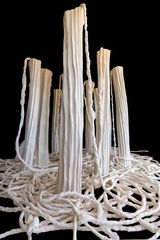
In the first room of the exhibition stands the installation Schwankende Säulen (Tottering Columns, 2025–26), a forest of thirteen tall paper columns. The paper is wound around the columns like bark, and vertical folds suggest fluting. Transparent threads attach them to the ceiling, and they move with every breath of air. From the top of each column, a long strand of twisted paper falls to the ground and intertwines with the others to form a web. The column, for Azade Köker, is a double image, trunk and figure. For a long time already, she has explored the caryatid, the female figures bearing beams in architecture. Their burden there appears all elegance and posture; the effort of weight-bearing remains invisible. Köker’s columns support no roof. At the place where a capital would normally shoulder its weight, the strand of paper growing out of the column eludes it and, like a stolon, tries to render new life possible on the floor. With this image, nurturing takes its place alongside bearing as a bodily and social work, which, while essential, often goes unnoticed. The burden has not vanished, it has only changed its form. The bearing figure has become one tied in to its neighbors: a form which supports through its relationship to others, while these relationships also tie it down.
Works made of wire and light pick up on this web. Köker uses a web of wire, such as is employed in manufacturing coops, fences, and garden elements – a material that contains und separates. The artist shapes it into synapse-like branchings, which recall the points of contact among nerve cells. The wire lends stability to fragile forms, while itself retreating into near invisibility. For strips of light traverse the room and illuminate the darkness. That which is microscopic in the body fills the space; at the same time, the structure recalls a web of offshoots, which spread out, branch off, and create new relationships.
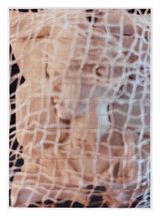
In Im Netz des Ich (In the Web of the Self, 2025–26) hangs a large ball of paper in a net of intertwined strips of paper. The ball bears a red inscription spelling “ICH” (I or ego or self). The net holds it, and holds it tight. Without the net, it would fall. Our language knows both nets – the safety net that catches and saves from harm, as well as the trap net that captures and won’t let go. Society’s net can be both. “Caught” and “Captured” here lie right next to one another. The video work Stagnant Motion (2013) shows the feet and legs of a woman from behind, as well as the red seam of her skirt. Her steps venture falteringly forward, then back and to the side, without fixing on a direction. The title names both the stagnancy and the motion, and the work leaves open the question of which prevails in the moment. The subject is not holding her ground, she is trying out, testing the ground. Stolons, too, move in this way. They do not take off running, they shift.
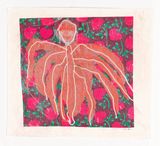
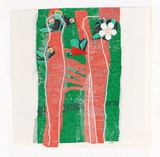
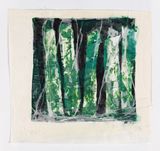
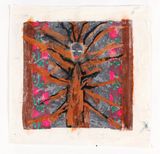
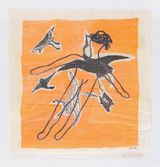
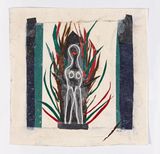
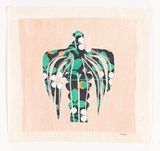
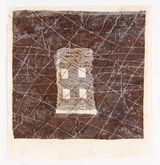
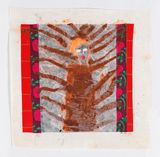
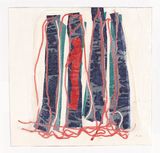
Azade Köker’s small-format collages show frontal figures constructed of patterned paper. Arms and bodies reach out in branches and roots, faces appear in the fabric, threads are loosely sewn on. Titles such as Der Spinnenbaum (The Spider Tree, 2026), Krabbenfrau (Crab Woman, 2026) and Im Flug mit den Vögeln (Flying with the Birds, 2026) associate human beings, animals, and plants. The figures are not contained within clear contours, they bleed into each other. None of the beings exists in and of itself, each one is in a state of evolution connected with others. Azade Köker’s exhibition shows a body of work in motion. Every form is held and tied in – but by what it is often hard to see. The forms do not end on their edges, but reach out, like steps that explore the floor, or offshoots that keep growing.
Azade Köker (*1949, Istanbul), after completing her studies at the Istanbul State Academy of Fine Arts, came to West Berlin in the 1970s to study at the Hochschule der Künste there. Starting in the 1980s, she participated in numerous exhibitions and fulfilled commissions for works of public sculpture, among them the fountain on Cuvrystrasse in Berlin in 1983/84. Her first major solo exhibition in Berlin took place at the Kunstamt Kreuzberg in Bethanien in 1984, followed in 1990 by her solo exhibition Plastiken. Erde und Stein (Sculptures. Earth and Stone) at the Georg Kolbe Museum. As professor, Köker taught from 1995 to 2003 at the at Burg Giebichenstein University of Art and Design in Halle, and from 2003 to 2015 at the Institute for Architecture-Related Art at Technische Universität Braunschweig. Her works can be found in public collections including the Los Angeles County Museum of Art, the British Museum, the Istanbul Modern, the Berlinische Galerie, the Deutscher Bundestag, and the MMK Museum für Moderne Kunst in Frankfurt am Main. In 2026, she participated in the Manifesta 16 Ruhr, as well as the exhibition Labouring Bodies in the Museum Tinguely in Basel, where the work Akkordarbeiterin (Woman employed for Piece-Work) can be seen in terracotta; the Gropius Bau is showing a bronze version of the same work this year. Azade Köker lives and works between Istanbul, Bodrum, and Berlin.
Press release courtesy Zilberman, Istanbul/Berlin. Text: Lotte Laub. Translation: Darrell Wilkins.
Azade Köker’s earlier works are mainly concerned with identity and belonging. The artist proposes hybridity as an inevitable survival mechanism, which is achieved through a subjectivity based on discrepancy, transparency and vulnerability. In her later works, nature is negotiated as a cultural construct. She creates images of nature inhabited by traces of human intervention, which she then deconstructs by a repeating pattern on the surface. Through this layering and reworking of the surface, she disrupts the perfection and legibility of the represented image and comments on the possibilities of paintings.


Zilberman, founded in Istanbul in 2008, stages 10–12 exhibitions every year in its gallery spaces in Istanbul and Berlin. The gallery occupies two separate floors of Mısır Apartment, one of the most famous examples of art nouveau architecture in Istanbul.
A respected voice in contemporary art discourse.
Focusing on ambitious storytelling and insightful art-world commentary. Ocula Magazine publishes in-depth interviews, critical essays and timely analysis on the artists, exhibitions and ideas driving the global art world.
Learn more about Ocula Magazine
Showcasing the best of the art world.
Ocula partners with galleries from around the world to highlight their artists, artworks and exhibitions. Gallery membership is by application and invitation, with each member vetted by an independent panel.
Learn more about Ocula Membership

Specialises in the sale of major artworks.
Led by a team with deep ties to the world’s leading auction houses, galleries and collectors. Ocula’s advisory team offers bespoke services to high-net-worth clients from around the world who are looking to acquire the best of contemporary and modern art.
Learn more about our team and services