






Michael Ho in the Studio
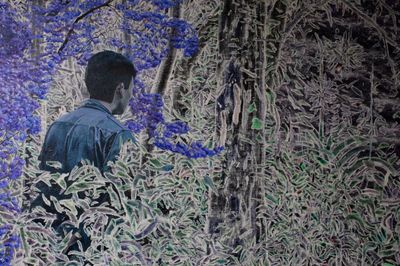
Michael Ho, Feeling for Answers (2023). Oil and acrylic on canvas. 220 x 340 cm. Photo: William Waterworth.


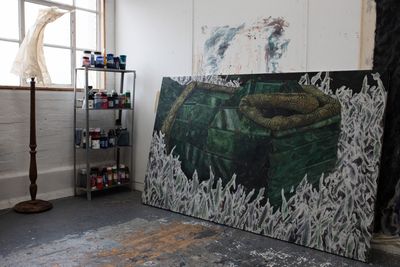
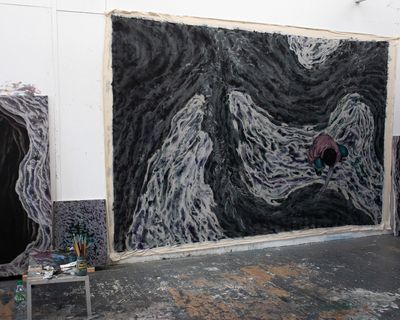
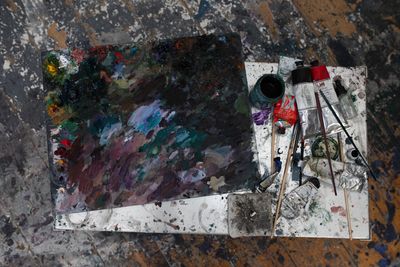
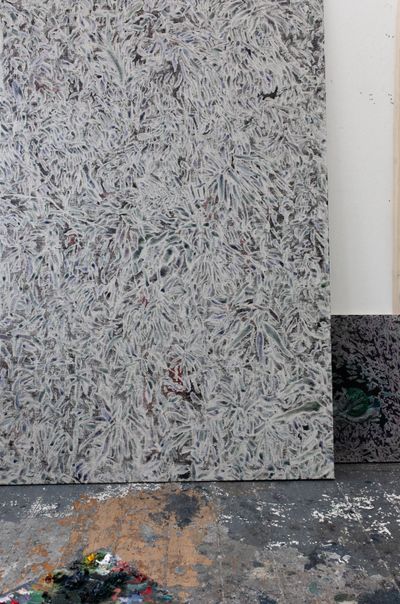
Painting on the back of the canvas, Michael Ho‘s textured compositions depict fictional, fragmented spaces in an unusual palette of violet, emerald, black, grey, and white.
Ho, a second-generation immigrant from China raised in Germany, makes work rich in narrative and personal identity that considers the mechanics of cultural assimilation.
Ahead of the London-based artist’s solo show at Gallery Vacancy in Shanghai, curator Robert Spragg speaks to Ho about cultural mismatches, the artist’s laborious experimental techniques, and the future of his multidisciplinary practice.

Could you tell me about your upbringing?
I grew up in a small town in Germany called Gevelsberg. My parents emigrated from Wenzhou, China to Europe in the 1990s, so most of my childhood was spent in Germany.
I grew up bilingual. My parents spoke Wenzhounese to me and I learnt German through my surroundings. I remember communicating with body language for a while. At my friends’ homes, for example, I would signal to their parents that I was hungry by rubbing my stomach. By primary school, I could speak German fluently.
What is the importance of assimilation to your work?
Assimilation is at the core of my practice. Growing up in Germany, I never felt truly German or truly Chinese. Questions of home and belonging were blurred and difficult for me to answer. When asked where I was from, I wondered whether they were asking me where I’m from ethnically, or where I grew up. It raised many internal questions.
Being queer complicated the question of belonging further, bringing me to a point where I felt homeless. Somehow, I found a sense of belonging in this in-between space. Conceptually speaking, home for me is now within that liminal space, which is what I’m exploring and visualising, particularly through my painting practice.
Thinking about spatiality, when did you realise you were interested in architecture?
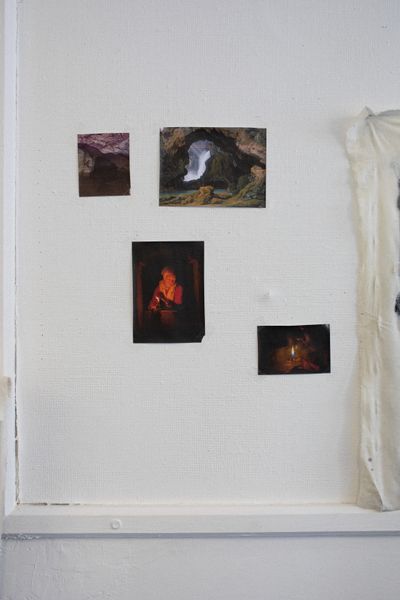
I had an interest in architecture from a young age when my school encouraged us to think about our career paths. I always wanted to create art but architecture seemed like a more ‘serious’ profession. I didn’t know that you could make a real career in art back then.
Growing up, I wasn’t exposed to a lot of art. It was only when I came to England that I engaged with art, both conceptually and physically.
You once said, ‘art allows you to ask open questions, whereas architecture is about finding solutions and answers’. Could you expand on that?
Architecture is an education that was really provocative and formative for my practice. At the Architectural Association in London, we almost weren’t taught how to build buildings. You tend to learn that when you work for a practice.
As an education, architecture is very broad and equips you with many useful skills. You research a lot. You learn how to formalise an argument and how to convince people of the strength of your concept. In that sense, it was very helpful for art, as an artist you’re doing that as well: formulating concepts which are believable, for other people to believe in.
Do you think not studying art, then, has been positive for the development of your work?
When you study something else, you think more laterally, and you’re prone to make mistakes. It’s key to make mistakes and to learn from them to push forward. Sometimes if you’re too trained, you follow a linear path and it doesn’t produce something new.
I came to painting not knowing anything about the medium. I started to paint during the Covid-19 pandemic with my former working partner Chiyan Ho [who passed away in 2022]. We spent a year exploring and making sculptures, clothes, poetry, and video works.

When everything shut down in 2020, the only thing we had in the studio was this cheap Ikea fabric. We started painting on it with oil paint, not knowing that we had to prime the canvas beforehand.
The first painting we made was terrible, so we decided to flip it over because we didn’t want to look at it and then we saw the paint bleeding through. We noticed the interesting textures that the paint created at the back of the canvas.
Shortly after, we experimented, developed, and refined the technique, swapping oil for acrylic which dries quicker but also made sense for conservation purposes.
What were you painting at that time?
During our degree, we used Photoshop to make collages. We began researching diasporic narratives, having both been brought up in Western contexts with Asian heritage. We felt we’d stumbled upon something we could really explore for the rest of our lives.
The beauty is that I’ll never be able to answer it. The point is just to reflect on it and find more perspectives. The more I do, the fuller the picture gets.
Can you talk about your film Echoes from the Void (2022) and how it feeds into your paintings?
Echoes from the Void (2022) emerged from an open call from Film and Video Umbrella in London. When we wrote the brief, there was a lot of anti-Asian stigma and we wanted to comment on it.
The film examines the game of Chinese whispers, which, of course, already has inherent racist tendencies in the name itself. In the film, I’m performing, shouting conspiracy theories about the origin of Covid-19 in China. As the film developed and Covid-19 started to disappear, the concept shifted consequently.
The film reflects on how misinformation is produced and consumed in the digital media age, and how truth and falsehood are blurred—they are shouted into caves and forests and echo out.
You have two upcoming shows, a group show—New Moroism (31 May–9 September 2023)—at White Cube Hong Kong and a solo show at Gallery Vacancy in Shanghai opening in July. The cave is a central subject of the Shanghai show—how does the cave function in your work?
The show at Gallery Vacancy is titled ‘Grotto Heavens’, which in Chinese is Dòngtiān, which refers to sacred Taoist sites. In Chinese mythology, there is a concept of the Eight Pillars of the Sky, which are a group of mountains.
They were thought to hold apart the earth and the sky (or heaven) as if they were ladders allowing travel between the two. Within the mountains, interior worlds are made out of grottos and caves, which are seen as a mirror of the heavens.
I like the idea that the cave is a portal to the other side. With Chiyan’s passing, I see the paintings more than ever situated in a liminal space. Chiyan also started to appear in one of the paintings. Somehow it just felt right and I thought of it as the first re-encounter.

What do you think of the relationship between your use of caves, which are porous, and portals from which things come from, and the jade burial suit, which is hermetically sealed?
In both Buddhist and Daoist thinking, the idea of impermanence is key. Often we think of rocks or mountains as very fixed, but in actual fact, they are constantly changing. Even if solid, they just follow a different timescale.
The jade burial suit does the reverse by protecting the body from decay and change. Interestingly enough, jade burial suits were placed in mountains. They existed as myths until the first one was discovered in the 1960s, turning the myth into reality.
How does your practice approach the depiction of East Asian figures in contemporary painting?
Part of the reason I started to paint was to think about the depiction of East Asian figures in contemporary painting. I introduced characters in my paintings like Dr. Fu Manchu, a fictional villain character in Sax Rohmer’s novels, which I used as the protagonist for my solo presentation Tryst at Frieze London (12–16 October 2022) with Gallery Vacancy.
The character was Rohmer’s attempt to depict someone oriental as this monstrous supervillain, which leads to the discussion around Sinophobia. There was a feeling of anti-Asian stigma and a resurgence of ‘Yellow Peril’ while I was researching during the Covid-19 pandemic.
Later on, I became interested in the complexities around the sexuality and queerness of Dr. Fu Manchu that arose in films such as The Mask of Fu Manchu (1932), which contained many homoerotic moments. Even the depiction of Dr. Fu Manchu himself seemed very camp, with his long fingernails and make-up.
Main image: Michael Ho, Feeling for Answers (2023). Oil and acrylic on canvas. 220 x 340 cm. Photo: William Waterworth.

A respected voice in contemporary art discourse.
Focusing on ambitious storytelling and insightful art-world commentary. Ocula Magazine publishes in-depth interviews, critical essays and timely analysis on the artists, exhibitions and ideas driving the global art world.
Learn more about Ocula Magazine
Showcasing the best of the art world.
Ocula partners with galleries from around the world to highlight their artists, artworks and exhibitions. Gallery membership is by application and invitation, with each member vetted by an independent panel.
Learn more about Ocula Membership
Specialises in the sale of major artworks.
Led by a team with deep ties to the world’s leading auction houses, galleries and collectors. Ocula’s advisory team offers bespoke services to high-net-worth clients from around the world who are looking to acquire the best of contemporary and modern art.
Learn more about our team and services