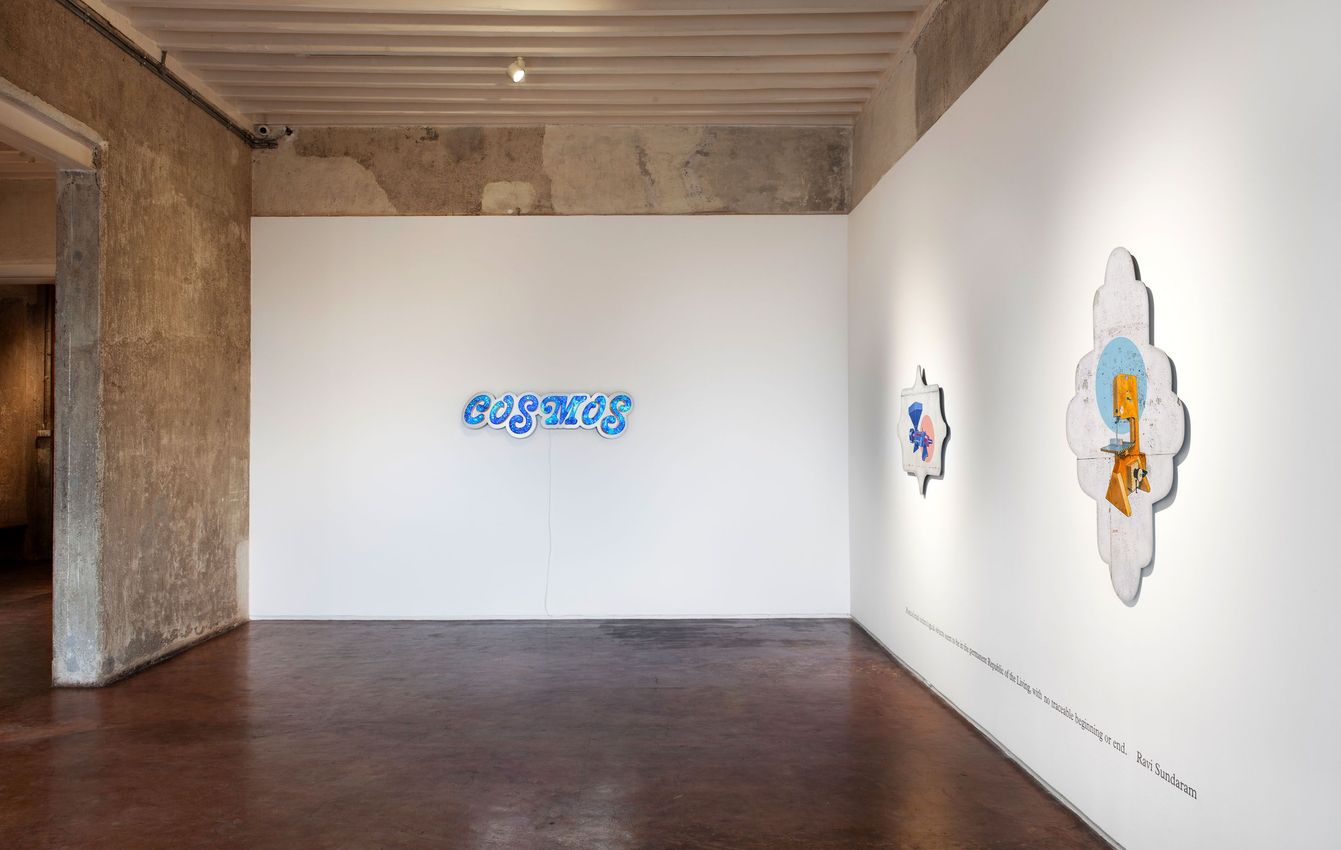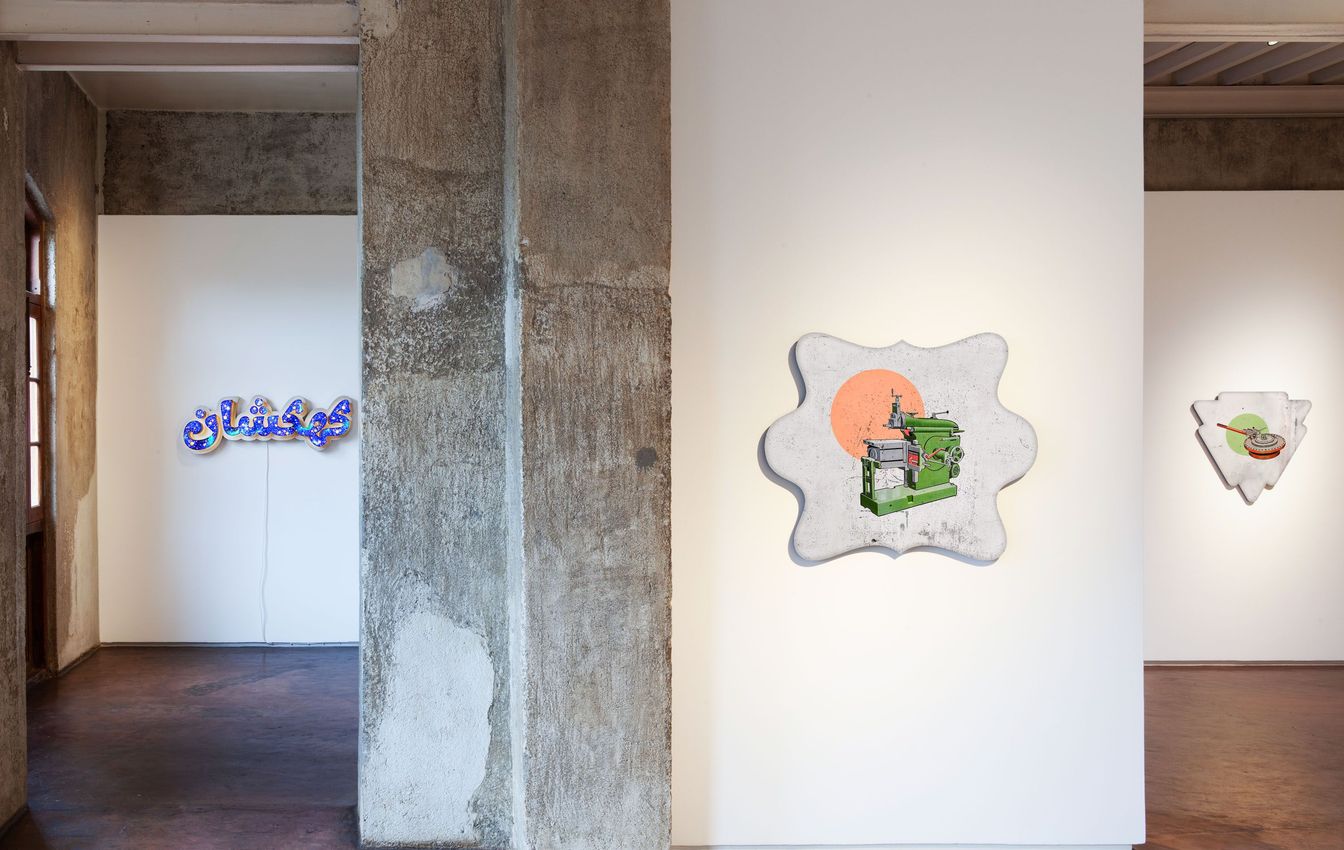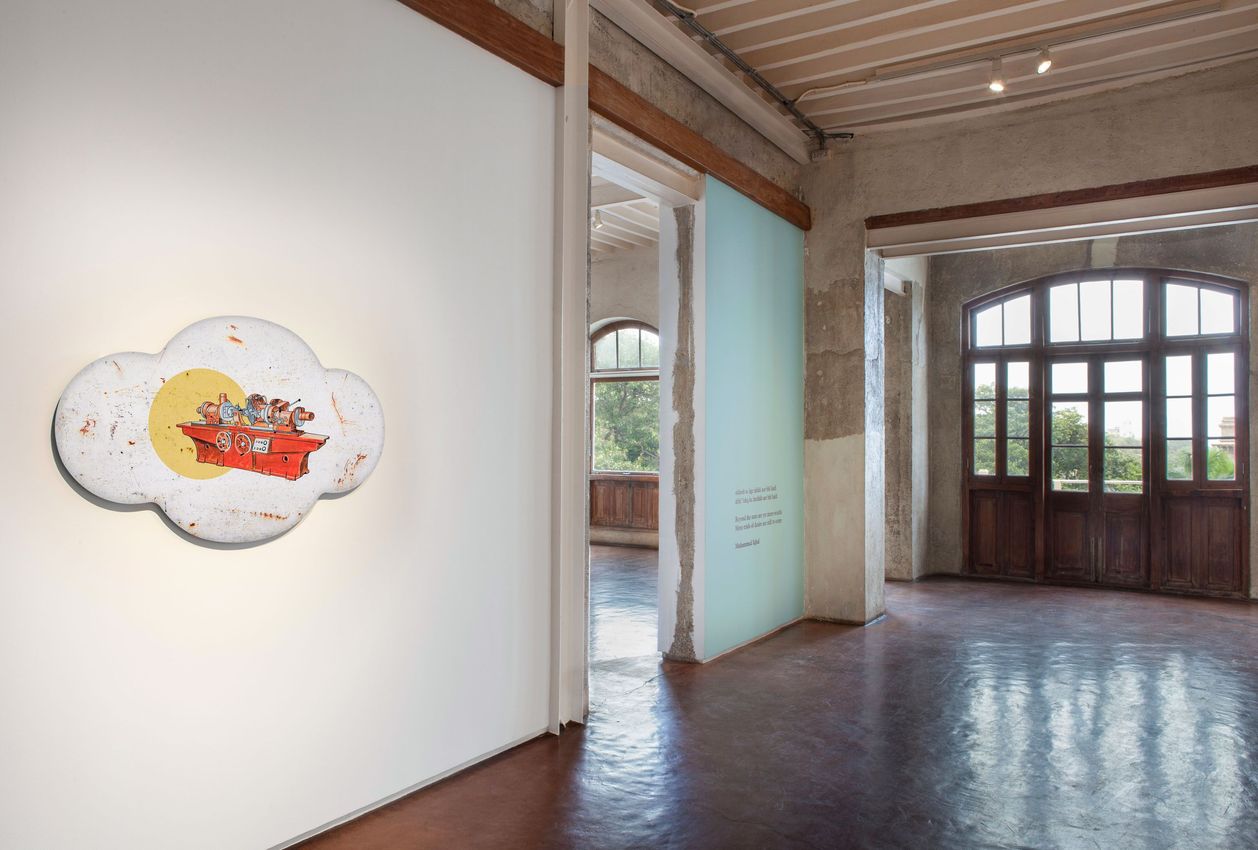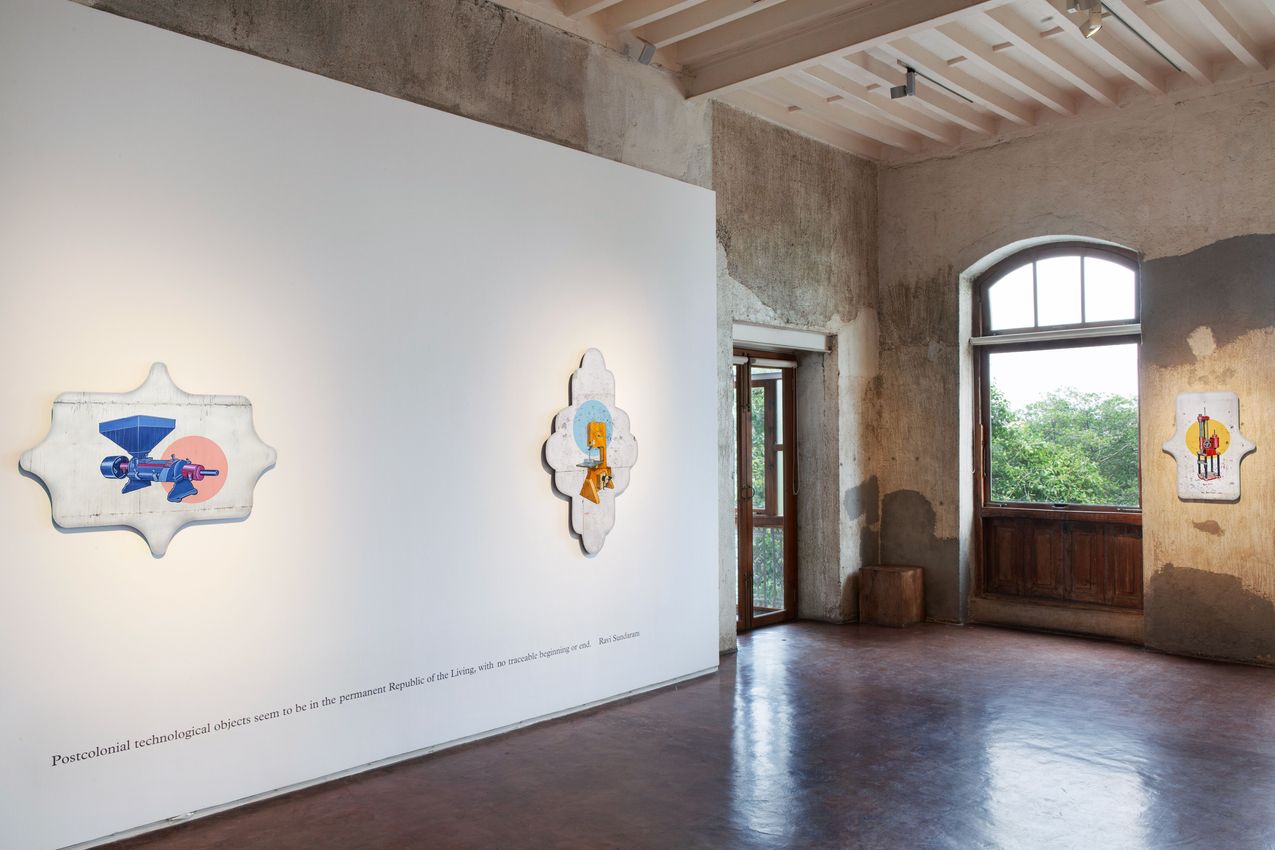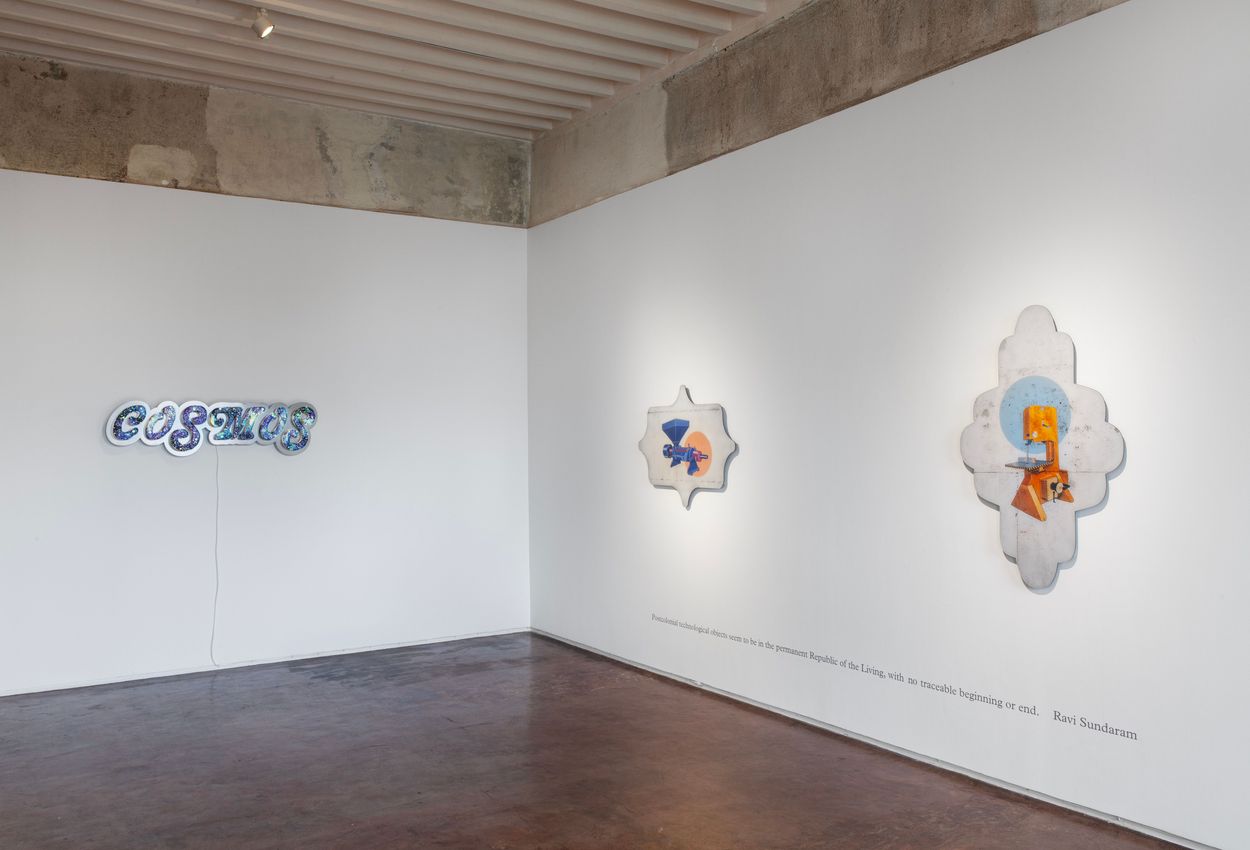
Elizabeth and Iftikhar Dadi’s new work merges ideas that are often treated as opposites: the mysteries of creation and the practical work of manufacturing; useful objects and decorative forms; the polished appearance of the new and the traces of time left behind by forms of production that have faded from view in the post-industrial world but remain active, often invisibly, within the informal economies of the Global South. The series consists of glossy diasec prints depicting machines isolated against circular fields of color. The prints themselves are shaped like ornamental forms, immediately bringing together the mechanical and the decorative.
At first glance, this pairing of machines and ornament recalls a longstanding debate in art history about the relationship between function and decoration. Yet the works do more than simply reference this familiar tension. Instead, they expose the limits of the opposition itself. The distinction between function and ornament often obscures the fact that both useful forms and decorative forms emerge through processes of production, many of which involve machines. In this sense, function and ornament are not opposites so much as different outcomes of the same fundamental act: creation.
By placing machines at the center of each image, the Dadis suggest that machines belong to neither side of this divide. As instruments through which forms come into being, machines are equally responsible for the production of both utility and ornament. If machines stand prior to this basic foundational distinction, they also unsettle a whole series of related oppositions that have shaped cultural and aesthetic values: structure and surface, truth and artifice, rationality and sensuality, economy and luxury, modernity and tradition, industry and craft. These categories have never been neutral. Historically, they have helped determine what societies choose to value and what they choose to overlook or denigrate. The works in this exhibition ask us to reconsider the assumptions built into such binary ways of thinking.
In this respect, Cosmos enters into a rich artistic tradition concerned with machines, readymades, and mechanized forms. From Futurism’s celebration of speed and technology, to modernist abstraction’s engagement with industrial forms, to postwar explorations of the uncanny relationship between human and machine bodies, artists have long turned to the machine as a subject of fascination. The Dadis contribute something distinctive and original to this tradition. Through the image of the machine, they investigate the very idea of value itself—both in its worldly, secular dimensions and in its more transcendent or spiritual ones.
Each print depicting a machine bears the name of a star. These titles suggest an important question: do the star names point toward the grandeur of human aspiration, or toward the hubris of imagining ourselves capable of mastering the cosmos? At the same time, the act of naming the stars is itself a human gesture, an attempt to create meaning in a universe that remains indifferent to our systems of significance. The wonder and mystery associated with the cosmos thus become a way of thinking about earthly forms of world-making and historical change.
Even the most basic necessities of life—food, shelter, clothing—depend upon acts of creation. Digitization and its forms of abstraction, too, depend on machines. Human beings continually transform the world in order to meet their needs. Seen from this perspective, the machine becomes a mediating figure linking Creation in the cosmic sense with creation in the human sense. It stands between the ongoing formation of the universe and the making of social, political, and economic worlds. The machine becomes a bridge between the divine and the everyday.
This is one reason the machines in these works possess a distinctly surreal quality. Like surrealist images, they interrupt habitual ways of seeing and understanding. No longer taken for granted or rendered invisible along with the people who would operate them, these machines appear as objects of contemplation and even reverence. They signify something beyond their immediate function. They point toward the condition that makes all value possible: the capacity to create. From this perspective, values that often seem separate—economic, ethical, political—can be understood as aspirations toward a larger cosmological significance. They present themselves not only as products of human activity but also as expressions of a much broader order of existence. In a striking surrealist gesture, the series reveals how machines—assemblages of grease, metal, gears, and pistons—can also be understood as temporary and aspirational links to infinity.
The two LED signs displaying “Cosmos” and “Kehkashan” in English and Urdu may initially appear distinct from the rest of the works, yet they provide an important grounding for the exhibition as a whole. They locate its philosophical and art-historical concerns within the familiar visual language of the street. One could easily imagine such signs in Mumbai or Dhaka, but their aesthetic belongs more broadly to the vernacular visual culture of cities throughout the Global South. At the same time, these signs draw attention to the exhibition’s engagement with Pop Art.
The glittering sensorium of advertising and mass culture, which was so central to Pop Art’s challenge to the boundary between everyday life and high art, is put to critical use here. The machines appear in intensely saturated, jewel-like colors that are heightened by the reflective surfaces of the diasec prints. Yet rather than reducing the machines to simplified or cartoonish images, this treatment makes them appear even more vivid and compelling.
Part of this effect comes from the attention paid in the images to the smallest of mechanical details. Equally important, however, is the visual tension between the polished surfaces of the artworks and the distressed markings enclosed within them. Scratches, stains, and marks appear throughout the images. In works such as Zaurak, Talitha, and Alsafi, rust-colored traces evoke the passage of time. Across the series, such marks appear almost accidentally, as residues of production itself. In Tureis, for example, it is not clear if the marks are the byproduct of mechanical processes or the result of water and age becoming absorbed into the image over time as its patina. Perhaps this distinction is also an unstable one, since both processes unfold in time and point to slightly different kinds of inevitability.
Whether they signal the effects of time or the contingencies of production, these marks sit uneasily beneath the glossy surfaces that enclose them. The works seem to resist the temptation to take shine at face value. Instead, they encourage viewers to understand gloss as only one moment within a larger process of making and unmaking. Like the machines they depict, these artworks, too, live in time. The traces visible beneath the polished surface point toward another mystery associated with the cosmos: entropy. Entropy names the gradual and often unpredictable movement toward disorder that unfolds over time, sometimes as the result of a process of creation itself. The effects of entropy can be seen in the slow deterioration of whatever has been made, whether by nature or by human beings. Just as the social, economic, and political worlds we build are subject to decay and transformation, so too are the stars themselves. They eventually dim.
The works therefore offer a reflection on wear and tear that is at once everyday and cosmic in scale. The lesson is a simple but profound one: everything that is created exists within time and is subject to changes initiated through a melding of its own internal processes and larger cosmic processes. What better image to convey this truth than the machine—an object built to produce new worlds, yet itself destined to age, erode, and transform?
Zahid R. Chaudhary, 2026
Professor of English, Princeton University
Iftikhar Dadi & Elizabeth Dadi have collaborated in their art practice for over twenty years. One focus of their work is on questions of memory, borders, and identity in contemporary globalization. Another trajectory engages with the productive and creative capacities of urban informalities in the Global South. They draw from diverse archival, art historical, and media references, and work across a variety of mediums.
Jhaveri Contemporary was formed in 2010 by sisters Amrita and Priya with an eye towards representing artists, across generations and nationalities, whose work is informed by South Asian connections and traditions. The gallery’s dedication to original scholarship, engendered through its carefully crafted shows, is one of the many ways it distinguishes itself. Entwined with this philosophy is another guiding principle: showcasing the heterogeneous practices of long-celebrated luminaries as well as emerging talents, often in generously interrogative conversations. With a focus on mining lesser-known art histories, Jhaveri Contemporary facilitates dialogue between artists, curators and historians to add to the wider field of art. Estates served by the gallery include Mrinalini Mukherjee and Anwar Jalal Shemza.

A respected voice in contemporary art discourse.
Focusing on ambitious storytelling and insightful art-world commentary. Ocula Magazine publishes in-depth interviews, critical essays and timely analysis on the artists, exhibitions and ideas driving the global art world.
Learn more about Ocula Magazine
Showcasing the best of the art world.
Ocula partners with galleries from around the world to highlight their artists, artworks and exhibitions. Gallery membership is by application and invitation, with each member vetted by an independent panel.
Learn more about Ocula Membership

Specialises in the sale of major artworks.
Led by a team with deep ties to the world’s leading auction houses, galleries and collectors. Ocula’s advisory team offers bespoke services to high-net-worth clients from around the world who are looking to acquire the best of contemporary and modern art.
Learn more about our team and services