





Salman Toor’s Visual Autofiction
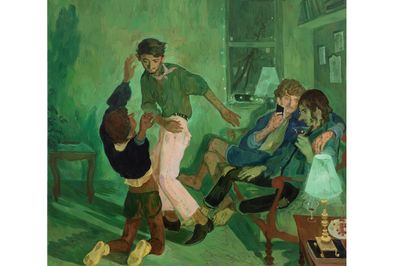
Salman Toor, Four Friends (2019) (detail). Oil on panel. 101.6 × 101.6 cm. Collection of Christie Zhou. Courtesy the artist.



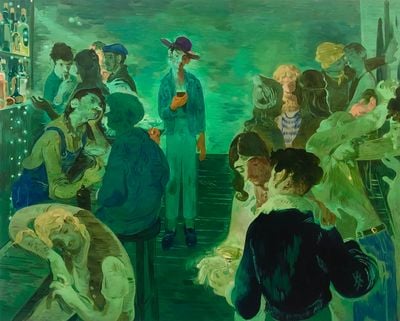
In Bar Boy (2019), a phone’s luminescence lights up the face of a loose-limbed South Asian man.
Described by Toor as ‘marionettes’, his figures have an ethereal air, ready to drift from the canvas to elsewhere. That’s part of the point. Toor orchestrates intimate moments with groups and small clusters of these figures to reflect on imagined lives and habits of queer South Asian men, crafting a transnational identity.
These gangly figures are often caught in a vortex of time, where references from art history assimilate into contemporary settings. Toor references a catalogue of Old Masters, sampling the qualities of Peter Paul Rubens and Anthony van Dyck, among others, and remixes them with modern Pakistani and Indian artists like Bhupen Khakhar and Amrita Sher-Gil.
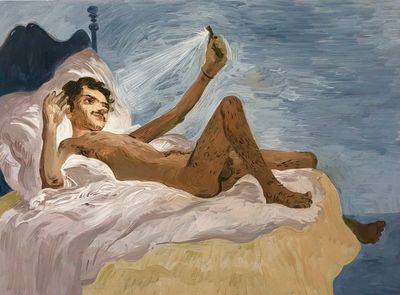
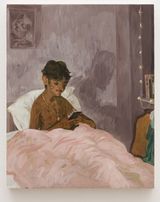
Bedroom Boy (2019) updates and inverts the reclining nude tradition by putting a queer South Asian man centre stage. The painting boasts thick, lavish brushstrokes adding a Rococo opulence and his sensitivity to this moment of 21st-century pleasure.
Toor has honed his ability to empathetically depict the nuances of diasporic life as a queer South Asian man. Man with Face Creams and Phone Plug (2019) is a bleak portrait capturing an over-the-counter moment at immigration.
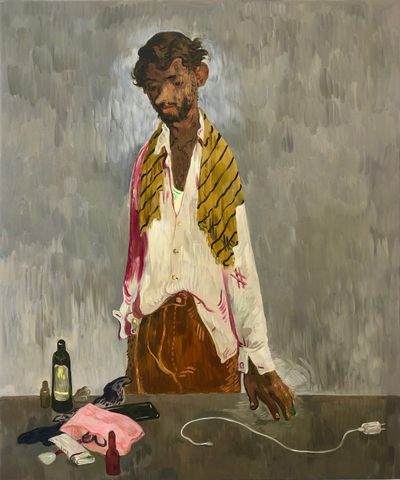
With the contents of his toiletry bag discourteously splayed across the desk, the man looks understandably dejected. As if seen through the eyes of the officer, his ragtag clothing with a patched-up tear plays up to assumptions and the place that South Asian men entering the U.S. are given.
“Toor evokes the interchangeable feelings of inclusion and exclusion felt by his figures.
Toor’s paintings might be contingent on these figures. He puts them, quite literally, in the limelight, but they at once find themselves on the fringes, perambulating scenes of frivolous activity. Bar Boy (2019) is cast under Toor’s vicious green light. As he has said, it’s a venomous yet inviting colour that lends his scenes ambience. In this bar full of lusty embraces, writhing figures packed in against the walls, shooting each other longing looks of desire, the protagonist is isolated.
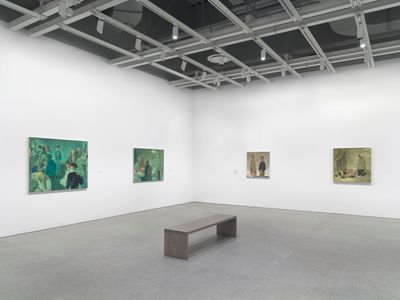
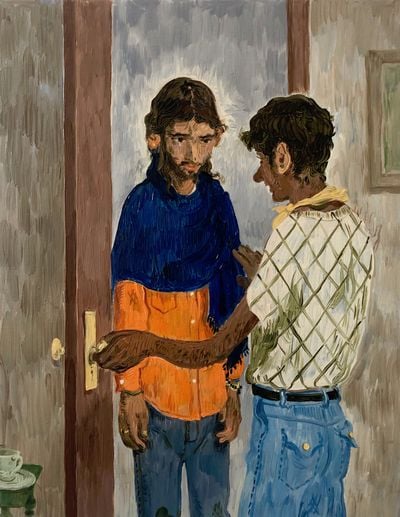
It’s similar in Tea (2020), where a cosy domestic scene is given an uneasy edge by a hovering, faint figure. He stands alone while a family group sit preoccupied with a fleshy bowl of fruit. Their sharp knives are poised, ready to dive into the fruit. The scene is hostile and dour. The male’s vulnerability and exclusion from the group is only echoed by his green washed face, which regresses into the background.
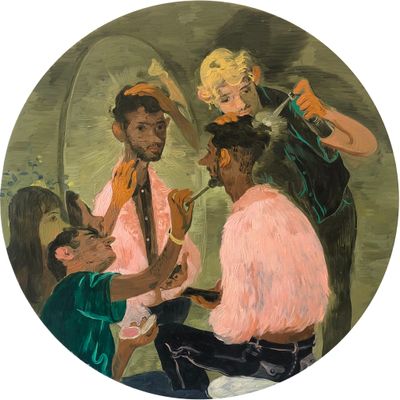
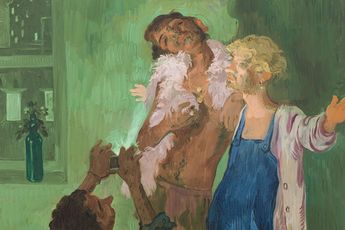
Do Toor’s figures ever become fully empowered? Even The Star (2019), a figure who is, as Toor describes, being tended to and being made ‘his best self’, emits a low-level sadness.
The preening of his hair and painting of his face does not conceal the man’s disquiet. His close grip on his phone suggests there’s an image he’s trying to replicate or perhaps he’s preparing for a selfie. Either way, he’s part of a trade of idealised images and is quite possibly putting himself into circulation. There are parallels to be drawn within Toor’s practice as a whole.
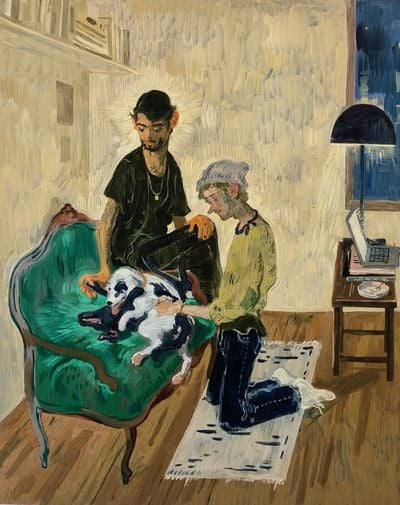
Toor is an artist inserting underrepresented male figures into an art canon preoccupied with white, straight men. With an opulent aesthetic where paint is used in excess, brushstrokes frolic in abundance, and figures are lithely, delicate, and euphoric, Toor evokes the interchangeable feelings of inclusion and exclusion felt by his figures. —[O]
1 Ambika Trasi, ‘The Self as Cipher: Salman Toor’s Narrative Paintings’, Whitney Museum of American Art, Accessed 16 December 2020, https://whitney.org/essays/salman-toor-self-as-cipher
Main image: Salman Toor, Four Friends (2019) (detail). Oil on panel. 101.6 × 101.6 cm. Collection of Christie Zhou. Courtesy the artist.







A respected voice in contemporary art discourse.
Focusing on ambitious storytelling and insightful art-world commentary. Ocula Magazine publishes in-depth interviews, critical essays and timely analysis on the artists, exhibitions and ideas driving the global art world.
Learn more about Ocula Magazine
Showcasing the best of the art world.
Ocula partners with galleries from around the world to highlight their artists, artworks and exhibitions. Gallery membership is by application and invitation, with each member vetted by an independent panel.
Learn more about Ocula Membership
Specialises in the sale of major artworks.
Led by a team with deep ties to the world’s leading auction houses, galleries and collectors. Ocula’s advisory team offers bespoke services to high-net-worth clients from around the world who are looking to acquire the best of contemporary and modern art.
Learn more about our team and services