The art world in focus
Subscribe to our newsletter for news and insights on artists, galleries and exhibitions.
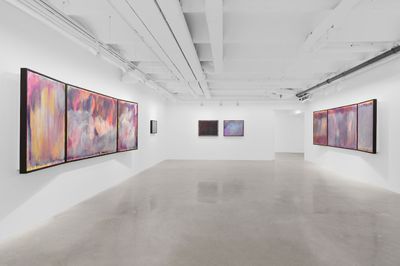
Exhibition view: Thu-Van Tran, In spring, ghosts return, Almine Rech Tribeca, New York (7 May–15 June 2024). Courtesy Almine Rech. Photo: Thomas Barratt.
Born in Ho Chi Minh City in 1979, four years after the Vietnam War ended, the artist migrated to France with her family as a refugee at the age of two. Although Tran made her home in Paris and was nominated for France’s most prestigious visual art award, the Marcel Duchamp Prize, in 2018, her country of birth remains central to her practice.
During her studies at the Ecole Nationale Supérieure des Beaux-Arts in Paris, Tran began to develop her own language rooted in exploring social and historical issues. Considerations of war and colonisation have consequently permeated her wide-ranging practice, which spans painting, sculpture, video, and installation.
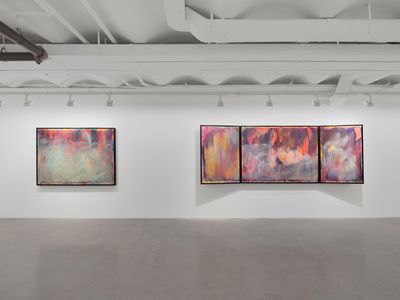
Showing at Almine Rech Tribeca, New York, until 15 June, Tran’s solo show, In spring, ghosts return, continues her investigations into Vietnamese history. Central to the exhibition is the series ‘Colors of Grey’ (2012–ongoing), which references the Rainbow Herbicides used by the U.S. military in Vietnam between 1961 and 1971 to clear jungles and expose enemy soldiers. More than 19 million gallons of chemical compounds with cancer-causing residues were sprayed, with massive human health implications.
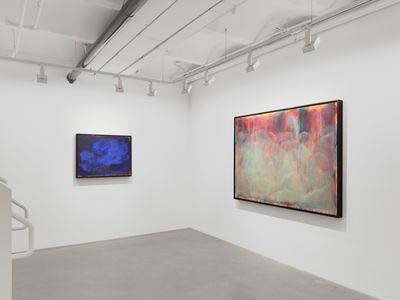
Each painting in the ‘Colors of Grey’ series takes its cue from these deadly compounds. Their compositions mirror the U.S. military’s semantic gaslighting in concealing danger behind the benign phrasing ‘Agent’ in tandem with a colour—most famously Orange. Previously installed as a series of frescoes along the upper wall of Carnegie Museum’s sculpture hall, the series takes on a more intimate format at Almine Rech, where visitors can observe the individual shades dissipating within clouds of grey, hinting at the underlying menace.
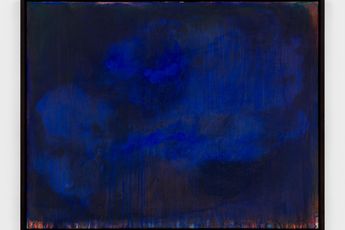
Take the bright cerulean of Colors of Grey (2024), in which visible drips of acrylic paint along the edges of the canvas attest to an intentional act of erasure. For Tran, this process replicates and attempts to clear the contamination of warfare and colonialism and the human and ecological damage. ‘My mind was haunted by the first act of ecocide on earth and our collective imagination remembers the American aviation flying over the millenary forests of Vietnam to drop dioxins,’ the artist told Surface Magazine ahead of her show opening.
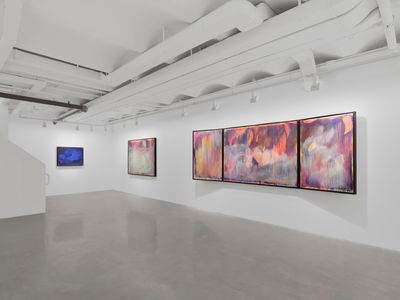
Tran’s paintings, arranged in a horizontal line at window height, nod to the immersive panoramas that served as a popular storytelling medium, particularly during the 19th century, when they were used for various purposes, from spreading wartime propaganda to perpetuating Orientalist stereotypes. While engaging with the medium, Tran favours abstraction to hint at the collapse in understanding that occurs when we neglect to account for another’s perspective. Tran’s works convey the history of Vietnam through a process that, albeit evading violence, is no less impactful in its messaging. —[O]
A respected voice in contemporary art discourse.
Focusing on ambitious storytelling and insightful art-world commentary. Ocula Magazine publishes in-depth interviews, critical essays and timely analysis on the artists, exhibitions and ideas driving the global art world.
Learn more about Ocula Magazine
Showcasing the best of the art world.
Ocula partners with galleries from around the world to highlight their artists, artworks and exhibitions. Gallery membership is by application and invitation, with each member vetted by an independent panel.
Learn more about Ocula Membership
Specialises in the sale of major artworks.
Led by a team with deep ties to the world’s leading auction houses, galleries and collectors. Ocula’s advisory team offers bespoke services to high-net-worth clients from around the world who are looking to acquire the best of contemporary and modern art.
Learn more about our team and services