






Raque Ford’s Aesthetics of the Aftermath
Danielle Ezzo considers the accumulation of forms and feelings in the bold but softly reciprocal work of Raque Ford at Greene Naftali, New York. Save to My Ocula

Lining the walls of Greene Naftali’s upstairs gallery are black paper monotype prints marked with silhouettes of daisies, alongside repurposed checkerboard dance floors—all adorned with scrapes, scrawls, and laser-cut words. To the right, several small receipt printers spewing forth coils of paper are displayed on pedestals spray-painted with vivid greens, oranges, and blacks, their hastily rendered signage insisting on the terms of sale: ‘Only $5’.
At first glance, what might seem most recognisable about American artist Raque Ford’s exhibition The Barkeeper’s Friend (1 July–8 August 2025) are her graphic motifs: the familiar form of the 1970s flower power daisy appears in Photocopy Dream I – section one (Brooklyn) (2023–25) and is repeated throughout the exhibition. Despite her use of simple emblems and glossy, seemingly shallow surfaces, Ford’s work resists flattening. Look past the industrial materials, such as laser-cut acrylic, to notice more fragile and exposed elements, unmediated by glass and subtly marked with the patina of human touch. This goes beyond what the materials would suggest unaltered, and alludes to a more personal narrative articulated in their wear and tear.




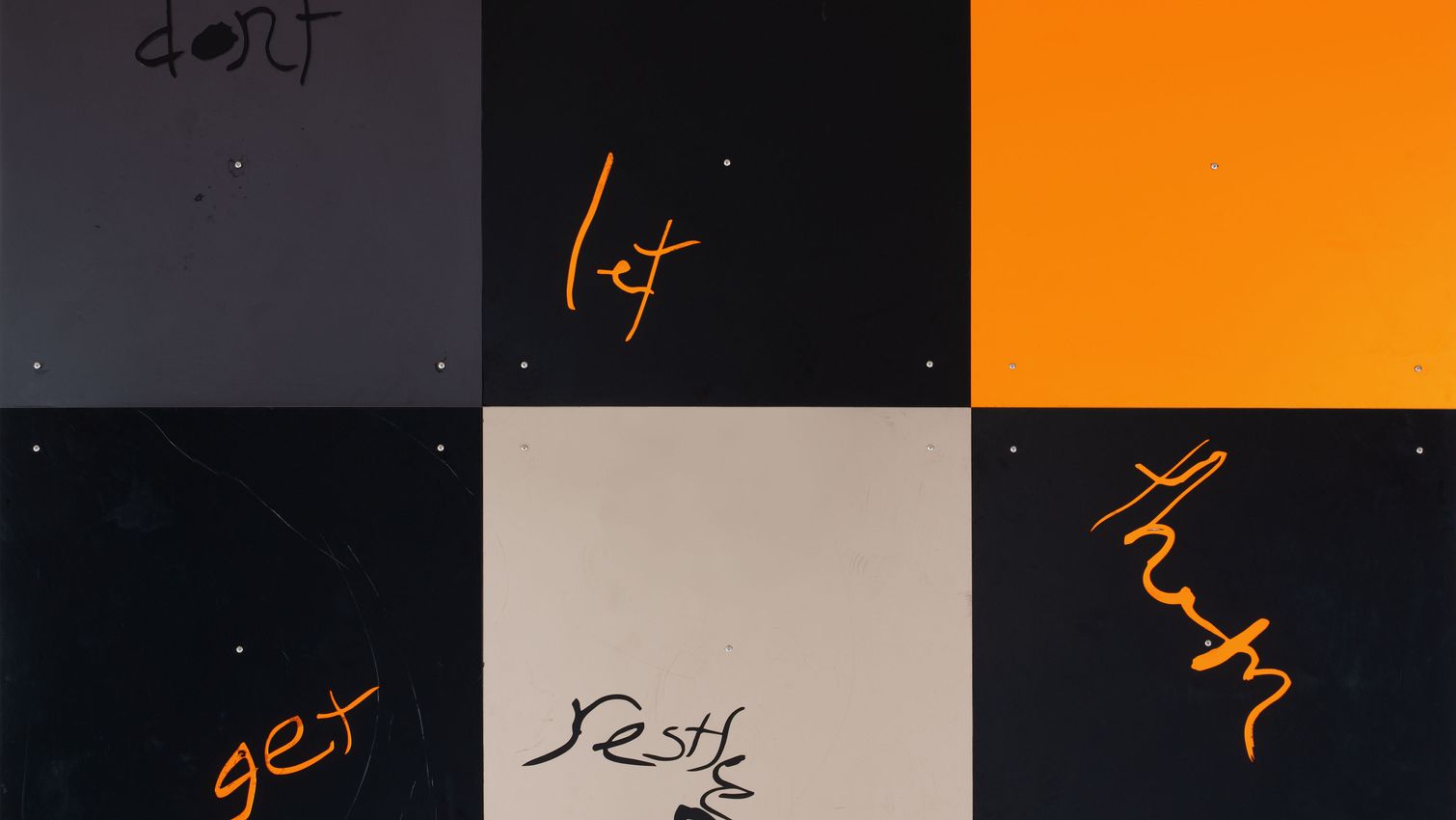
In previous exhibitions by the artist, gallerygoers activated checkerboard dance floors by walking across them, tarnishing the surfaces with their traces. Here, though, the scuffed dance floors are fixed to the walls. Claire Bishop wrote about this kind of participatory dynamic in Artificial Hells: Participatory Art and the Politics of Spectatorship (2012), where the viewer is no longer a passive observer but becomes part of the work’s structure and meaning. Our participation in works like let them get restless (Manhattan & Queens) (2022–25) and stick or slide past (Manhattan & Queens) (2022–25) is certainly more observational here: we can only speculate as to why these works bear the marks that they do. They’re the aestheticised aftermath of an experience, one that we did not engage in ourselves.


What does it mean to bear witness to something that was once embodied and participatory, but no longer is? In Cry Baby (PB&J) (2025), Ford overlays the glass panes of Greene Naftali’s industrial windows with transparent coloured vinyl squares. As the sun moves through the space, lavender and golden hues track across the floors and walls, animating the room with an atmosphere that conjures the Derridean concept of ‘hauntology’: elements of a cultural past that loom like spectres over the present. The slim font depicting the words ‘Cry’ and ‘Baby’ casts long shadows, stretching out like lazy ghosts. Although this scene unfolds more passively than last night’s dance party, the affective remnants still linger. Proximity to the smudges and smears made by others, those that imply that something worth remembering took place here, induce a cascade of soft feelings, moving between longing and regret to anticipation and carnate joy.

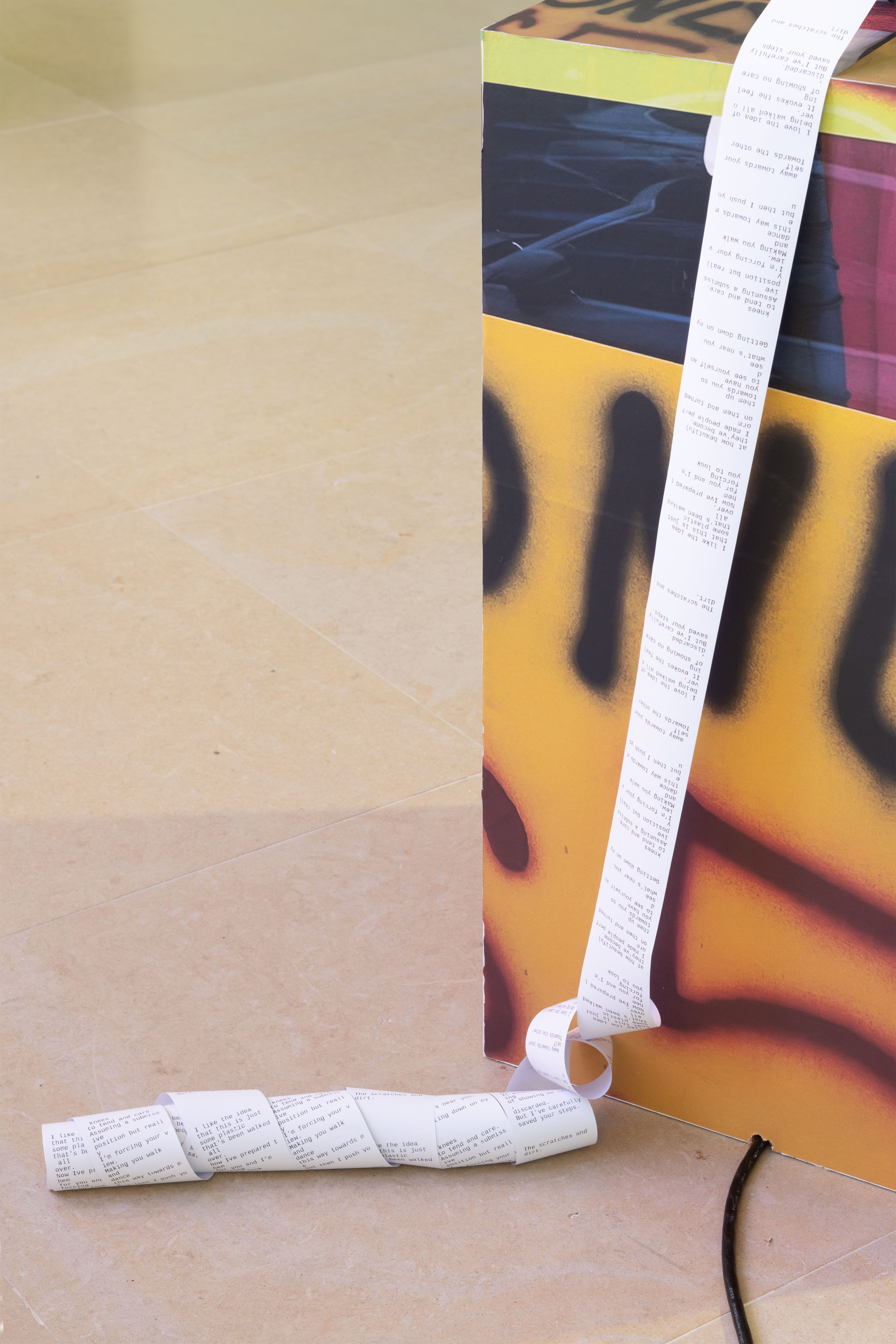
It’s easy to get caught up in the enticing material qualities of Ford’s work, as I surely did, taking quiet pleasure in the inspection of a poem printed on office paper and tucked behind an unframed corner of acrylic in my false intimacy intimacy is my false (Chicago) (2023–25). Or in babyblue (2025), where text printed on reams of thermal receipt paper unspools from cash registers onto the floor. As Ford told me, ‘I wanted to play with another form of using language and I thought about receipt printers. They remind me of when I worked in restaurants using scrap paper or just a form of communication that’s really ubiquitous and part of everyone’s life.’
Thermal paper, which responds to heat, is a surface designed for sensing. It is a material that metaphorically echoes the show’s broader preoccupation with marking somatic experience and transforming it into tangible, at times literal, forms. Ford’s exhibition is not simply the trace of what remains, but a willingness and invitation to show up and be reciprocal with environmental and emotional elements. Writer Saidiya Hartman calls this ‘waywardness’: a practice of ‘living otherwise’, drifting along the edges of prescribed forms—a kind of resistance sustained through the accumulation of sensation, contact, and feeling. —[O]
Raque Ford: The Barkeeper’s Friend is on view at Greene Naftali in New York until 8 August 2025.
Main image: Raque Ford, let them get restless (Manhattan & Queens) (2022–25) (detail). Acrylic on Dibond. 121.9 × 182.9 × 2.9 cm. Courtesy the artist and Greene Naftali, New York. Photo: Júlia Standovár.




A respected voice in contemporary art discourse.
Focusing on ambitious storytelling and insightful art-world commentary. Ocula Magazine publishes in-depth interviews, critical essays and timely analysis on the artists, exhibitions and ideas driving the global art world.
Learn more about Ocula Magazine
Showcasing the best of the art world.
Ocula partners with galleries from around the world to highlight their artists, artworks and exhibitions. Gallery membership is by application and invitation, with each member vetted by an independent panel.
Learn more about Ocula Membership
Specialises in the sale of major artworks.
Led by a team with deep ties to the world’s leading auction houses, galleries and collectors. Ocula’s advisory team offers bespoke services to high-net-worth clients from around the world who are looking to acquire the best of contemporary and modern art.
Learn more about our team and services