The art world in focus
Subscribe to our newsletter for news and insights on artists, galleries and exhibitions.
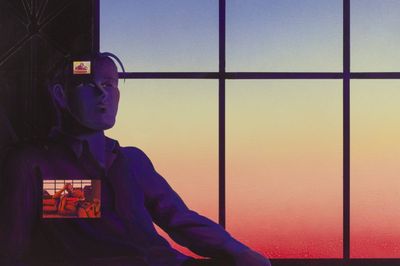
Jonny Negron, Ich Ruf Zu Dir, Herr Jesu Christ (2024) (detail). Acrylic on linen. 162.6 x 142.2 cm. Courtesy the artist, Château Shatto and Crèvecœur, Paris. Photo: Ed Mumford.
Today I learned that ‘heartbreak’ translates to ‘crève-cœur’ in French. Crèvecœur, the Parisian gallery established in 2009 by Axel Dibie and Alix Dionot-Morani, was named after such sweet sorrow. For his debut exhibition La Vision Del Pan (5 June–20 July 2024) at Crèvecœur in Paris, it seems that Los Angeles-based artist Jonny Negron has also been doing some linguistic research.
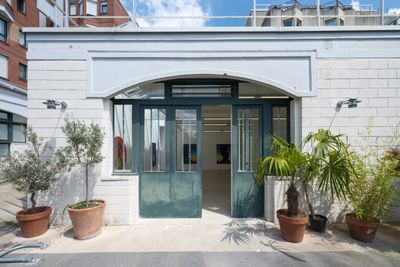
Ocula met with Negron a few days before the opening at the gallery’s Cascades space, tucked away on a leafy side street in the city’s 20th arrondissement. Surrounded by his new works propped up around the space waiting to be hung, Negron introduced his latest body of work, the painterly influences of Ed Ruscha, and finding peace in organ music at an L.A. church.
I wanted to ask you about music and the inclusion of the video work Vehiculum Streaming (2024), accompanied by an ambient soundtrack, in the show. I read that you have a very well-curated vinyl collection in your studio in L.A.
Music is a great passion of mine. For those of us who have a creative drive, we’ll often find ways to express ourselves in an array of mediums. When I was growing up in New York, I began with drawing—I was influenced by comics and storytelling. But I started to outgrow it and gravitate more towards fine art.
In this show, I felt it was important to incorporate my interest in music. I produced all the music in the video myself—I play keys and there’s improvisational flute thrown in there as well. It’s essentially ambient music, electronic music. There’s something so immediate about music that brings people together which I love.
It feels more democratic than art at times.

Essentially, yes. As much as the art world is a beautiful place, it’s not as inclusive as some might think. It’s important to communicate with people in different ways; in ways that can bring peace in our fellowship.
What are you drawn to in the L.A. music scene?
It’s quite vast, but lately I’ve been gravitating towards religious experiences. Lately I’ve found myself visiting the First Congregational Church of Los Angeles, a gorgeous church down in Koreatown. It has one of the largest organs in the world with over 18,000 speaking pipes, and the organist there is incredible; the music is incredibly moving.
It’s a modest congregation—at best about 100 people on a Sunday—and I often look around and think to myself, why is everyone at Coachella? It’s so peaceful here.
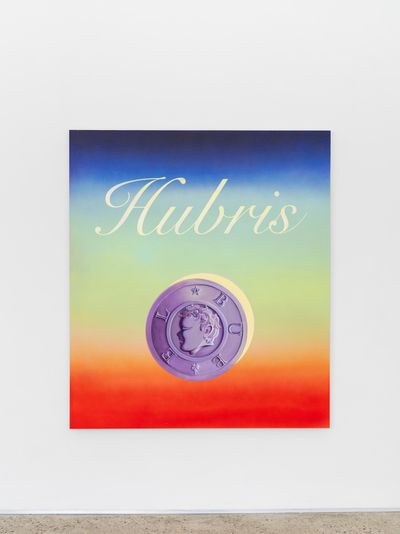
You moved to L.A. from New York just before the Covid-19 lockdown. A number of your paintings seem to harness Ed Ruscha’s use of gradients and text. Is he an influence?
Certainly living in L.A., artists like Ruscha bear much influence on your work. Over the past few years, a number of my paintings have incorporated text, but it’s also the colour gradients that he employs that I thought fitting for this exhibition.
When thinking about gradients, I’m considering the time of day when the light spectrum is visible: dusk and dawn. In works such as Ich Ruf Zu Dir, Herr Jesu Christ (2024), I’m thinking about dawn as a period of dreaming—that passage between sleeping and waking when your subconscious is active and your mind runs away into unknown worlds.
With the early signs of sunrise behind him, the figure gazes outwardly, with small windows into his subconscious activity relating to the heart: romance or companionship, and an image of a sphinx upon his forehead representing a higher consciousness.
How does a work like this play into the wider theme of the exhibition and its title, La Vision Del Pan?
I arrived at La Vision Del Pan or ‘vision of bread’ through examining the etymological relationship between various words. ‘Pan’ means ‘bread’ in Spanish, similar to the French translation ‘pain’, which brings to mind the English term ‘pain’. I began drawing connections between ‘pain’ and ‘bread’, particularly the symbolic connections you find between the two in Christianity—the pain of existence, the pain of human suffering.
The circular painting Draft Day (2024), which depicts a man burning on a star-shaped stake, seems the clearest example of such suffering in the show.
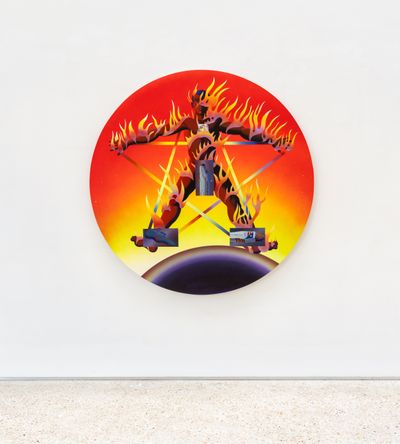
On 30 May 2019, a man set himself on fire near the White House. I started to research other events that coincided with this date and found that Joan of Arc was burned at the stake on this day in 1431.
But it’s the smaller motifs superimposed on the paintings that relate to more personal traumas on this date. My grandmother was killed in the Lod Airport massacre, a terrorist attack at Israel’s main international airport (now Ben Gurion International Airport) on 30 May 1972. Three members of the Japanese Red Army recruited by the Palestinian Liberation Front smuggled guns in violin cases—referenced in this painting on the man’s left foot—onto an Air France plane from Rome and opened fire in a waiting room of the airport.
Upon the man’s chest sits an image reminiscent of a flag with the Lion of Judah, while the aeroplane over the sex of the man is in reference to the Air France flight. The right hand foot bears a loaf of Puerto Rican bread in a casing adorned with the country’s flag in reference to my grandmother’s heritage. And across from it, a violin case bears the blood of the victims who lost their lives that day.
The star-shaped stake appears in various forms across the show.
The five-pointed star relates to the five senses of the human. I didn’t want to choose imagery too overtly relating to these conflicts. I see the Lion of Judah as an image related to religious sovereignty, but it’s a sovereignty that doesn’t belong to a particular nation. I think the tragedy lies in when groups are trying to claim sovereignty over another, which is virtually impossible. There’ll never be peace and it will only lead to suffering.
These cryptic messages and beliefs seem to shine through your figures as well as leitmotivs.
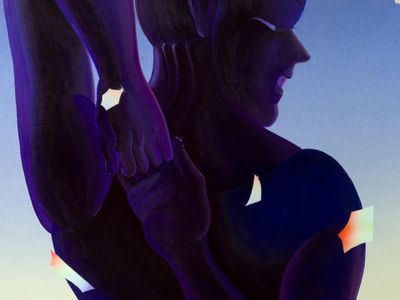
The woman sustaining a yoga position in The Vision of Pain (2024) was chosen as a symbol relating to the transmutation of pain. In yoga, through mastering the body, you’re sustaining painful techniques while also transmitting that pain into control. The figure is breaking perceptions and turning her back on ego, represented on the zodiac-etched shards of mirror that are exploding before her.
Do you find painting meditative?
Absolutely. I’ve been drawing since two years old, I’ve been a creative person my whole life. All that time and that concentration while standing in front of the canvas—it’s an all-absorbing practice.
Selected Artworks
A respected voice in contemporary art discourse.
Focusing on ambitious storytelling and insightful art-world commentary. Ocula Magazine publishes in-depth interviews, critical essays and timely analysis on the artists, exhibitions and ideas driving the global art world.
Learn more about Ocula Magazine
Showcasing the best of the art world.
Ocula partners with galleries from around the world to highlight their artists, artworks and exhibitions. Gallery membership is by application and invitation, with each member vetted by an independent panel.
Learn more about Ocula Membership
Specialises in the sale of major artworks.
Led by a team with deep ties to the world’s leading auction houses, galleries and collectors. Ocula’s advisory team offers bespoke services to high-net-worth clients from around the world who are looking to acquire the best of contemporary and modern art.
Learn more about our team and services