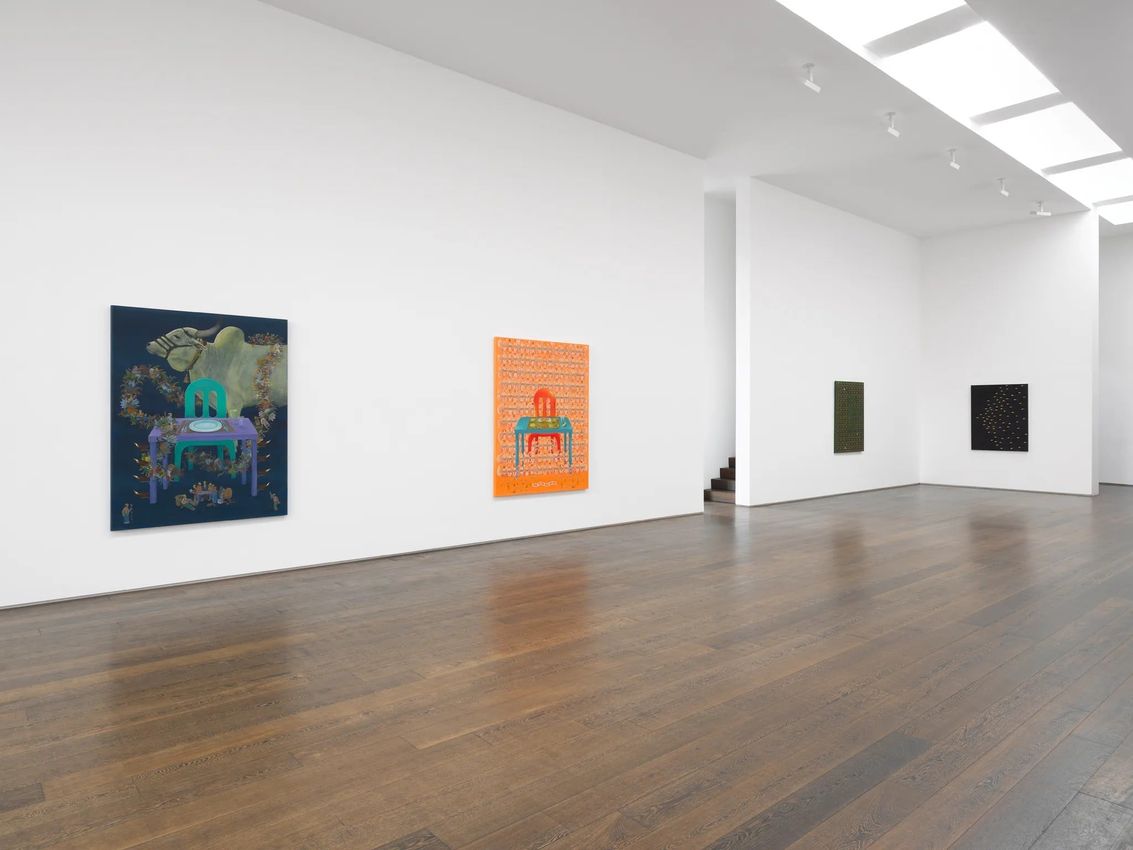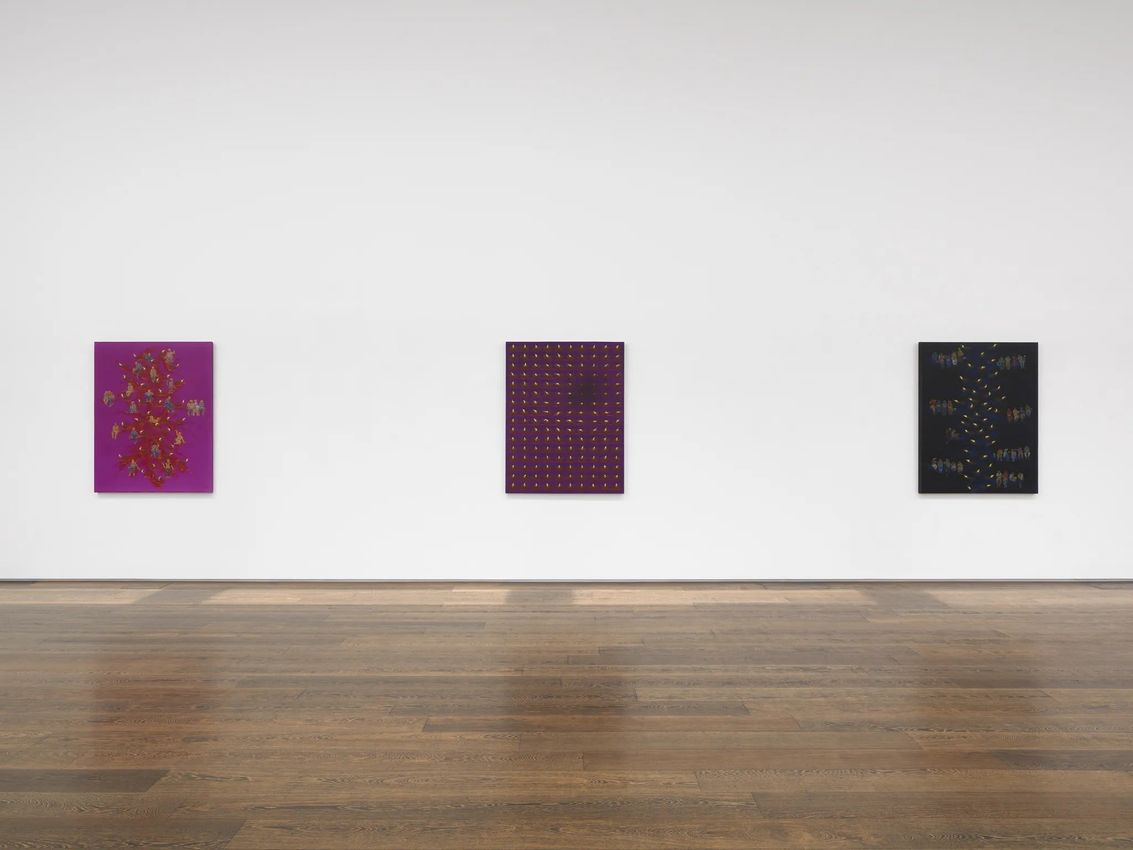




Victoria Miro is delighted to present an exhibition of new paintings by NS Harsha.
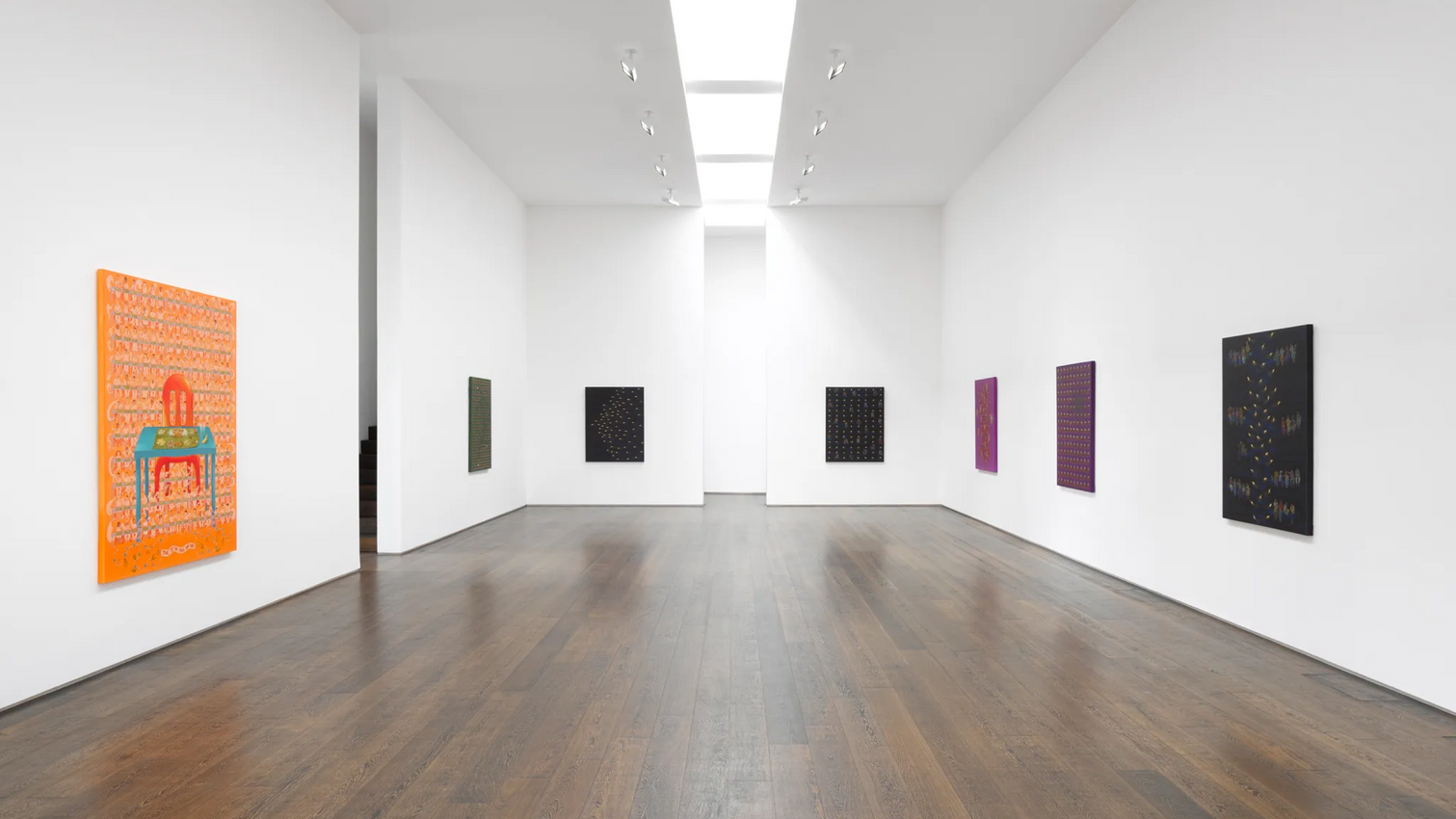
Camel and the tent times elaborates on the artist’s celebrated, ongoing ‘lamp grid’ series. The paintings all feature diyas – lamps traditionally made from clay that are lit during rituals, prayers, ceremonies, celebrations and during power cuts – with flames and trails of smoke together creating patterns that guide the eye around each canvas: rising as a column (Workers having a break); ascending the legs of a table (Camel and the tent times); dancing shoal-like (Journey through water marks); or delineating a series of fluid brush strokes (Harvest as a water mark).
The emerging narratives pivot between aspects of work and rest, the small yet heroic figure of the worker appearing in agricultural or industrial scenarios that springboard into larger philosophical questions. Workers having a break takes inspiration from the well-known 1932 photograph Lunch atop a Skyscraper, depicting ironworkers sitting on a beam of the RCA Building during the construction of the Rockefeller Center in Manhattan. Harsha’s diverse workforce takes its break held aloft by trails from a central column of lamps that extend into a nocturnal sky, suggesting a more mysterious interlude or escape into the nightly realm of dreams. The composition is echoed in the fiery A chandelier of our time, which the artist describes as ‘a chandelier studded with eternal human labour’.
Workers in ostensibly rural settings, such as in Harvest as a water mark, inspired by a visit to a paddy field, find themselves in the company of suited middlemen counting money, or birds feeding on insects and cows grazing, indicative of other ecosystems. This theme is picked up in Again, and again, and again where stooped rice field workers and ascending flames are counterpoints in a composition of rhythmic insistence.
Often the paintings explore the interplay between a static, harmonising structure – in essence, a grid or succession of diyas, figures and other motifs, depicted in a shallow space on backgrounds of a single, strong colour – and fleeting natural forces. Harsha describes his intent to capture a momentary event passing through a collective framework, much like a gentle breeze causing flames to twist, turn and flicker in their struggle to remain alight. He finds beauty in the dynamic tension between stability and flux, especially when viewed as part of a wider consideration of the structures of knowledge, belief and power, and the potential of an invisible force to reshape and drive change.
About the artist
Born in 1969, NS Harsha lives and works in Mysore, India. He was a recipient of the prestigious DAAD Scholarship in 2012 and was awarded the Artes Mundi Prize in 2008.
Solo institutional exhibitions and projects have taken place at international venues including Naoshima New Museum of Art, Japan (2025); NS Harsha: Gathering Delights, CHAT (Centre for Heritage, Arts and Textile), Hong Kong, China (2019); NS Harsha: Facing, Glynn Vivian Art Gallery, Swansea, Wales, UK (2018); Mori Art Museum, Tokyo, Japan (2017) the Dallas Museum of Art, TX, USA (2015–16). Harsha’s work has featured in recent group exhibitions at venues including the Tokyo National Museum Hyokeikan, Japan (2025); The Box, Plymouth, UK (2024); MK Gallery, Milton Keynes, UK (2023); Museum of Contemporary Art Antwerp, Belgium (2021–21).
His work is in permanent collections including the Glynn Vivian Gallery, Swansea, UK; Kiran Nadar Museum of Art, New Delhi, India; Mori Art Museum, Tokyo, Japan; Muhka Museum, Antwerp, Belgium; National Museum of Cardiff, UK; and Queensland Art Gallery, Brisbane, Australia.
Courtesy Victoria Miro.


Drawing on a broad spectrum of Indian painting traditions and popular arts, as well as the western canon, NS Harsha creates quietly philosophical, luminous works that reflect on geopolitical order and our ever-more technologically mediated relationship with the world. In exquisitely rendered paintings, works on paper, wall and floor works, sculptures, site-specific installations and public projects, the Mysore-based artist examines structures, borders and barriers as a series of ever-shifting concepts, alluding to an interconnectedness that compels the viewer to consider their relationship to the art work as part of a wider conversation about systems of knowledge, belief and power.

A respected voice in contemporary art discourse.
Focusing on ambitious storytelling and insightful art-world commentary. Ocula Magazine publishes in-depth interviews, critical essays and timely analysis on the artists, exhibitions and ideas driving the global art world.
Learn more about Ocula Magazine
Showcasing the best of the art world.
Ocula partners with galleries from around the world to highlight their artists, artworks and exhibitions. Gallery membership is by application and invitation, with each member vetted by an independent panel.
Learn more about Ocula Membership

Specialises in the sale of major artworks.
Led by a team with deep ties to the world’s leading auction houses, galleries and collectors. Ocula’s advisory team offers bespoke services to high-net-worth clients from around the world who are looking to acquire the best of contemporary and modern art.
Learn more about our team and services