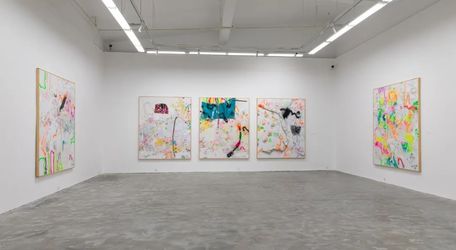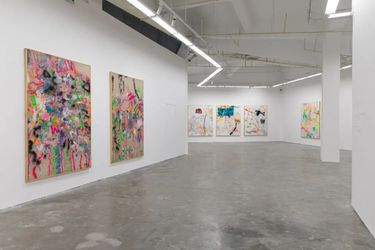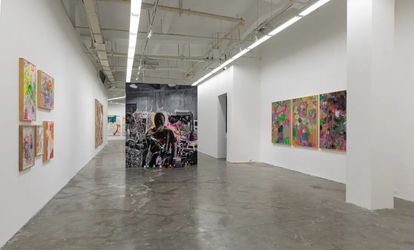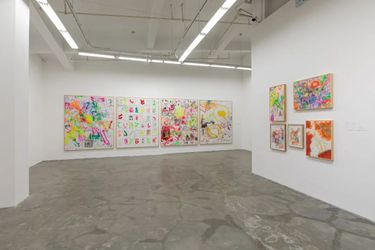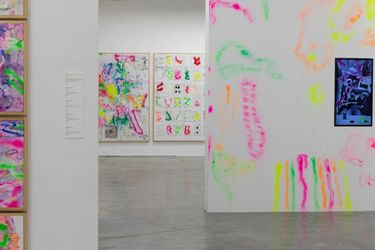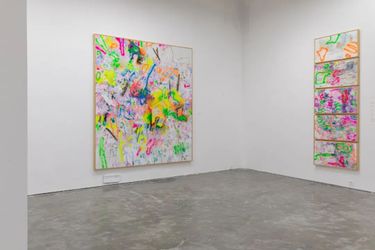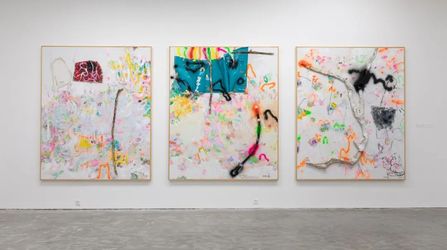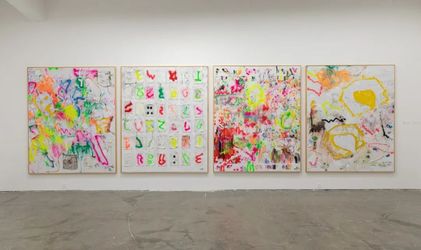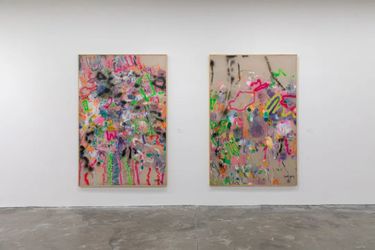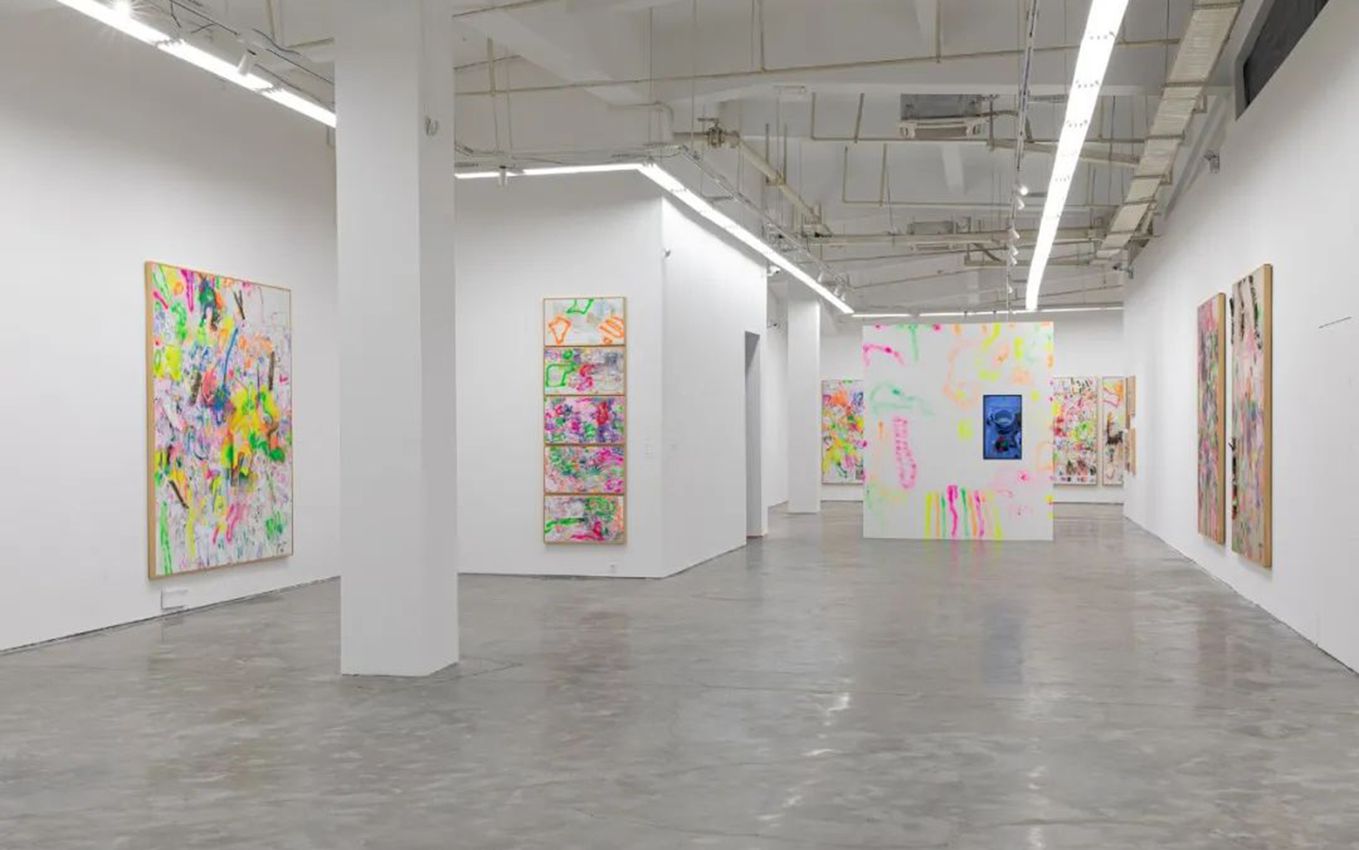
Yang Shu has been a rebel since the 1980s. Contrary to many radical experimentalists, he has never strayed away from canvas, the furthest from which is his occasional addition of everyday readymades. ‘What medium does an artist choose depends on whether it opens up one’s own nerves.’ For him, such medium is painting. Therefore, Yang Shu has never agreed on that painting is an outdated language. Neither is he a fundamentalist painter. To his view, there is no medium distinctions, painting is but a simple format, one that we go through as we eat, drink, shit and piss, as we experience love and hatred, living and dying... In a word, for Yang Shu, painting is an personal life condition in-itself and for-itself. To that extent, the space of Huangjueping and Organhaus are both considered extensions of his body.
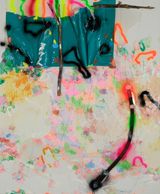
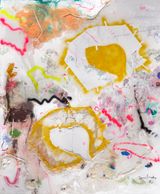
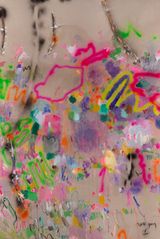
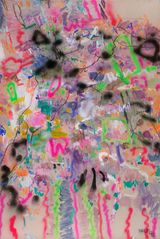
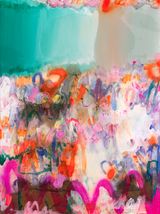
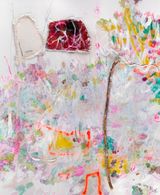
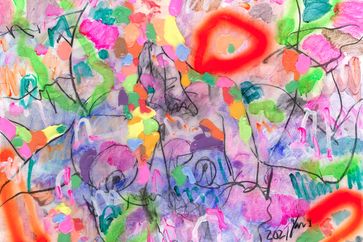
Yang Shu has always been painting without premeditation, he paints when he wants to, vice versa. He refuses to express any profound thoughts or concepts through painting. Thus his works have no messages, representations, or anything behind. This is no return to pure formalism, for his disbelief in anything ‘pure’ – which always insinuates some sort of fascism. Yang Shu does not intend to resort to chaos – for most of times, there are precise judgments and boundaries to what he identifies with or argues against. After all, the colourful, disorderly and children’s graffiti-like depictions or writings in the paintings are actually his daily traces: random, irregular and slightly disturbed lines and brushstrokes are often the masks for latent potential. Transparent mediums (such as paint, light perception) often makes the picture more opaque and invisible. This seems to be a very subjective act of writing, but it is actually an automatic writing after objectifying oneself.
Therefore, the inference that Yang Shu’s style is ‘anti-painting’ obviously simplifies or even narrows his practice. In my opinion, what Yang Shu opposes (to be precise, commits blasphemy against) is not so much the historical order of painting as all the things that follow preset rules and all the sacred things. He does not shy away from the subtle ‘interference’ of art history (such as Rauschenberg, Twombly) and trendy interests (such as fluorescence, inkjet); he does not worry about whether the pictures are good-looking or not, of course his paintings are not ugly; he refuses to allow the picture to carry any function other than being a painting, especially detests those who try to use some kind of symbol to prove their identity, and even all symbolic and meaningful expressions, he believes that painting is actually the surface; ... It can be seen that what he really believes in is extreme individualism free of dominance or influence from any person - of course, the premise is that he will also not interfere or influence others. If this is a kind of painting Dadaism, then its true background is anarchism. However, he neither wants to be classified or defined, nor is his purpose to instigate a revolution that would destroy all conventions. Instead, he returns to the simple individual primitivism of passive and barbaric animality, in order to defend or resist the ubiquitous mental oppression and inner division.


Yang Shu is one of the youngest artists who had the famous exhibition Chinese Avant-Garde Art in 1989 at National Art Museum of China, and he is also the explorer of the Chinese Experimental Painting in the early days. His inherent sculpt talent and steady academic sketch basis did not become an obstacle for his creation, but helped him to form the deep cognition of abstract structure and colour from the perspective of classical aesthetics. Since 1990s, Yang Shu’s work has been gradually transformed from the non-figurative art that influenced by the expressionism to the present visual creation with the unique ‘Yang Shu’ glamour. His work not only sheds lights on the changes of the physical world but also integrates the critical spirit and the aesthetic creation; it transforms the structural damage into the composite-materials reconstruction and condenses the cold yet fully explosive-force poetry.
A Thousand Plateaus Art Space was founded in 2007 in Chengdu, China. It is a professional gallery committed to present and promote China’s contemporary art. Equipped with exhibition hall for artworks and collection and screening room for video data, it is mainly on researching, presenting and promoting outstanding works and experimental projects of China’s contemporary art and culture, actively carries out domestic and international cooperation projects.

A respected voice in contemporary art discourse.
Focusing on ambitious storytelling and insightful art-world commentary. Ocula Magazine publishes in-depth interviews, critical essays and timely analysis on the artists, exhibitions and ideas driving the global art world.
Learn more about Ocula Magazine
Showcasing the best of the art world.
Ocula partners with galleries from around the world to highlight their artists, artworks and exhibitions. Gallery membership is by application and invitation, with each member vetted by an independent panel.
Learn more about Ocula Membership

Specialises in the sale of major artworks.
Led by a team with deep ties to the world’s leading auction houses, galleries and collectors. Ocula’s advisory team offers bespoke services to high-net-worth clients from around the world who are looking to acquire the best of contemporary and modern art.
Learn more about our team and services