“In fact, everything leads back to borders-these dead spaces of non-connection which deny the very idea of a shared humanity, of a planet, the only one we have, that we share together, and to which we are linked by the ephemerality of our common condition.”
(Achille Mbembe, in Necropolitics, 2019, p.99)
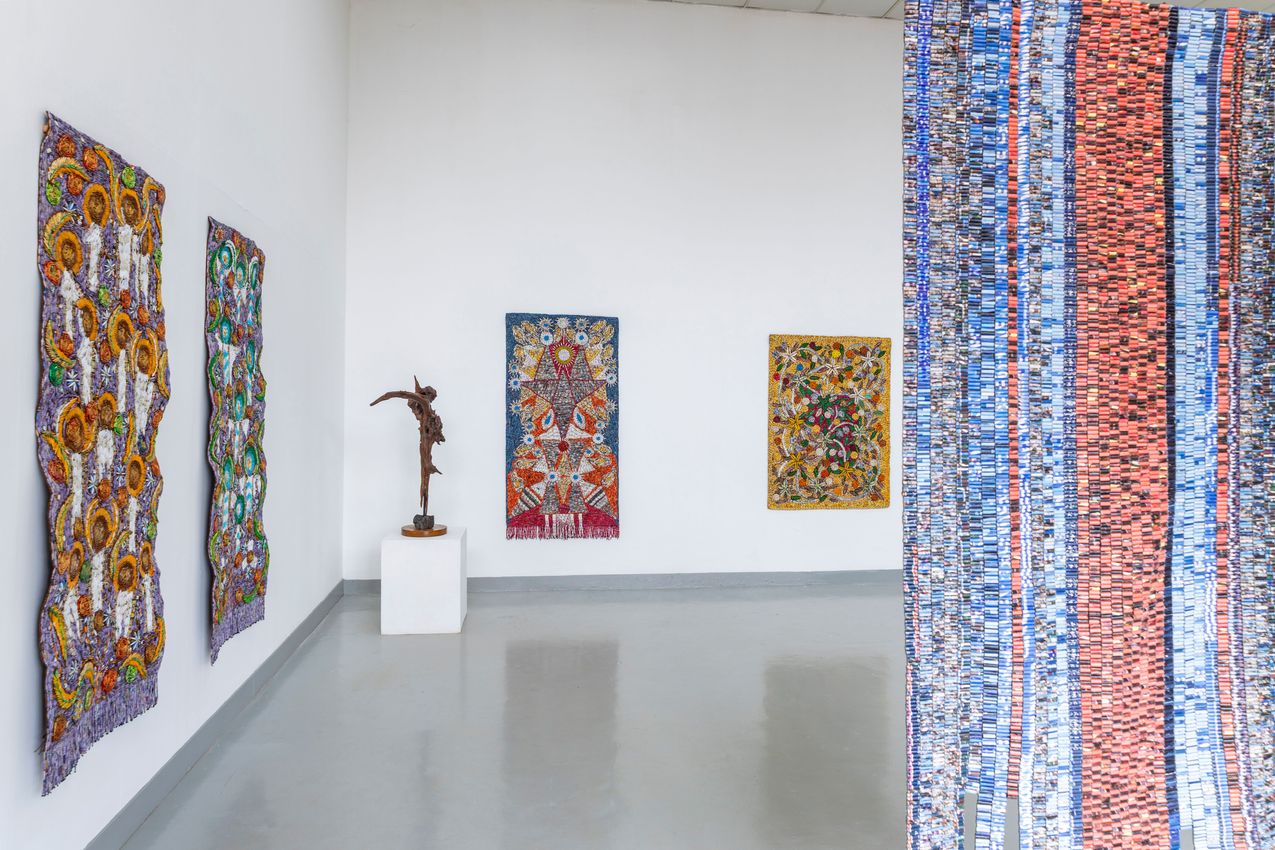
Okutambula Kulaba*: To Travel is to See, a solo exhibition by Ugandan artist Odur Ronald (b. 1992, Kampala, Uganda), features new works from his ongoing project The Republic of This and That, a body of work that began in 2020 with a single embossed aluminium passport. Through installations, tapestries, and printed, embossed, and manipulated aluminium sheets incorporating his signature passports, border stamps, and other symbolic forms, the series expands into a broader exploration of mobility, access, freedom, and self-determination.
Rooted in the artist’s own experiences with visa applications and immigration systems, the exhibition reflects on how global systems of classification determine who is able to participate fully in an increasingly connected yet divided world.
Recurring throughout the exhibition are fictional immigration stamps reading phrases such as “Entry Subject to Human Value - Please Prove Your Worth in a Language We Understand”, “Citizen of Historical Lines - Inherited Realities”, “Accent Detected - Credentials Doubted”, and “Cultural Value Accepted - Human Access Denied,” They reveal that beneath Odur’s obvious concern with mobility and freedom lies a deeper critique of global power structures.
Many former colonial powers continue to benefit from systems built through centuries of resource extraction and exploitation in colonized regions. Although these systems now operate under different names and institutions, they largely reflect colonial divisions and the underlying inequalities remain. Little has been done by former imperial powers to meaningfully address the disparities created by colonialism. As a result, resources continue to flow from the Global South to the Global North, while the humanity and well-being of the people whose lands, labour, and resources sustain these systems are often overlooked, both from outside powers and the internal governing elites whose dysfunctional systems are, to a large extent, a legacy of colonial destruction of indigenous systems themselves. In this context, one recurring stamp in Odur’s work, “Resource in Transit - Classified as Resources, Not as Human,” becomes particularly evocative. It points to a world in which raw materials, labour, and cultural production circulate globally with relative ease, while the people connected to them remain subject to restrictions, suspicion, and exclusion.
Taking us back to the exhibition’s opening quote by Cameroonian political theorist Achille Mbembe, Odur’s interrogation of borders, mobility, and belonging can be understood not only as a critique of contemporary immigration systems, but also as an examination of the deeper structures of power that determine whose lives are valued and whose are rendered expendable.
Mbembe’s concept of Necropolitics, first developed in a 2003 essay and later expanded into a book in 2019, offers a useful lens through which to view Odur’s concerns. The word Necropolitics can be broken down into two parts: ‘Necro’, from the Greek word nekros, meaning dead body, or death, and ‘Politics’ referring to the exercise of power, governance, and the organization of society. Literally, Necropolitics therefore means the ‘politics of death’. In simple terms, it addresses who is deemed worthy of protection, care, and freedom, and who is left exposed to insecurity, exclusion, and abandonment.
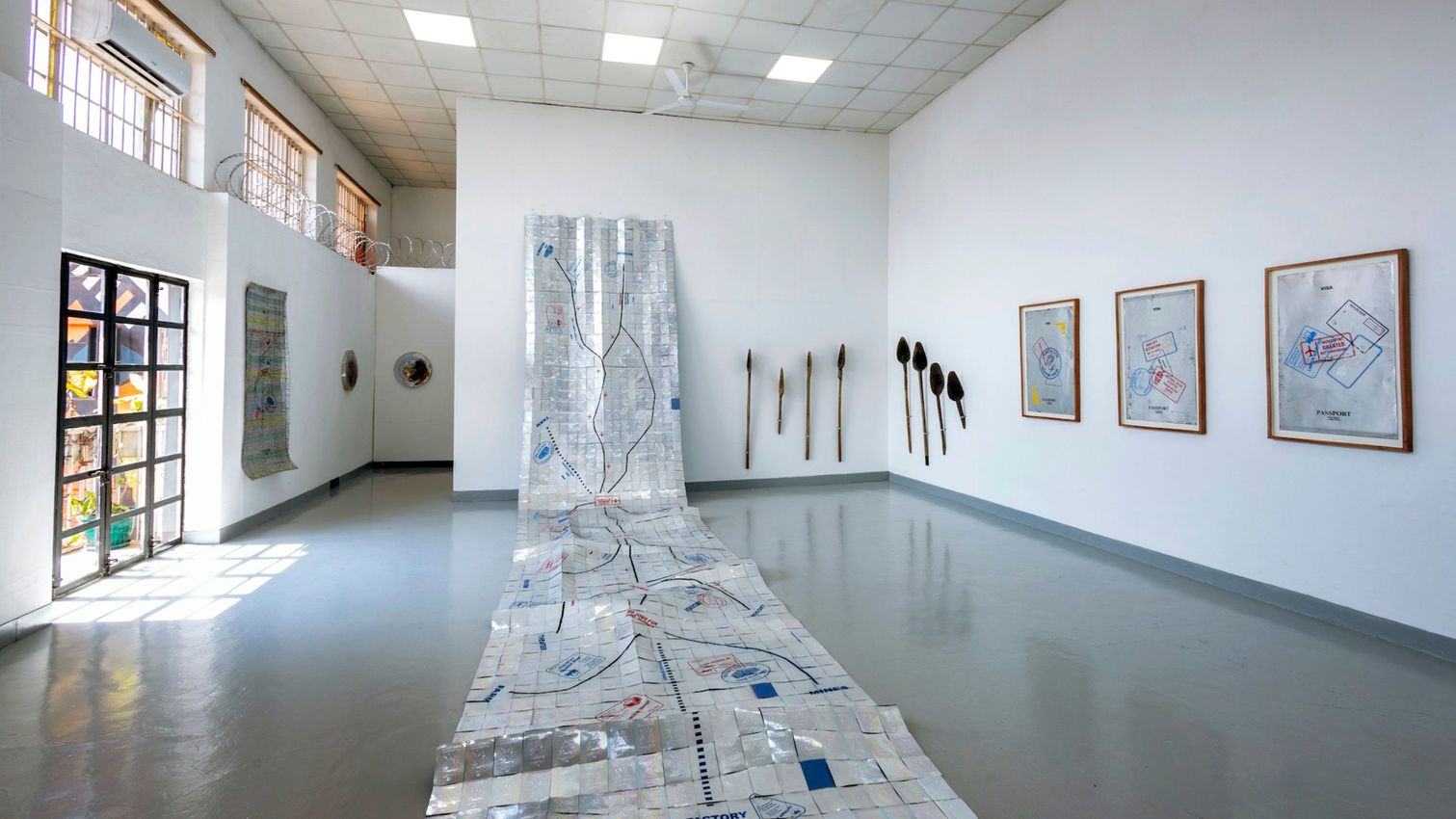
“What does it mean when a document determines your humanity more than your existence?” the artist asks in a phrase engraved onto an oar. For both Mbembe and the artist, borders are sites of violence. They reveal a grotesque obsession with classifying and categorizing human beings according to their assigned documents, limiting their right to exist freely and fully.
Odur’s work reveals a world in which goods, capital, natural resources, and even artworks often cross borders more easily than the people who produce them. Through Mbembe’s lens of necropolitics, it becomes even more evident that these inequalities are not merely economic but are manifestations of systems that determine whose lives are protected, whose movement is facilitated, and whose suffering is tolerated.
The exhibition’s centerpiece is a large-scale installation composed of 1,386 joined embossed aluminium passports. Across its surface unfolds a map-like trajectory of movement, aspiration, and obstruction: pathways that abruptly turn into a dead end, routes that take undesired turns, and a small number of passages that remain accessible under conditions. The work visualises a geography of unequal mobility, where access is not determined by desire or need but by systems of classification and inherited privilege. Read through Mbembe’s framework, the installation becomes a cartography of necropolitical power, illustrating how borders function not simply as administrative boundaries but as sites that regulate whose movement is enabled and whose is restricted.
A laser-engraved oar, repurposed from fishing boats on Lake Victoria, asks: “At What Point Does Waiting for a Visa Become More Dangerous Than Risking the Journey?” The question resonates powerfully in the context of migration across the Mediterranean. According to the UNHCR, approximately 154,500 people arrived in Europe via the Mediterranean in 2025 alone, while at least 2,950 people were recorded as dead or missing. The real number is likely much higher. These are lives treated as expendable. Human rights organizations argue that many of these deaths are preventable, whether through different migration policies, safer legal routes, or an end to the continued neglect of rescue efforts at sea.
Woven mats made from strips of aluminium sheets bring this large geopolitical theme back home. Constructed in the manner of a Ugandan Mukeka, traditionally a place to gather, sit, eat, converse, and share, these works introduce a powerful counterpoint to the exhibition’s imagery of restriction. The Mukeka is a symbol of hospitality, community, and collective space. Yet here its woven surface doubles as an enlarged visa page stamped with phrases such as “Resource in Transit - Classified as Resources Not as Human” and “Entry Subject to Human Value - Please Prove Your Worth in a Language We Understand.” The work creates a tension between inclusion and exclusion, asking what happens when the values embodied by communal traditions encounter systems that sort people according to economic utility.
If Mbembe helps us understand the systems of power and exclusion that Odur critiques, he does not stop at presenting us with a grim ‘politics of death’. He asks for a radical shift: to develop a new ethics based on care and responsibility. He suggests that in order to create a world in which not profit and power but people come first, we need to rise above the individualistic and self-centered mindset of neoliberalism. Mbembe proposes a different way of imagining life together: one based on care, responsibility, and the recognition that our fates are intertwined. Rather than organizing society around competition, exclusion, and accumulation, he argues for forms of coexistence that place human life and dignity at their centre; eventually replacing a ‘politics of death’ with a ‘politics of life’.
Today’s world seems so far from Mbembe’s utopian vision that it seems almost pathetic to imagine, especially from the point of view of those not favored by the status quo. Art cannot dismantle visa regimes or redraw geopolitical realities, but it can expose the logics that sustain them. Art can challenge the assumptions we have been conditioned to accept and create space for imagining alternatives. It is within this space that Odur’s work operates.
In my opinion, Odur’s work can be understood as a form of resistance, and therefore an action towards a more humane world. He challenges a system that deems him and many others insignificant. A system that sends a ruthless reminder with every rejected visa application that, indeed, you do not matter. That you are not considered for being human, but for your documents and labels, and your identity itself is a shortcoming.
But what distinguishes Odur’s work is not only its incisive social and political commentary, but also its playfulness: a subtle humour that functions both as a way of moving through life gracefully and as a means to cope with the frustration, anger, and helplessness experienced while confronting systems of violence far larger than oneself. Alongside this runs a deep commitment to community and collective creation. His practice draws strength from shared processes, foregrounding solidarity and collaboration. Community, care, and play become both method and premise for creating.
Odur does not ask easy questions, nor does he offer simple answers. Yet, at its core, this exhibition challenges us to imagine a different world, in Mbembe’s terms, a ‘politics of life’: What if we moved beyond the labels and categories that divide us and met one another as human beings first, in all our complexity? What might the world look like if our shared humanity guided how we relate to one another?


Odur Ronald is a multidisciplinary visual artist. He mainly uses aluminium printing plates by exploring its possibilities, one technique at a time, by not only painting on the aluminium sheets, but also dents, burns, layers, stitches and weaves the shiny metal, thus achieving texture, colour, shape and character.

Founded in 2002 and located in Kampala, Afriart Gallery (AAG) is one of the leading international contemporary art galleries representing artists who live and work on the African continent. Our mission is to connect African artists to the global art market and audience, creating a fair and supportive environment where creativity thrives, and powerful ideas find their voice.

A respected voice in contemporary art discourse.
Focusing on ambitious storytelling and insightful art-world commentary. Ocula Magazine publishes in-depth interviews, critical essays and timely analysis on the artists, exhibitions and ideas driving the global art world.
Learn more about Ocula Magazine
Showcasing the best of the art world.
Ocula partners with galleries from around the world to highlight their artists, artworks and exhibitions. Gallery membership is by application and invitation, with each member vetted by an independent panel.
Learn more about Ocula Membership

Specialises in the sale of major artworks.
Led by a team with deep ties to the world’s leading auction houses, galleries and collectors. Ocula’s advisory team offers bespoke services to high-net-worth clients from around the world who are looking to acquire the best of contemporary and modern art.
Learn more about our team and services