


Press Release

After studying at the Academy of Fine Arts in Munich during the mid to late 1970s, Günther Förg started producing monochromatic wall paintings, which echoed colours found in their immediate surroundings. Thus integrating the environment into his practice from the very beginning, whereas architecture would eventually become one of the main components of his oeuvre and allow him to rethink not only the context of the exhibition space, but also the wider context of 20th century art.

Organized with the Estate of Günther Förg, this new exhibition at Almine Rech Gallery in London follows the artist’s reflexive principles.

Förg’s works could be regarded as windows opening onto the history of Modern Art. Indeed, the artist somewhat reflects on its continuum, and sometimes even literally when he installed real mirrors in his shows. He revisits a pantheon of references ranging from Edvard Munch, Piet Mondrian and Paul Klee to Barnett Newman.

The series of paintings displayed in the gallery’s first room evoke the aesthetics of Ernst Wilhelm Nay (1902-1968), one of the most renowned German painters whose art was considered ‘degenerate’ by the Nazis. This selection of blue, orange, green and black dot paintings is all the more significant here as the previous exhibition in Grosvenor Hill was actually that of similar works by Nay.

Installed on pedestals in the middle of this room, bronze masks further reinforce the museum quality of the overall display by evoking last century’s early modernism. The artist’s sculptural experimentation helped in forging the complex extent of his vocabulary. Just like his drawings, watercolours and etchings, his sculptures and bas-reliefs show how he played with different kinds of materials outside of material hierarchies.

During the 1980s, Förg diversified his practice. He began a photographic body of works, which mostly documented modernist architecture such as the legacy of Bauhaus in Israel or that of monumental political architecture in Italy.

Hanging on a bicolour wall painting, the 1990 series of five large-scale pictures taken in a university campus forms a unique and indivisible pictorial-photographic ensemble.

They represent parts of buildings at the Sapienza University of Rome, among which are the Mineralogy and the Chemistry departments. The overall campus or “Città Universitaria” was designed by the Rationalist architect Marcello Piacentini in what became a mainstay of fascist style under Mussolini’s dictatorship.

Around the same time, Förg also introduced what is perhaps his most famous series of works, which he realised by covering wooden frames with lead sheets that he then painted with acrylic.

In a conversation with David Ryan in 1997, he further explained: ‘I like very much the qualities of lead - the surface, the heaviness... I like to react on things, with the normal canvas you often have to kill the ground, give it something to react against. With the metal you already have something - its scratches, scrapes.’ Förg’s use of lead blurred the boundaries between painting and sculpture. While playing with the materiality of the metal, he made his pictorial practice reach a sculptural dimension.

Thus, the series of small lead paintings presented in the show appears like a frieze of a bas-relief in front of the artist’s architectural photographs.

At the beginning of his career, Förg had painted many black monochromes, the surface of which produced a milky effect. What is one of the most important canons in the history of painting actually became a constant in his practice. He even realised monochromatic works without paint, such as the colourful textiles he made in homage to the German artist Blinky Palermo, who died in 1977 at the age of 33.

In the gallery’s last room, paintings that seem black at first glance actually represent the walls of an apartment. They were inspired after works by Auguste Chabaud (1882-1955), a French Modern painter who depicted scenes of rural life in Provence.

Leaving minimalism behind, Förg’s painting changed in the 2000s. He adopted a brighter colour palette and a more expressionist touch to explore various grid motifs in a way that is reminiscent of Cy Twombly’s graphic outbursts.

The intent of this “retrospective” exhibition at Almine Rech Gallery is to present the different facets of his oeuvre, which reactivates - all the while questioning the relevance of - modernist canons through painting, photography and sculpture.

Nicolas Trembley. Translated from French by Violaine Boutet de Monvel

Read More

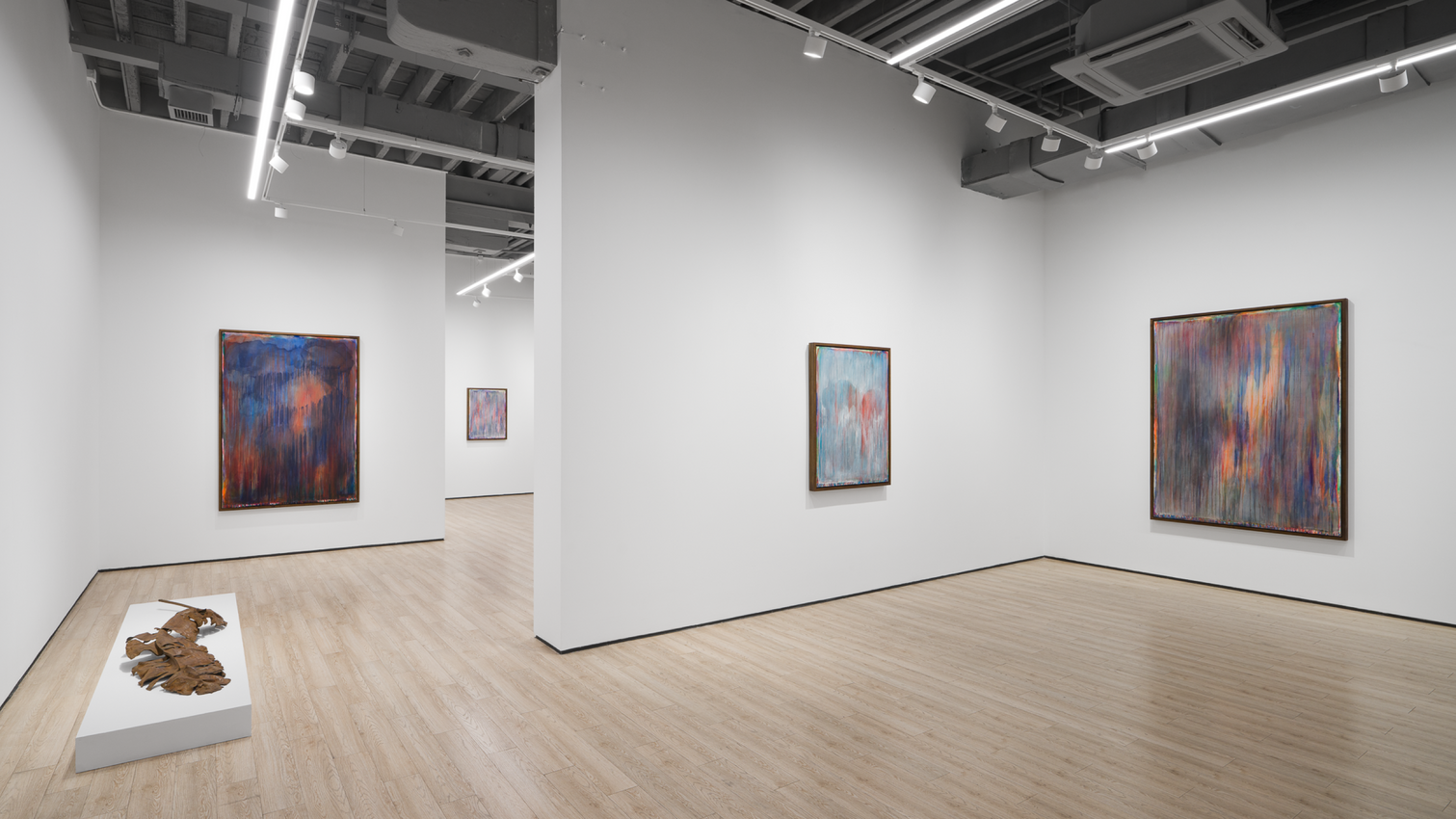
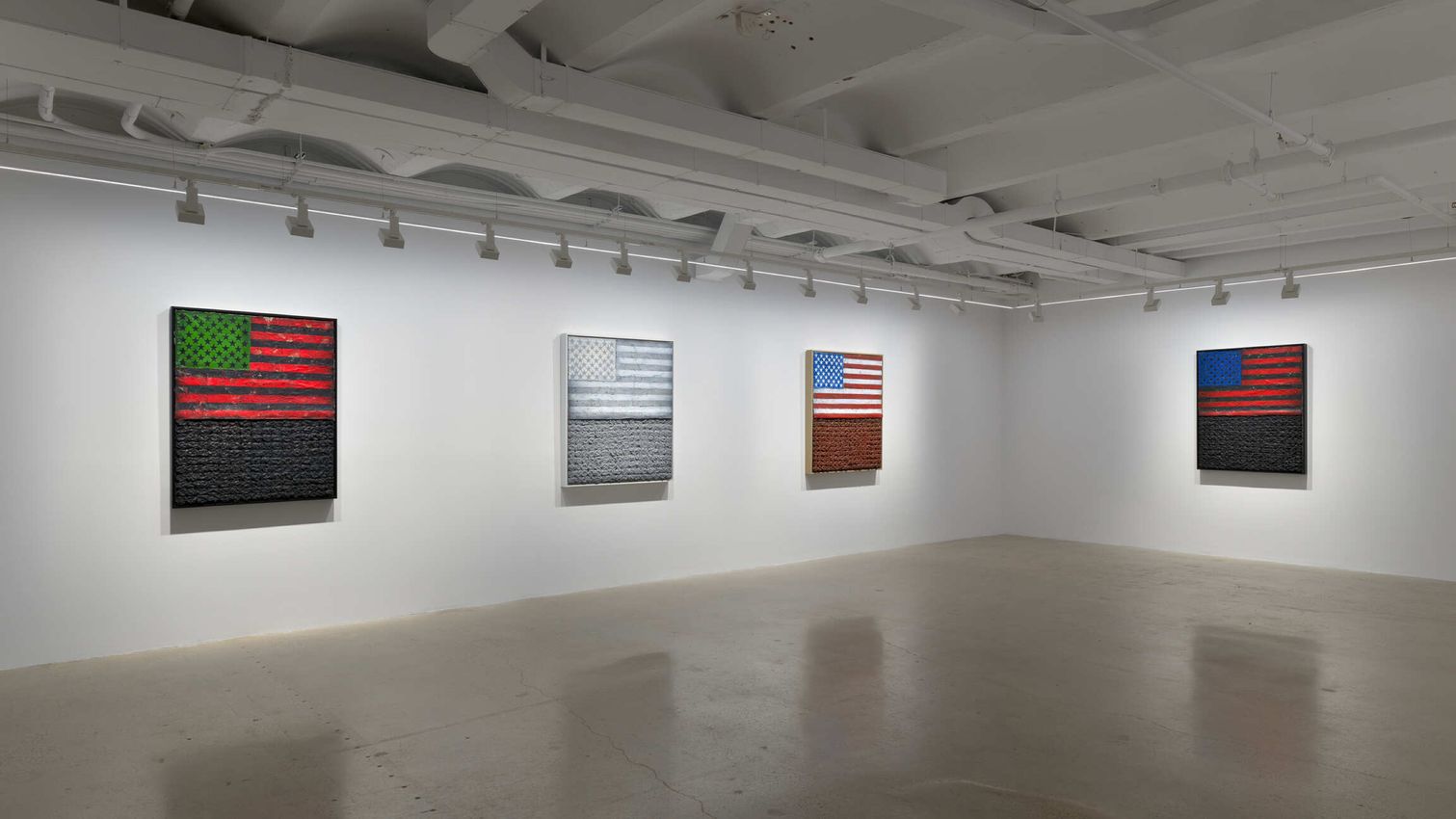
Installation Views

About the Artist

The work of german artist Günther Förg encompasses a variety of media from sculpture to painting, ceramics to photography. Although Förg has worked in a variety of techniques and materials, painting remains his most important expressive medium. He started his career in the 1970s in Munich, where he was influenced by Blinky Palermo and his proclivity for wall painting arose from his interest in architecture, reflected in his turning towards photography. After his early monochromatic paintings, Förg continued to explore modernist themes from postmodern perspectives. Gradually, he achieved a complete command of colour to create space and form, opening up new insights and perspectives in his painting. In his later works, which bear resemblance to the watercolours by Paul Klee, the colour fields of Mark Rothko, or the scumbled marks of Cy Twombly, Förg has gone on to appropriate older strategies of picture-making, presenting them afresh.

View Artist Profile

Also Exhibiting at Almine Rech

About the Gallery

Almine Rech London will showcase curated presentations of works by artists from the 20th and 21st centuries and will be open Tuesday through Friday, from 10am to 6pm, with Monday and Saturday visits available by appointment.

View Gallery Profile
Address
11 St George Street
Hanover Square
London
United Kingdom
Opening Hours
Tuesday – Friday
10am – 6pm
The gallery will be open on Mondays and Saturdays by appointment only
(1)
London 11 St George Street, Hanover Square
Almine Rech
11 St George Street, Hanover Square, London, United Kingdom
+44 207 287 3644
http://www.alminerech.com

Opening hours
Tuesday – Friday
10am – 6pm
The gallery will be open on Mondays and Saturdays by appointment only
The art world in focus
