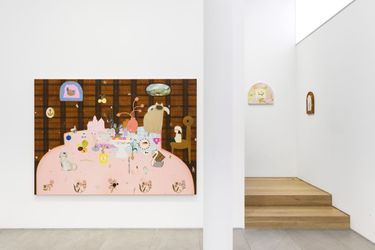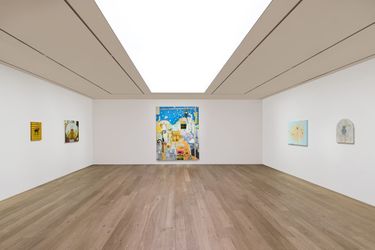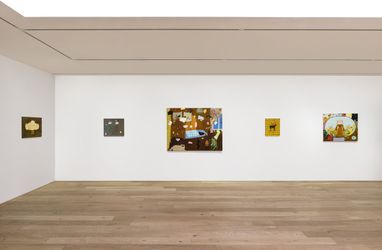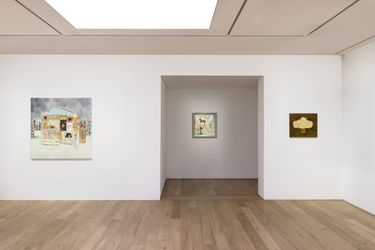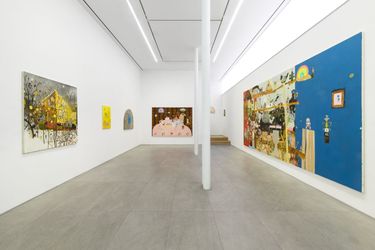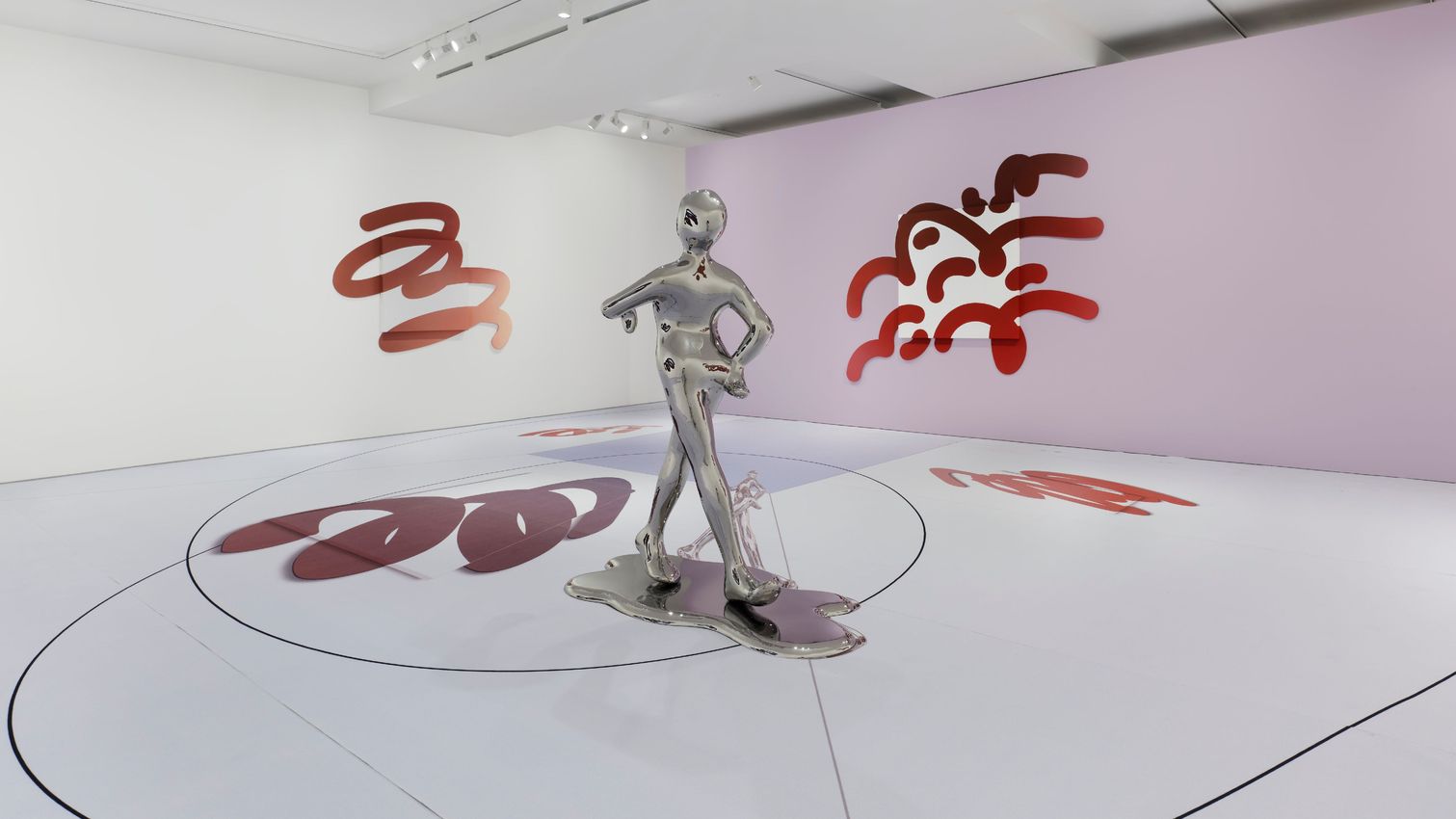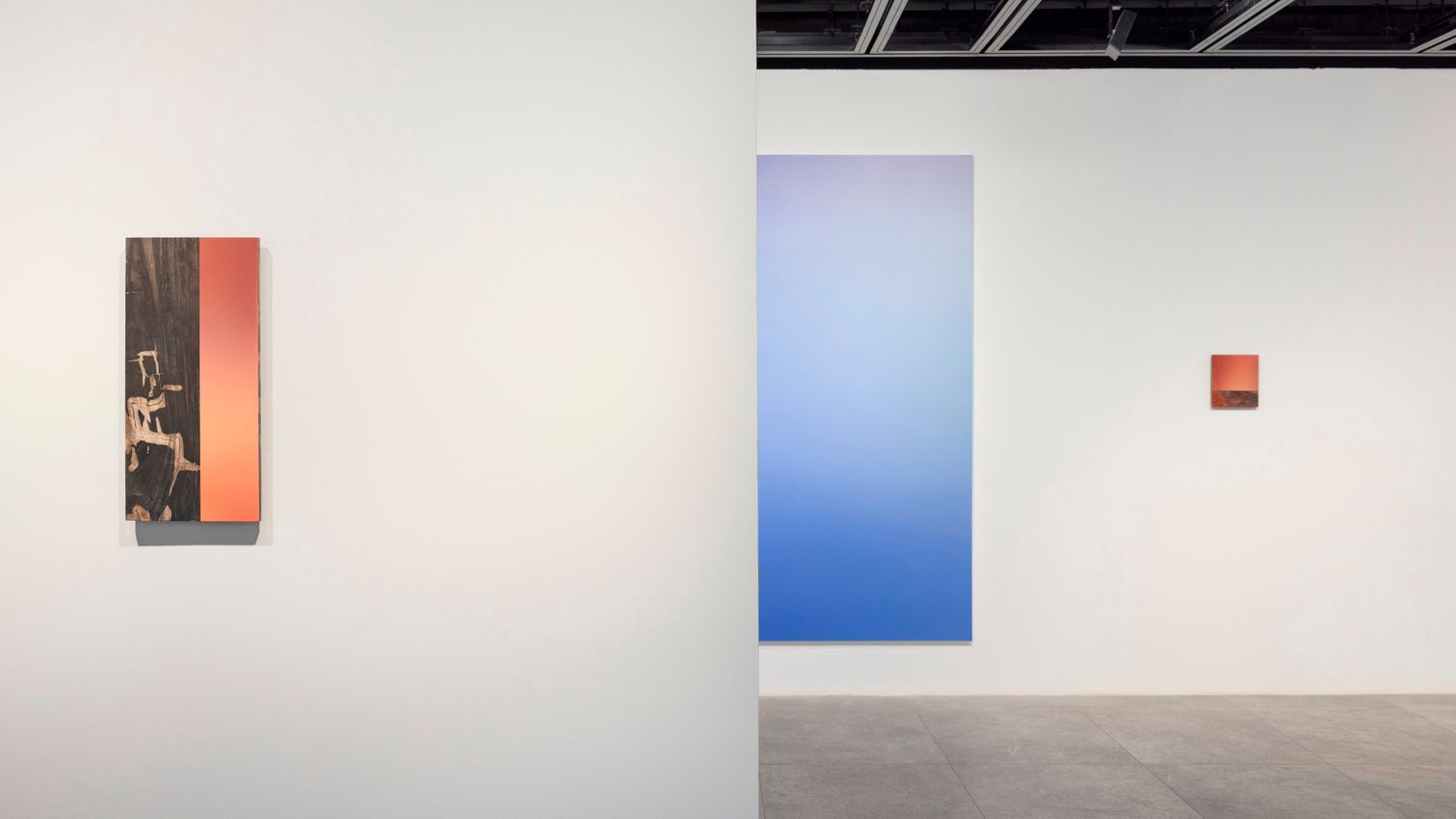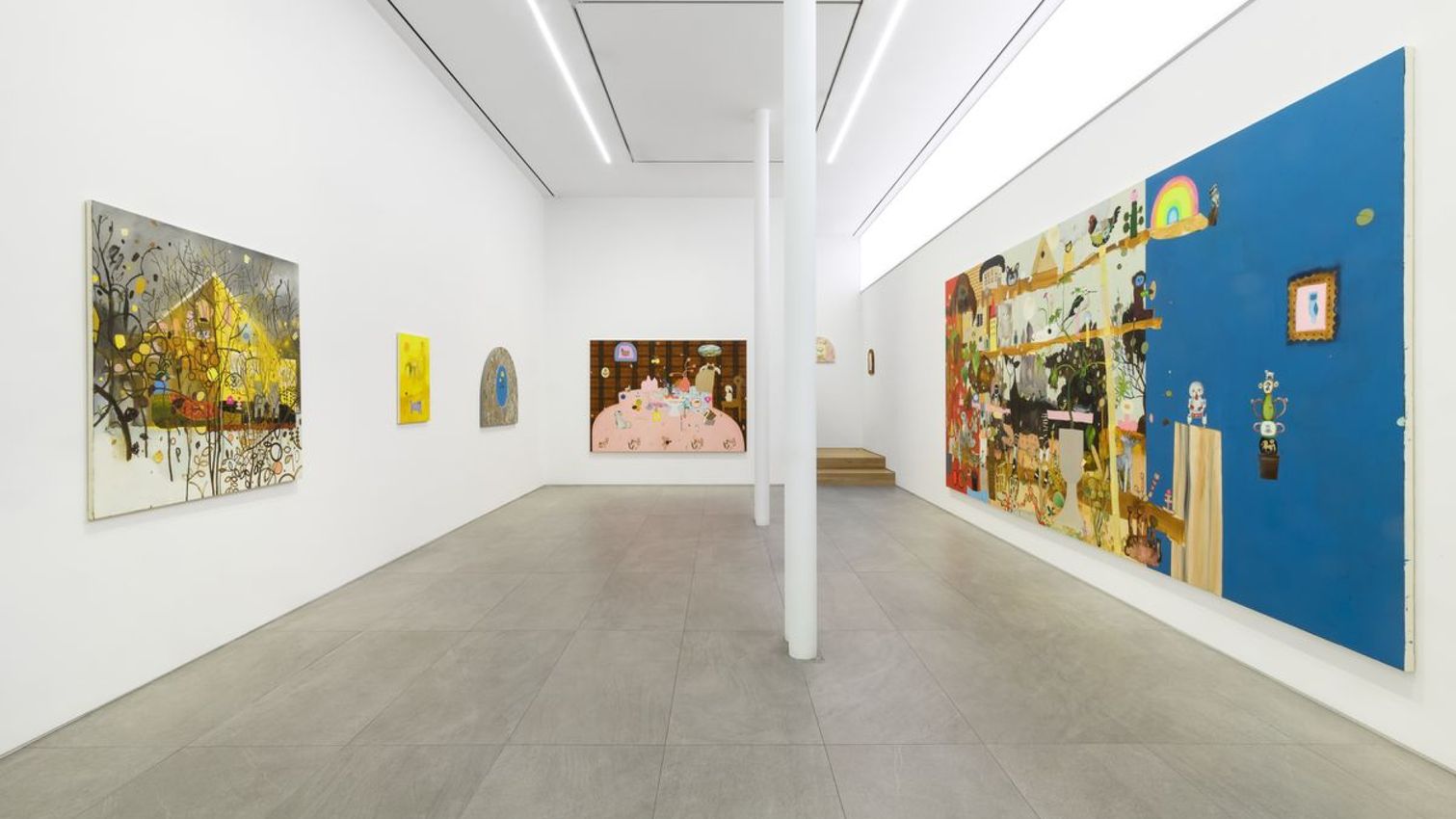
Perrotin Seoul is pleased to present Origami Light and Cabbage- Green Curtains, a solo exhibition by Tomoko Nagai. Focusing on the artist’s recent works, the exhibition offers an overview of the distinctive visual language and sensibility she has developed through painting. Nagai’s compositions begin with everyday and intimate subjects, which she reconfigures into unique spatial structures and rhythms. Intuitive arrangements, bold colors, and swift brushwork bring a vivid energy to the canvas, while familiar motifs are placed and expanded in unexpected ways. This painterly approach creates scenes where reality and imagination intersect, inviting viewers to move fluidly between layered moments. The exhibition highlights Nagai’s refined sense of form and her position within contemporary painting, suggesting new possibilities for a practice where personal memory and visual imagination converge.
Teddy bears, girls, dollhouses, flowers, and picnics are certainly among Tomoko Nagai’s recurring motifs, yet her works are never simply cute as one might expect. Her painterly surfaces have intricate strata of colors, strokes, and sometimes sprayed gradations that the true depth of layering can never be fully reproduced in photographs. The ‘new-tro’ palette is also edgy and sophisticated. Every corner of her paintings brims with a striking sense of form and color: playful, yet grounded in years of cultivated experience in paint and dry media that lend her work daring confidence. Nagai’s paintings unfold like a warm, hazy atlas, filled with the joy of painting, the serenity of composition, and a sense of blissful emotion.
Nagai was born in Aichi Prefecture, home to Nagoya—Japan’s third-largest city after Tokyo and Osaka. After graduating from the oil painting department of Aichi University of the Arts, she began her professional career primarily in Tokyo. Like many of Japan’s elite art universities, Aichi maintains a rigorous entrance examination system grounded in academic tradition, with an emphasis on classical exercises—plaster casts, still lifes, and self-portraits. The university also counts Yoshitomo Nara among its alumni, an artist celebrated for his now-iconic portraits of girls; like him, Nagai also prepared for the demanding “art entrance exam,” acquiring a fully traditional foundation in drawing and composition before gradually moving toward her current style. Nagai’s images—girls in dresses, pink rabbits, simplified trees and mushrooms, spaces emptied of conventional perspective—may at first seem disarmingly naïve. But a closer look reveals the hand of a dexterous painter: a finely calibrated sense of balance, controlled layering of paint, confident strokes, and tight details that together confirm a ‘technically’ faux-naïf style.
Characteristic of Nagai’s paintings, Renaissance perspective is often abandoned in favor of laying out animals, plants, and small objects across the picture plane, almost like Roman wall paintings; unhierarchical and flat, the scene maps out a sense of openness and freedom. A carpet gradually transforms into a night sky, and flowers in a pot spill out into a tropical jungle, bleeding into one another like a single continuous thread of narrative. This spatial fluidity recalls the work of Henri Matisse, who, in his charming interior scenes of hotel rooms in Nice, would insert a glimpse of the French Riviera beyond a window frame, or let the pattern of a tablecloth climb upward into the wallpaper, bending the space between the different dimensions with characteristic grace. In both cases, the images seem to suspend the ordinary passage of time, allowing only the sweetest moments of happiness to flow on. Space shifts freely in Nagai’s paintings from a girl’s bedroom to a dollhouse or a forest, then to the cover of a notebook, as checkered patterns, polka dots, fruits, and animal characters drift playfully. The artist’s quick and lively marks keep our eyes in constant, pleasurable motion. Just as children peer into a dollhouse, the pictorial space is at once three-dimensional and unfolded, interior yet exterior, real yet artificial in these paradoxically refreshing settings.
This freshness may also come from Nagai’s working method, as she paints intuitively without a draft, guided by a mental blueprint. She has described how she locks in with intense concentration when working for a certain period, then releases the tension between painting cycles. This description brings to mind Georges Bataille’s reflections on the prehistoric painters of Lascaux. Bataille argued that the cave’s teeming, overlapping animal images were not meant simply to be decorative or for aesthetic pleasure. He believed that these images emerged from the spontaneous force of genius rather than habitual technique, and that this transcendence of conscious intention was the very momentum from which their power arose. The appeal of Nagai’s paintings seems to originate from her internal, holistic energy that eludes formal categorization and carries a quietly disruptive edge. There are many ways to make paintings and just as many, if not more, ways to find beauty in them.
As Nagai says she has “longings for small things,” the cherished objects of childhood often become the essence of her imagery: the excitement of acquiring them, the pleasure of indulging in them, and the memories they carry. Sylvanian Families figurines—tiny animal families (cats, rabbits, squirrels, and more) dressed in Western-style clothing and living in idyllic country houses—captivated many Japanese children growing up, and Nagai was no exception. Nagai also collected Licca-chan, Japanese equivalent of Barbie, and many other fashion dolls. As these toy worlds expand—with families, relatives, and friends multiplying—so do the costumes, accessories, miniature household objects, and food models that accompany them. This self-multiplying microscopic universe demonstrates the remarkable precision and obsessive dedication characteristic of Japanese design, transcending the category of children’s toys. For those who grew up with them, these objects also carry a gentle sense of escapist nostalgia; through Nagai’s imagery, viewers share the warmth and happiness of those memories.
Among her contemporaries, Nagai’s work finds notable affinities with artists such as Elizabeth Peyton and Karen Kilimnik in terms of painterly subjects and approaches. The impulse to fill the canvas—long regarded under the strictures of Modernism as a fundamentally public domain—with intimate, personal expressions of affection for cherished subjects is a distinctly postmodern painterly phenomenon. These artists share a common trajectory: they rose to prominence by unapologetically transposing private, kitsch-inflected narratives onto the canvas and into the exhibition space. Drawing on dreamlike motifs from everyday life and memories of girlhood, their paintings constitute an act of pictorial provocation that challenges the medium by discarding outmoded mannerisms in favor of loose and casual brushwork. Beneath this apparent informality lies the refined sensibility of a new generation.
That Nagai’s sensibility both leads and appeals to the public at large is further reinforced by her past collaboration with NHK Educational TV, a sister service of Japan’s national network with far-reaching influence. True to Japan’s reputation as a design powerhouse, NHK’s educational programming has served not only as a platform for knowledge but also as a channel for shaping the future of Japanese design as leading designers and artists have participated in their children’s programs. Working together on a pedagogical TV show creating the opening title sequence and the artistic production, Nagai introduced avant-garde and playful imagery to a nationwide young audience. With her distinctive sensibility and forward-looking imagination, it seems only a matter of time before Nagai’s work captivates audiences in Korea as well.


Nagai Tomoko is a talented Japanese artist known for her whimsical and heartfelt creations. Born in Aichi Prefecture in 1982,She graduated from Aichi Prefectural University of Fine Arts and has since become an established figure in contemporary art circles in Japan. Nagai’s art is characterized by personality-packed depiction of everyday life, often featuring a cast of surreal human caricatures in dreamlike, fantastical environments. Nagai’s use of warm colors and bold brushstrokes captures the viewer’s attention by telling stories about intimacy, growth, and the bonds that grow between people and major milestones in their lives. Nagai continues to inspire many upcoming artists with her work that ranges from small painting to large canvas murals. Her contributions to the realm of contemporary art are well-respected by her colleagues and appreciated by art aficionados around the world.


A respected voice in contemporary art discourse.
Focusing on ambitious storytelling and insightful art-world commentary. Ocula Magazine publishes in-depth interviews, critical essays and timely analysis on the artists, exhibitions and ideas driving the global art world.
Learn more about Ocula Magazine
Showcasing the best of the art world.
Ocula partners with galleries from around the world to highlight their artists, artworks and exhibitions. Gallery membership is by application and invitation, with each member vetted by an independent panel.
Learn more about Ocula Membership

Specialises in the sale of major artworks.
Led by a team with deep ties to the world’s leading auction houses, galleries and collectors. Ocula’s advisory team offers bespoke services to high-net-worth clients from around the world who are looking to acquire the best of contemporary and modern art.
Learn more about our team and services