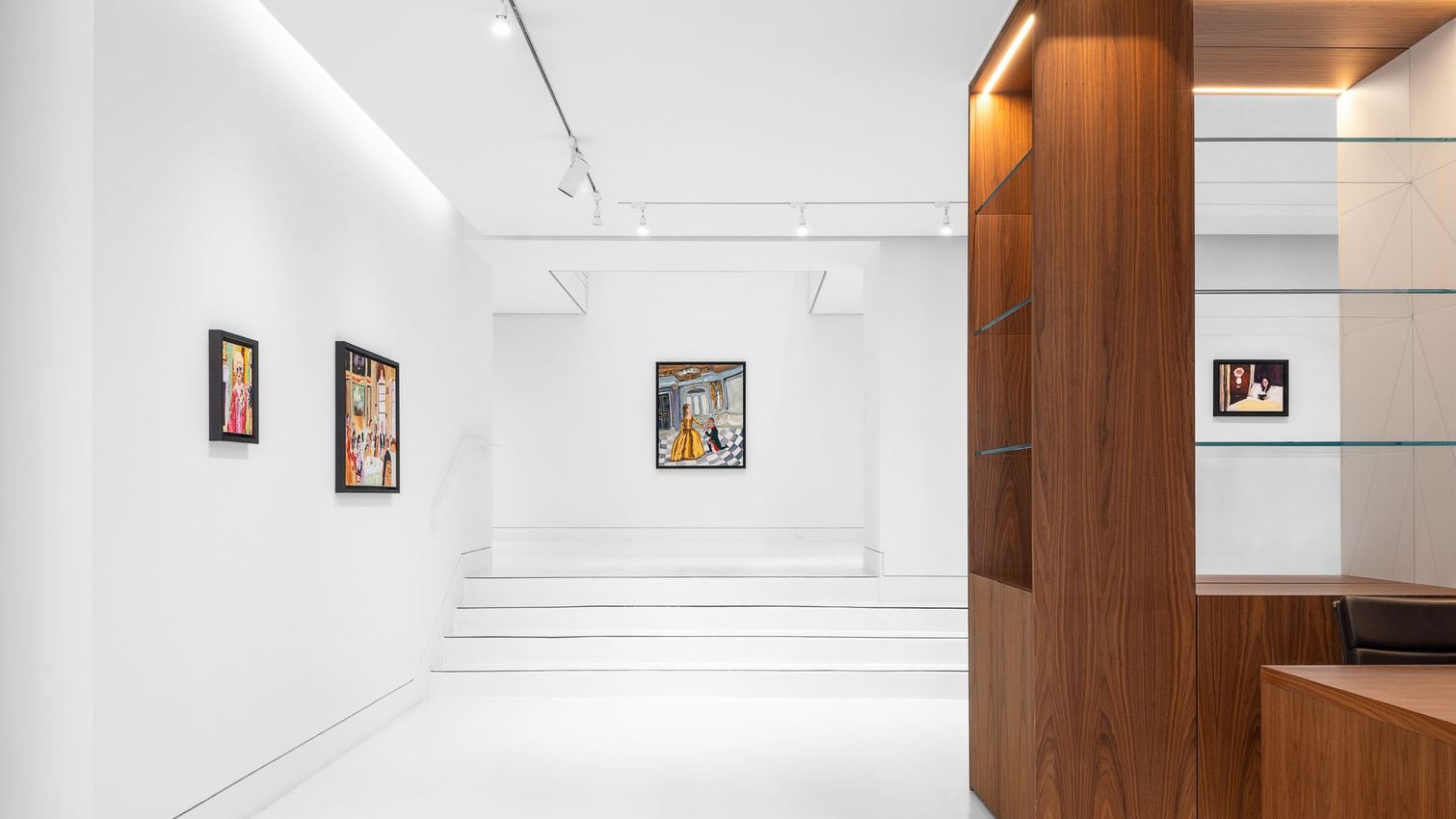
Almine Rech Shanghai is pleased to present Farah Atassi’s third solo exhibition, on view from 16–23 July 2022.
The society of the spectacle. The performance is over, or perhaps it is yet to begin. Farah Atassi’s dancers are at rest, sometimes even asleep, on a stage with a half- open curtain, not for some ballet but for other art forms. Indeed, in the centre of a space lined entirely with an impeccable grid that plays almost hypnotically with the reclining dancer’s striped costume, striped paintings emerge from the decor, while on the ground a frame seems to be waiting to become an abstraction. These intersecting lines in Sleep- ing dancer 3 reveal other crossings, other encounters–those of painting, dance, and theatre. This singular dialogue occurs again on the stage of Dancer on stage 2: next to some striped paintings strewn on the floor, the dancer, revealing her intimacy–she only wears a blouse and some slippers–lounges in the stage area, exposing an abstract, undulating decor that merges with the stage curtains. The same ripples appear in some of the colorful abstractions of the Swiss painter Verena Loewensberg (1912–1986), the only woman in the group of ‘Zurich concretes’ (Max Bill, Camille Graeser, and Richard Paul Lohse) whose project, similar to other historical avant-gardes, had the ambition to produce an abstract plastic which would become a universal language applying to all artistic forms and fields of society, blurring the boundary between art and life. Before becoming a painter, Loewensberg was a dancer in Zurich, trained by the choreographer Trudi Schoop. In Shanghai, in front of Farah Atassi’s paintings of dancers–among them perhaps a Loewensberg–the memory of the Swiss painter’s abstractions awakens, as much because of the geometry of the decor as the use of many art forms (theatre, music, ceramics, dance...). All of this leads to an image of painting which is not defined by its pure pictorial specificity but by its fertile grounding in other art history movements.
Abstraction and figuration, pas de deux. The choreography is perfect, the co- ordination is meticulously regulated. Neither take precedence over the other, the two protagonists complement each other with balance and harmony. The abstraction and figuration appear in this pictorial set like a couple of dancers executing a millimetric ballet. Thus the straight lines, diagonals, and semicircles make up the background with a concern for formal efficiency and geometrisation, to better accommodate the characters and objects dressed or covered in the same motifs. But there’s more. The modernist fable had made the pictorial abstraction an autonomous reality, existing for itself and resolutely far from any theatricality. However, in the paintings of Farah Atassi, the abstraction does not refuse a decorative or theatrical dimension. It enters the spectacl–the ballet does not take place, it remains invisible. According to a subtle chiasmus,
the painting becomes theatrical by becoming part of the decor, while the scene loses its theatricality insofar as the show is not going on. Resting dancers, but a majestic choreo graphic figure for the history of art.
Press release courtesy Almine Rech. Text: Marjolaine Lévy
Characterised by vibrantly coloured geometric shapes and plays on perspective, Farah Atassi’s paintings create imaginary yet inhabited spaces that, by means of their visual trickery, confusing depth and imminence, are impossible to fully grasp. The artist employs two main, methodological building blocks: a meticulous collection of images and a masking tape grid laid out in order to systematise the patterns produced within the abandoned interiors or scenes akin to still lifes she depicts. Situated on the fringes of narration, her paintings mix textile patterns and motley mosaics, referencing Modernism and Folk Art in equal measure. In the artist’s own words what we are dealing with are ‘figurative paintings that depict abstraction’.


Almine Rech opened its doors on April 1st, 1997 in the 13th arrondissement in Paris. The gallery was founded on an axis of California Minimal, Perceptual art and Conceptual art, representing artists such as James Turrell, John McCracken and Joseph Kosuth.

A respected voice in contemporary art discourse.
Focusing on ambitious storytelling and insightful art-world commentary. Ocula Magazine publishes in-depth interviews, critical essays and timely analysis on the artists, exhibitions and ideas driving the global art world.
Learn more about Ocula Magazine
Showcasing the best of the art world.
Ocula partners with galleries from around the world to highlight their artists, artworks and exhibitions. Gallery membership is by application and invitation, with each member vetted by an independent panel.
Learn more about Ocula Membership

Specialises in the sale of major artworks.
Led by a team with deep ties to the world’s leading auction houses, galleries and collectors. Ocula’s advisory team offers bespoke services to high-net-worth clients from around the world who are looking to acquire the best of contemporary and modern art.
Learn more about our team and services