



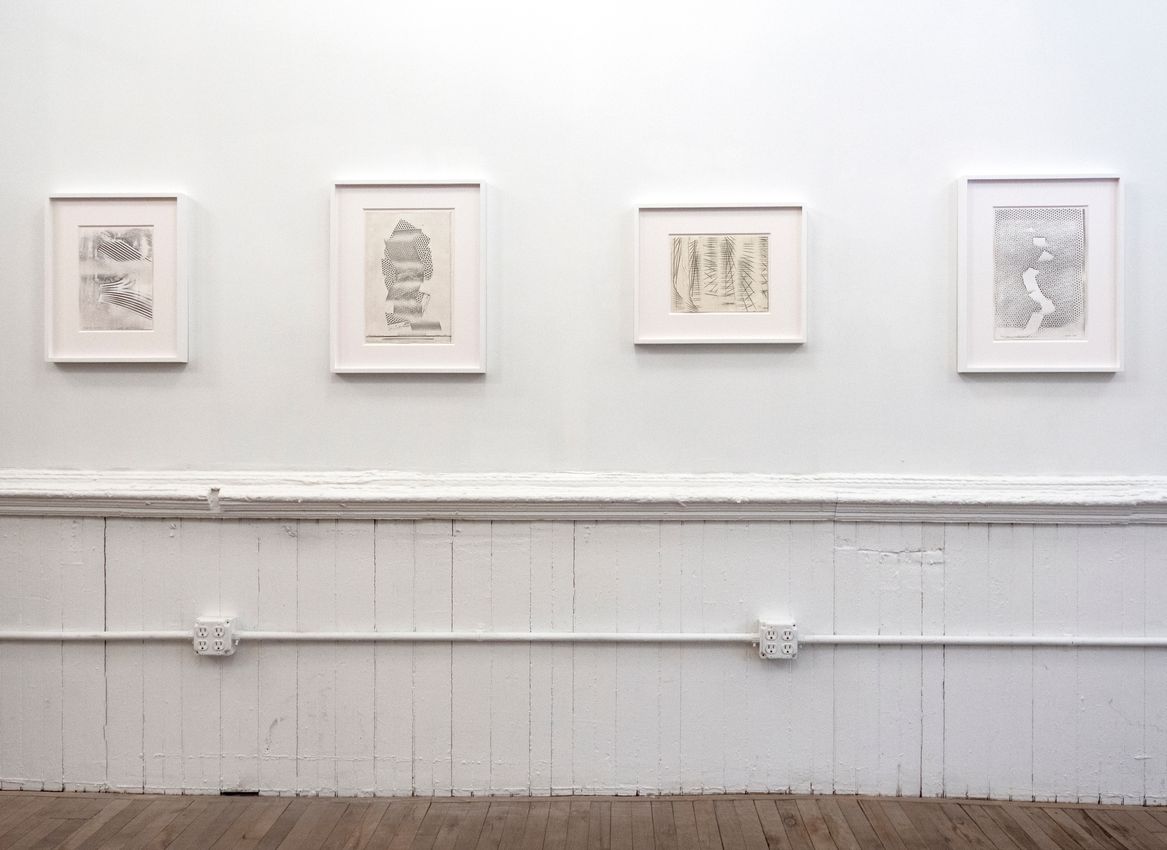
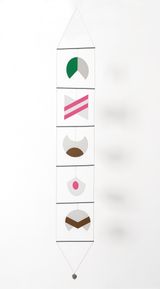
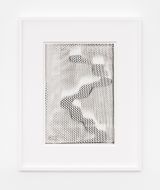
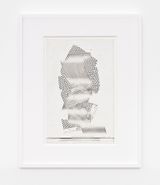
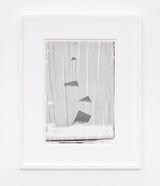
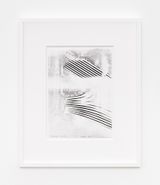
Andrew Kreps Gallery is pleased to announce a presentation of works by Bruno Munari at 55 Walker Street, organised in collaboration with kaufmann repetto.
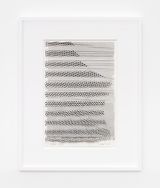
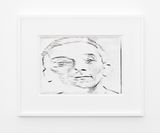
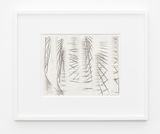
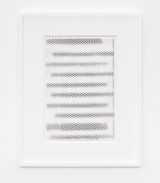
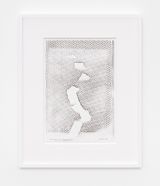
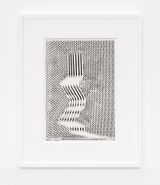
Focusing on Munari’s experiments with the Xerox 914 Machine, which began in 1963 and would continue throughout his entire career, the presentation brings a selection of works documented in his seminal book Xerografia: Documentazione sull’uso creativo delle macchine Rank Xerox (Xerography: Documentation of the creative use of the machine Rank Xerox). Published in conjunction with Munari’s participation in the 1970 Venice Biennale, to which Munari contributed a Xerox machine to an experimental laboratory within the Biennale, the book provides instructions on the many ways to subvert the commercial machine’s function to create original images and artworks. Ranging from abstract to figurative, Munari’s Xerox works distort the original subject as he moved images across the device’s surface for the duration of the scanning process.
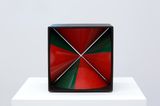
The presentation also includes Munari’s Tetracono (1965), an object with the purpose of ‘show[ing] forms while they are in the process of becoming’. Comprised of four cones set within a cube, each cone’s surface is divided equally between the complementary colours of red and green. Munari devised an 18-minute sequence of movement for the work, making Tetracono one of the earliest examples of programmed art. The result is a continuous balancing act of colour, shape, and form that unfolds before the viewer.
Bruno Munari is the first in a series of presentations organised by Andrew Kreps Gallery at 55 Walker Street, anticipating the gallery’s move to 22 Cortlandt Alley in June 2019.
Courtesy Andrew Kreps Gallery and kaufmann repetto, New York.
Bruno Munari described himself as an ‘artist, writer, inventor, designer, architect, and illustrator,’ a list that is nowhere near exhaustive. He began his career at an early age during the second wave of Italian Futurism, exhibiting his work for the first time in 1927 at Galleria Pesaro, Milan. In the years following, he progressively moved away from the influence of Futurism, developing an extremely personal and singular project over the course of 70 years. In 1930, he produced the Macchina aerea (Aerial Machine), from which came his Macchine inutili (Useless Machines), anticipating his interest in the deconstruction of the traditional work of art. Much of Munari’s work is characterised by a pedagogic interest and a radical vision of expanding man’s understanding of the world through the development of new forms of visual communication. Prolific in output throughout his life, and tirelessly inventive, his work defied categorisation and includes some of the earliest experiments in what Munari himself would term ‘programmed art’, as well as light art, installation art, projection-based art, and photocopy art. Throughout his work, Munari viewed technology as a democratising force within Art, citing the potential for an ‘art by all’, and the destabilisation of the idea of the singular artistic genius. Munari exhibited extensively throughout his lifetime—in 1955, he had a two-person exhibition with Alvin Lustig at the Museum of Modern Art, New York, and in 1966, had a solo exhibition at the Howard Wise Gallery, New York. Munari also participated in major international exhibitions, which include Documenta 3, Kassel (1964), Documenta 4, Kassel (1968), and nine editions of the Venice Biennale.


A respected voice in contemporary art discourse.
Focusing on ambitious storytelling and insightful art-world commentary. Ocula Magazine publishes in-depth interviews, critical essays and timely analysis on the artists, exhibitions and ideas driving the global art world.
Learn more about Ocula Magazine
Showcasing the best of the art world.
Ocula partners with galleries from around the world to highlight their artists, artworks and exhibitions. Gallery membership is by application and invitation, with each member vetted by an independent panel.
Learn more about Ocula Membership

Specialises in the sale of major artworks.
Led by a team with deep ties to the world’s leading auction houses, galleries and collectors. Ocula’s advisory team offers bespoke services to high-net-worth clients from around the world who are looking to acquire the best of contemporary and modern art.
Learn more about our team and services
