

HAEGUE YANG
b. 1971, South KoreaHaegue Yang layers different cultures to create her own visual language, combining everyday objects with artisan techniques and mass-produced materials. From installation to collage and sculpture to theatre, the Korean-born, Berlin-based artist considers humanity’s acceptance of the modernisation of society.
Early Years
Haegue Yang was born in Seoul in 1971. Her parents were activists and writers working against South Korea’s military government and the sociopolitical upheavals that accompanied her childhood have influenced her artistic practice, which considers movement and multiple cultures. She attended Seoul High School of Art, Music and Dance, then studied sculpture at Seoul National University, graduating in 1994. Moving to Frankfurt, she studied at the Städelschule Art Academy, which included a year at The Cooper Union in New York City. She graduated in 1999.
Haegue Yang: Artworks
Speaking to Ocula in 2014, Haegue Yang said: “...an artistic practice should be something actual; something to experience, not necessarily to understand; and it should rather resist the conventional idea of possessing a common thread or summary in the sense of an understandable message.”
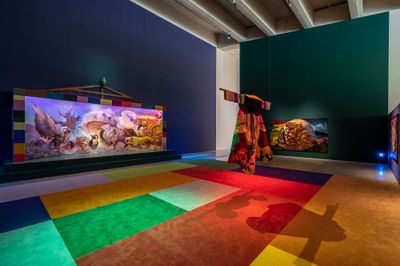
Haegue Yang’s artistic language is at once personal and universal, blending visual abstraction with sensory elements including sound, light and touch. She considers the role materials play in history and society, and frequently returns to themes of migration, social mobility and post-colonial diasporas. Working across sculpture, theatre, installation and collage, she uses everyday objects including Venetian blinds, radiators, household appliances and drying racks alongside traditional and culturally significant mediums including straw and small bells.
- Yang began working with Venetian blinds in 2006 and the material has become a key element in her practice. At the 53rd Venice Biennale in 2009, the artist represented South Korea with the exhibition Condensation, which explored the hidden spaces where development can occur. Series of Vulnerable Arrangements—Voice and Wind saw Yang create a system of blinds flooded with natural light, creating shadows suggesting experiences and places that weren’t physically present.
- 2009’s Sailim (a title that references Salim, the Korean word for home-making) is a life-sized replica of Yang’s kitchen in her old Berlin apartment. It included the radiator and the boiler, but also smells of food (coffee, bread) and digestion. .
- At the Taichung Art Museum—within the “Museumbrary”, which opened in December 2025—Haegue Yang was commissioned to create Liquid Votive—Tree Shade Triad (2025), a “cosmic tree” suspended from the ceiling of the museum lobby. The work, taking inspiration from Korean traditions around the sacredness of trees, inverted the traditional idea of a tree growing from the ground and hung three cascading Venetian-blind structures from the ceiling of the 27-metre-high space. Light and shadow throughout the days and seasons is transformed by the artwork. “It’s a rare platform where artworks can appear vividly after dark,” Yang said at the time.
Haegue Yang: Select Awards
- 13th Benesse Prize, Singapore (2022)
- The Republic of Korea Cultural and Arts Award, Visual Arts Sector (2018)
- Wolfgang Hahn Prize, Cologne (2018)
- Cremer Prize, Münster (2008)
- Bâloise Art Prize, Hamburg (2007)
Haegue Yang: Select Exhibitions
Select Solo Exhibitions
- Haegue Yang: Through, Dia Beacon, New York (2026)
- Haegue Yang: Star-Crossed Rendezvous, The Museum of Contemporary Art (MOCA), Los Angeles (2026)
- Lost Lands and Sunken Fields, Nasher Sculpture Centre, Dallas (2025)
- Arcane Abstractions, kurimanzutto, Mexico City (2025)
- Mesmerising Mesh—Paper Leap and Sonic Germination, dépendance, Brussels (2024)
- Haegue Yang: Flat Works 2004—24, The Arts Club of Chicago (2024)
- Haegue Yang: Leap Year, Hayward Gallery, London (2024) (and touring)
- Haegue Yang: Changing From From To From, National Gallery of Australia, Canberra (2023)
- Mesmerising Mesh—Paper Leap and Sonic Guard, Galerie Barbara Wien, Berlin (2022) (and touring)
- Haegue Yang: Handles, MoMA, New York City (2019)
- An Opaque Wind Park in Six Folds, Serralves Museum of Contemporary Art, Porto (2016)
- The Tanks: Art in Action, Tate Modern, London (2012)
- Condensation, South Korean Pavilion, 53rd Venice Biennale (2009)
- Foxed in the Forest, dépendance, Brussels (2007)
- Cremer-Preis, Landesmuseum für Kunst und Kulturgeschichte (LWL), Münster (2005)
- Air and Water, Dresdner Bank, Frankfurt (2002)
- Hamburgefonstiv, 1822—Forum, Frankfurt (1999)
- rraum, Frankfurt (1995)
Select Group Exhibitions
- Heredium Series: Tracing the Unfinished, Heredium, Daejeon (2026)
- Does the flower hear the bee?, 15th Shanghai Biennale (2025)
- Resonant Forms, The Hepworth Wakefield (2025)
- Attitude of Coexistence: Non-humans in East Asian Art, Hood Museum of Art, Hanover (2024)
- Performa Biennale 2023, Solomon R Guggenheim Museum/Peter B Lewis Theatre, New York City (2023)
- Planet B. Climate change and the new sublime, Palazzo Bollani, Venice (2022)
- Found Space, M+, Hong Kong (2021)
- Pine’s Eye, Talbot Rice Gallery, Edinburgh (2020)
- Hidden Beauty, Kunsthalle Nürnberg (2019)
- Lesson, National Museum of Modern and Contemporary Art, Gwacheon (2017)
- The Great Acceleration, Taipei Biennial (2014)
- The Grand Domestic Revolution—User’s Manual, Casco—Office for Art, Design and Theory, Utrecht (2011)
- From the Gathering, Helen Pitt Gallery, Vancouver (2009)
- Something Mr C can’t have, Kiaf, Seoul (2007)
- 5th Gwangju Biennale (2004)
- We’re not here to give you pleasure, rraum 02, Frankfurt (2001) (and touring)
- Where I Am, Lisbon World Exposition, Galeria Municipal da Mitra, Lisbon (1998)
Further Reading
- Haegue Yang’s website
- Haegue Yang’s Instagram
- Artist profile page at kurimanzutto
- Tour of Haegue Yang’s Leap Year
- Survey at the Hayward (2024) with senior curator Yung Ma
- Artist profile page at MoMA
Haegue Yang FAQs
Did Haegue Yang make a sculpture out of boxes?
In a sense—she created an installation from the cardboard boxes in which her artworks had been stored. In 2004, Yang was an artist in residence with no permanent address, yet her work had been in exhibitions across the world. Post-show, her artworks were being returned to her, but she had nowhere to store them, so she created Storage Piece, an assemblage of cardboard boxes and tape, sitting on a pallet. It’s been unpacked and repacked a few times: in Berlin in 2007, it was completely unpacked and the contents displayed in a new way. Gradual unpackings have also takes place in Los Angeles in 2009 and in London in 2025, when the curation team for Yang’s Leap Year exhibition at the Hayward Gallery unpacked a part of it every Tuesday afternoon.
What are Haegue Yang’s The Intermediates?
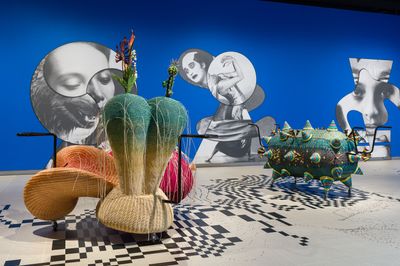
The Intermediates is a series of sculptural pieces that Haegue Yang began in 2015. She learned basket-weaving from an artisanal expert, but instead of using natural straw, she uses artificial material (referencing global mass production). The sculptures combine folklore, fairy tales and stories, as well as cultural elements that span East Asia.
When did Haegue Yang start using drying racks?
The familiar coated-wire racks used to dry clothes around the world first appeared in Yang’s Sadong 30 (2006), her first solo exhibition in Korea. The show took place in the former home of her grandparents, which had been uninhabited for years. Using ordinary household items (clocks, paint, the drying rack, a ventilator, a washbasin, IV stands) in states of abandonment, she created a “ghostly”, unconventional representation of everyday life.
Ocula
Works at Barbara Wien


171 x 100 x 15 cm
Barbara Wien Request Price & Availability


Recently Exhibited


Exhibiting Elsewhere


Works Elsewhere


95 x 75 x 75 cm
Galerie Chantal Crousel Request Price & Availability


Haegue Yang in Ocula Magazine







Explore and Follow Artists Shaping Contemporary Art
A respected voice in contemporary art discourse.
Focusing on ambitious storytelling and insightful art-world commentary. Ocula Magazine publishes in-depth interviews, critical essays and timely analysis on the artists, exhibitions and ideas driving the global art world.
Learn more about Ocula Magazine
Showcasing the best of the art world.
Ocula partners with galleries from around the world to highlight their artists, artworks and exhibitions. Gallery membership is by application and invitation, with each member vetted by an independent panel.
Learn more about Ocula Membership
Specialises in the sale of major artworks.
Led by a team with deep ties to the world’s leading auction houses, galleries and collectors. Ocula’s advisory team offers bespoke services to high-net-worth clients from around the world who are looking to acquire the best of contemporary and modern art.
Learn more about our team and services