Beijing Commune is proud to announce the opening of artist Qiu Xiaofei’s exhibition Rauschenberg Said, The Walking Stick Is Longer than the Maulstick, After All. on September 25th, 2013. The exhibition will continue until November 16th.
Since 2012’s Wood Behind Mountain Behind Wood, three-dimensional objects have started to appear in Qiu Xiaofei’s paintings. In his early 2013 solo exhibition Repetition at the Minsheng Art Museum, the artist’s capricious sense of chance established a new relationship between object and painting.
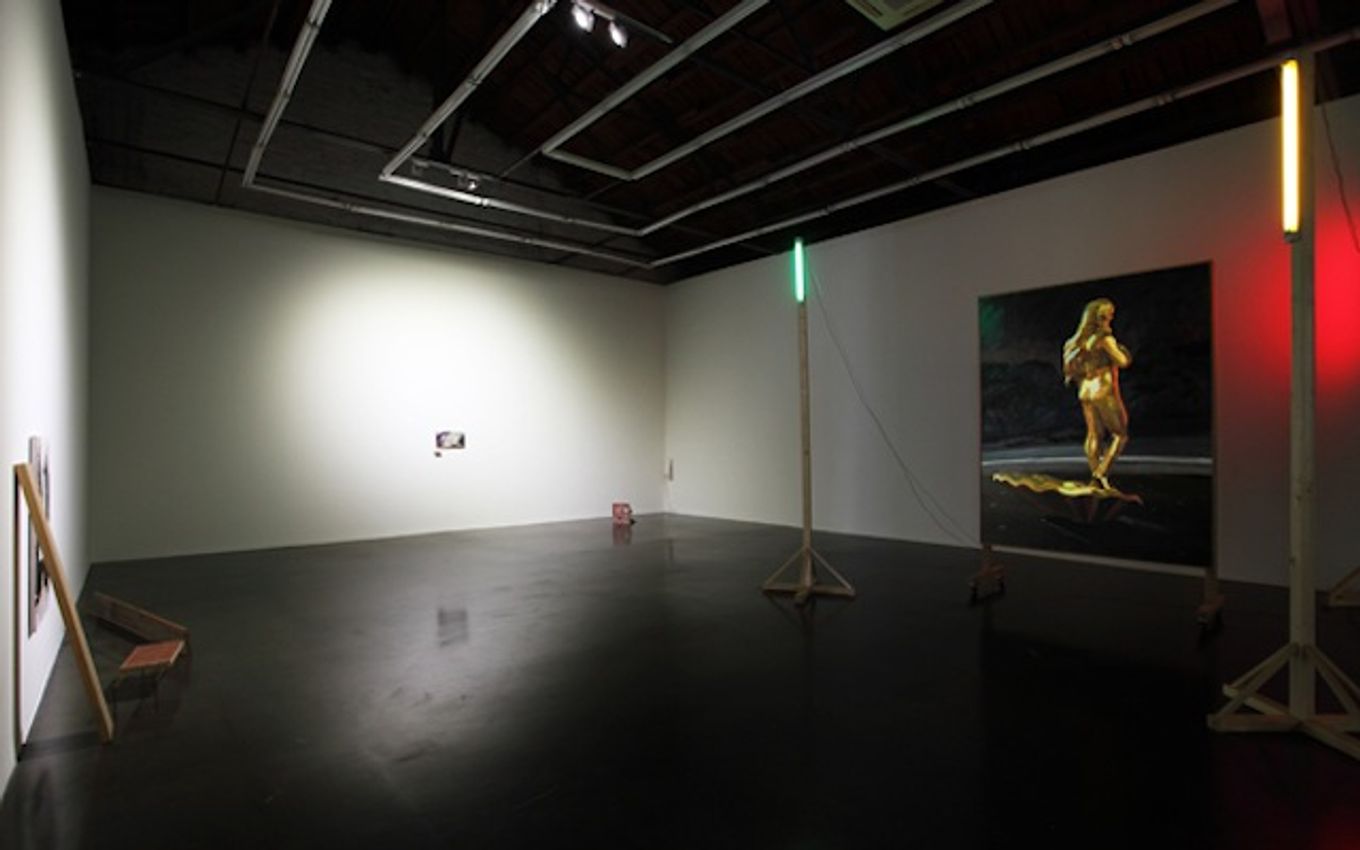
In this exhibition, Qiu Xiaofei displays a more rational bent in his explorations of this process. The new works in the show are separated into three elements-brushwork, colour, and modeling. For each element, Qiu explores its relationship to consciousness. In the centre of Space 1 is the painting installation Venus at the Outlet Mall, which investigates the relationship between colour and consciousness. The painting depicts a statue of Venus in the middle of a fountain in a suburban outlet mall at night. The gold sculpture is illuminated by three external light sources, reflecting red, yellow, and green. The artist then positioned three lampposts of his own construction around the painting based on these three reflections, thus giving the viewer the impression that there exists some ambiguous, hidden affiliation between the lampposts and the painting.
On the left side of the space, three small-scale works are arranged in a semi-circle: Chicken Wood, Soap View, and Ball Foot. In these works, object and painting act as extensions of and intrusions into each other. As Qiu Xiaofei has said, ‘If painting is an object coated in colour, then all coloured objects can be called paintings.’
In Soap View, a bar of soap used to wash paint brushes is set in the lower left-hand corner of the painting, the yellow brushstroke-like form mimicking the streaks of paint on the canvas. In Chicken Wood, the relationship between the wood planks arranged before the painting and the chicken legs emerging from the log cabin is even more mysterious. In Ball Foot, the relationship between object and painting is completely inverted, with two wax feet not only trampling on the object-as-painting (two small boards), but also trampling on the object of the painting that exists only in one’s consciousness (two dubiously floating spheres).
On the right-hand wall hangs a trapezoidal work entitled W. When the artist was uncertain as to what he would draw, he ordered an atypically shaped frame based on a hand-drawn W. On this set external shape the artist drew a refrigerator with an open door based on a W composition. As his vision became more and more concrete, three turnips were placed inside the refrigerator. He imagined that his fictional shopper and another experimental artist who probed issues of painting and object–Robert Rauschenberg–had met in a supermarket. In the end, they decided to swap the objects they carried, leading to the title of this exhibition.
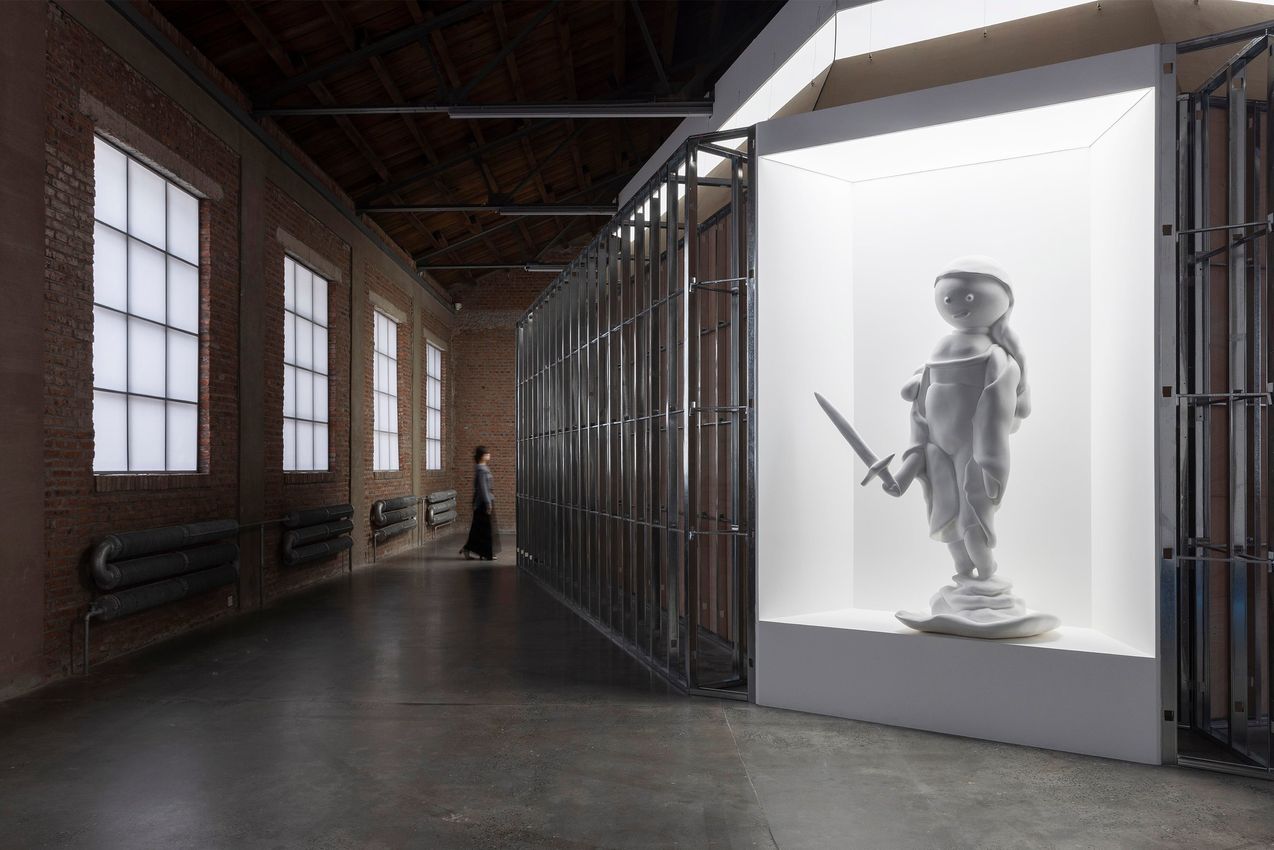
Robert Rauschenberg would never expect that his painting would be arranged into such a context made up by an artist from a much younger generation. His Golden Boy [Anagram(A Pun)] (1997) occupies the main wall of Space 2 and is accompied with a walking stick and a string bag with two metal balls that are popular as a tool for hand and mental exercises. And the maulstick and the string bag that were supposed to belong to Rauschengberg are put into the neighboring space with Qiu Xiaofei’s works. An interesting logic net has been eventually woven up by the narrative elements deduced from abstract form.
For Qiu Xiaofei, the Rauschenberg piece in this show is not only the consequence of his flowing consciousness, but also a salute to this artist. Rauschenberg developed the form of his art with various media via consciousness, while in Qiu Xiaofei’s works, form has been set up as the starting point in his work, and the flow of the artist’s consciousness is finally transformed into each of the concrete detailed part that makes up the content of the works.
Founded in 2004, Beijing Commune is now located in 798 Art Factory, Beijing. Its initial programs were mainly group shows exploring various currents in contemporary art while now it primarily focuses on solo shows to carry on the in-depth research.

A respected voice in contemporary art discourse.
Focusing on ambitious storytelling and insightful art-world commentary. Ocula Magazine publishes in-depth interviews, critical essays and timely analysis on the artists, exhibitions and ideas driving the global art world.
Learn more about Ocula Magazine
Showcasing the best of the art world.
Ocula partners with galleries from around the world to highlight their artists, artworks and exhibitions. Gallery membership is by application and invitation, with each member vetted by an independent panel.
Learn more about Ocula Membership

Specialises in the sale of major artworks.
Led by a team with deep ties to the world’s leading auction houses, galleries and collectors. Ocula’s advisory team offers bespoke services to high-net-worth clients from around the world who are looking to acquire the best of contemporary and modern art.
Learn more about our team and services