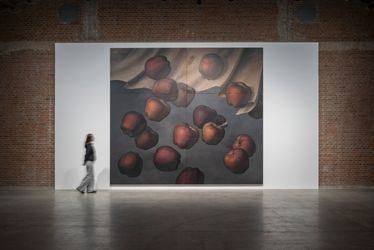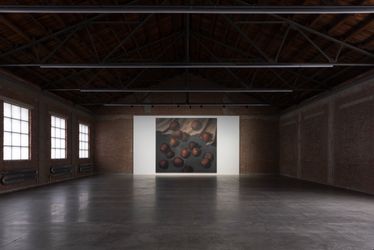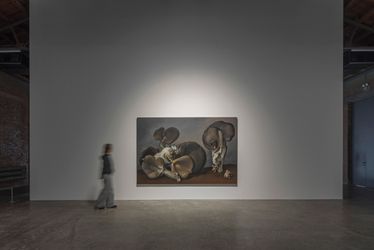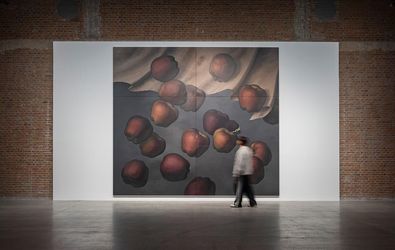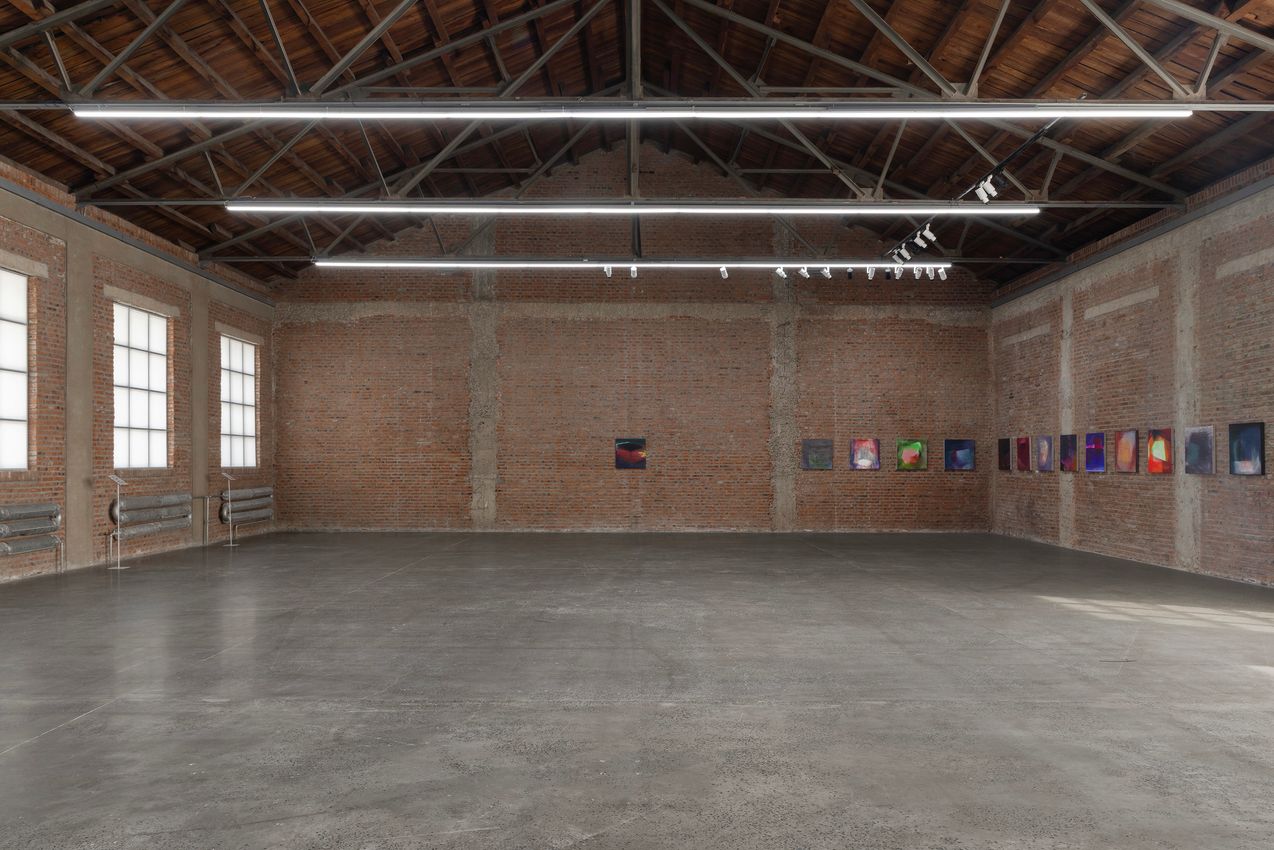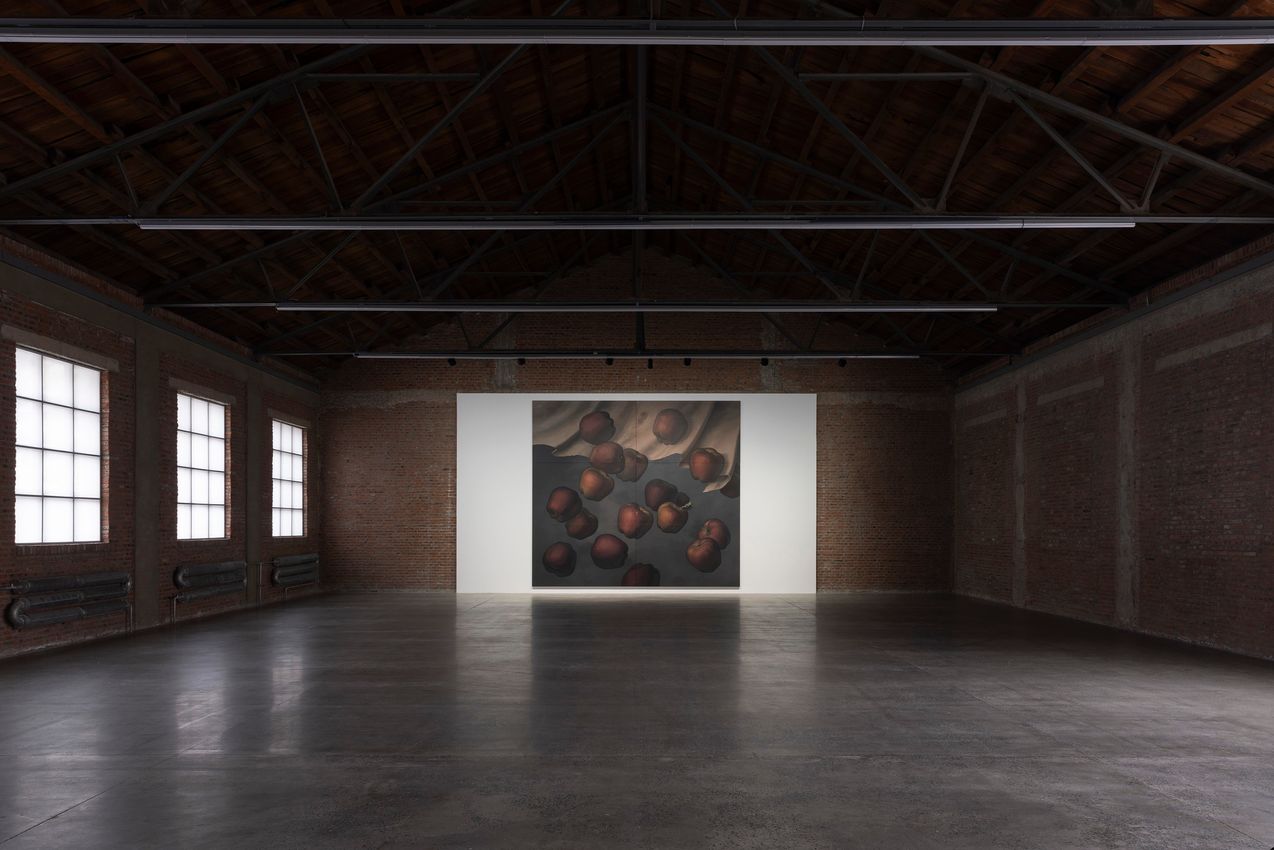
Beijing Commune is pleased to present Yan Bing’s solo exhibition Infatuated With, opening on November 6, 2025, featuring the artist’s latest paintings. Yan Bing is a remarkable artist who forges intimate and direct connections between subject matter and emotion. His art is at once grounded in reality, permeated with the vibrant breath of life, while simultaneously being imaginative and mythic, radiating throughout with qualities of will, spirit, and a certain persistence. In this exhibition, using only two large-scale works—The Lost Nakedness and resurrection—he clearly demonstrates his inseparable emotional ties to reality and humanity. He attempts to restore a sense of substance and direct connection to it through certain physical and material qualities within an uncertain present.
In The Lost Nakedness, the relationship between apples and cloth constitutes one of the most striking pairings in Yan Bing’s new body of work. In his paintings, the arrangement of internal pictorial space does not primarily stem from a desire to grant the picture an independent dimension; although the space occupied by these intensely rendered crops is highly concrete, what emerges more powerfully from Yan Bing’s canvases is the artist’s profoundly personal sensibility.
Yan Bing’s experiences growing up in Northwest China imbue his perception of life and life with a distinctive quality. Within this context, the relationship between people and the land reveals itself in its most fundamental and direct form: people labor on the land, the land yields food, and people find sustenance on the land. Within this simple and direct connection, human growth and the growth of crops share the same life. On the vast, open land, the uncertain fluctuations of life are felt directly and tangibly: the land’s solace and violence, its fertility and barrenness, its nurturing and decay...
Life is also mysterious and solemn. It represents a vast, immeasurable scale, yet within the depths of Yan Bing’s work, one can still strongly perceive the visage of concrete life. The apple and a piece of linen-textured cloth persistently evoke the functional relationship between the two. Hemp cloth is a tool of labor and daily life connected to the land; it assumes the simplest form while constantly changing its shape according to different purposes—a manifestation of life’s appearance. Within the experience of the land, descriptions of fate are not found in voluminous classics, but in the language that grows from the soil itself.
Yan Bing’s artistic journey is one of continually departing from and returning to his native land. The apple, too, has left the land: it is a crop, and it is a symbol in religion and classical texts. The apple is also one of the most familiar crops from Yan Bing’s hometown, but unlike the hemp cloth that remained there, the apple, having left his native place, continues to reappear within different life experiences, other systems of knowledge, and art history. In Yan Bing’s words, the apple is a kind of “temptation.” How to return to his native land is the question posed to Yan Bing by the “bewildered” apple. Opposite the apple, mushrooms establish relationships with one another through their very bodies on the dark stage of the earth. Through these relationships, Yan Bing narrates a certain connection to the land, the environment, and history. They are full of emotion and solace.
Through his continuous depiction of crops and their environments, and through an almost religious emphasis on humanity’s basic material conditions for survival, Yan Bing strives to overcome the fear of an uncontrollable and unimaginable future development.


Yan Bing was born in 1980 in Tianshui, Gansu Province, China and graduated from Central Academy of Fine Arts in 2007, 3rd Studio of the Oil Painting Department. He lives and works in Beijing. Recent solo exhibitions include: YAN Bing, Shanghai Minsheng Art Museum, Shanghai (2016); Love, Gallery Yang, Beijing (2015); My Labour II, Gallery Yang, Beijing (2013); Superfluous Things, No.5, Hive Center for Contemporary Art, Beijing (2013); Farming Poems, White Box Museum of Art, Beijing (2012); My Labour, Gallery Yang, Beijing (2011); 51㎡14#, Taikang Space, Beijing (2010); Temperature—curated by Liu Xiaodong, UCCA, Beijing (2009). He also participated in numerous group exhibitions held by institutions including CAFA Museum, Beijing; Minsheng Art Museum, Beijing; Urban Arts Space, Ohio State University, U.S.A.; RH Contemporary Art, New York, U.S.A.; Xi’an Art Museum, Xi’an; Taikang Space, Beijing; Guanshanyue Art Museum, Shenzhen; and G • ART, Nanjing.
Founded in 2004, Beijing Commune is now located in 798 Art Factory, Beijing. Its initial programs were mainly group shows exploring various currents in contemporary art while now it primarily focuses on solo shows to carry on the in-depth research.

A respected voice in contemporary art discourse.
Focusing on ambitious storytelling and insightful art-world commentary. Ocula Magazine publishes in-depth interviews, critical essays and timely analysis on the artists, exhibitions and ideas driving the global art world.
Learn more about Ocula Magazine
Showcasing the best of the art world.
Ocula partners with galleries from around the world to highlight their artists, artworks and exhibitions. Gallery membership is by application and invitation, with each member vetted by an independent panel.
Learn more about Ocula Membership

Specialises in the sale of major artworks.
Led by a team with deep ties to the world’s leading auction houses, galleries and collectors. Ocula’s advisory team offers bespoke services to high-net-worth clients from around the world who are looking to acquire the best of contemporary and modern art.
Learn more about our team and services