




ITHELL COLQUHOUN
1906-1988, IndiaIthell Colquhoun was a visionary British artist, writer, and occultist whose pioneering fusion of Surrealism and esoteric philosophy has earned her recognition as one of the most radical figures in 20th-century art. Her practice, celebrated in the landmark two-venue exhibition Between Worlds at Tate St Ives and Tate Britain in 2025, seamlessly combined automatic techniques, magical symbolism, and a fascination with the unconscious, nature, and the divine feminine.
Early Years
Colquhoun was born in Shillong, India, in 1906 to a British colonial family and moved to England as an infant. Growing up in Cheltenham, she attended Cheltenham Ladies’ College before enrolling at Cheltenham School of Art and then the Slade School of Fine Art in London, where she won the Summer Composition Prize for Judith Showing the Head of Holofernes in 1929. Her early years coincided with the aftermath of the First World War, a time of shifting gender roles and growing resistance to colonial power, which shaped her interest in alternative spirituality and artistic expression.
During her studies at the Slade, Colquhoun was exposed to both classical and modernist training, but it was her travels to Paris in the early 1930s and her encounter with Surrealism—especially the work of Salvador Dalí and André Breton—that profoundly influenced her direction as an artist. Her early paintings often featured liminal spaces—doorways, windows, and staircases—and combined figuration with Surrealist motifs, reflecting her fascination with the unconscious and the boundaries between worlds.
Ithell Colquhoun Artworks
Colquhoun’s art is distinguished by its unique blend of Surrealism, automatic drawing, and occult symbolism, exploring themes of sexuality, myth, gender, and the spiritual power of nature. Her practice evolved in tandem with her life experiences, shifting from early figurative Surrealism to later abstraction and magical symbolism.
Surrealist Beginnings and Automatism (1930s–1940s)
Colquhoun’s early works, such as Judith Showing the Head of Holofernes (1929) and Scylla (1938), reimagined mythological and biblical heroines, often in response to patriarchal Surrealist imagery. After meeting André Breton in 1939, she adopted automatic techniques, producing works like Rivières Tièdes (1939), which explored unconscious processes through fluid, dreamlike forms. Her first solo exhibition at Cheltenham Art Gallery in 1936 included plant studies reinterpreted as still-life compositions with erotic symbolism, marking her embrace of Surrealism and the influence of her time in Paris.
Occultism and Magical Symbolism (1940s–1970s)
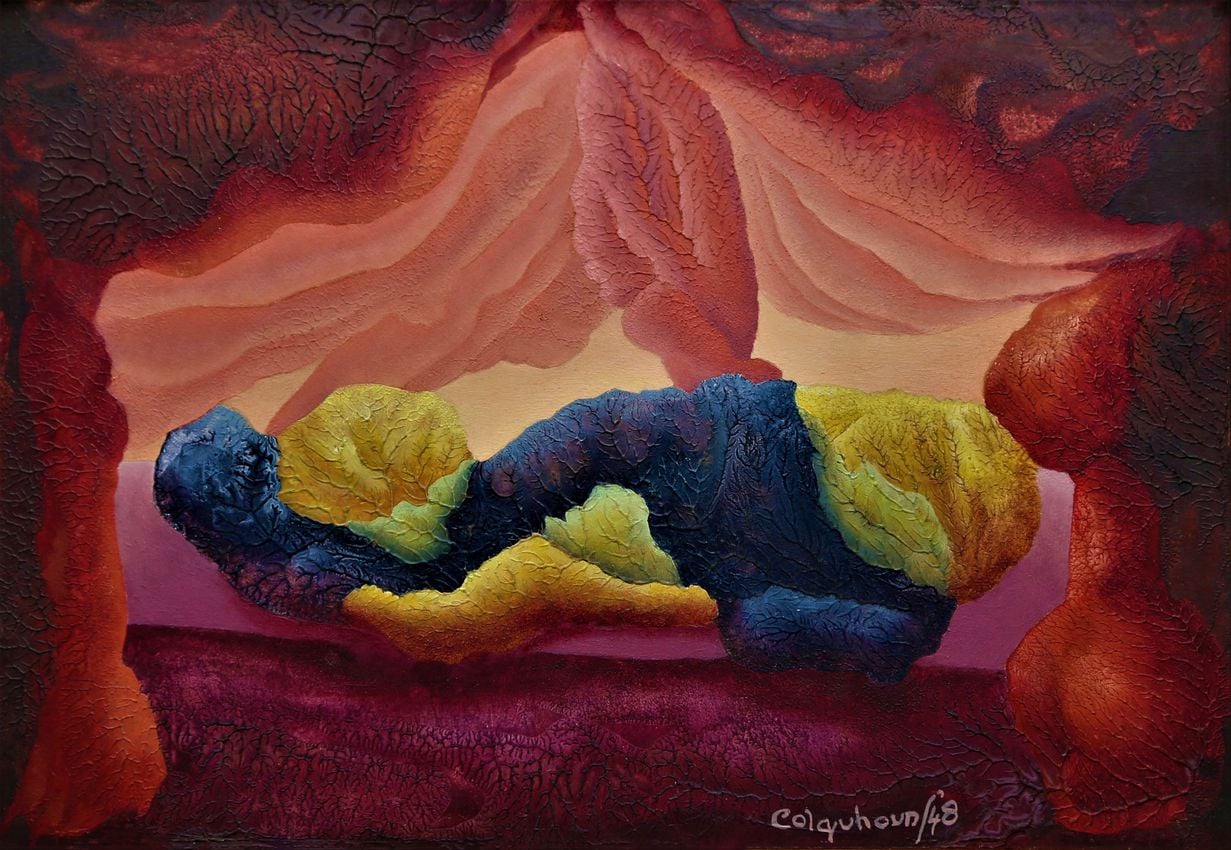
Colquhoun’s growing interest in mysticism, alchemy, and the occult led to her expulsion from the British Surrealist Group in 1940, after she refused to renounce her membership in occult societies. This break allowed her to pursue a more personal vision, developing new automatic methods such as ‘parsemage’ and creating visionary paintings and collages inspired by alchemy, Celtic mythology, and spiritual transformation. From the 1940s, she was increasingly inspired by the landscape and folklore of Cornwall, which became her home and creative base for the rest of her life. Her mid-career works, such as the enamel ‘convulsive landscapes’ of the 1960s, used automatic dripping techniques to evoke volcanoes and other transformative natural forms, reflecting her interest in magical transformation and the concept of ‘convulsive beauty’.
Tarot and Late Works (1970s–1980s)
In her later years, Colquhoun produced a complete Tarot deck and The Decad of Intelligence, a series of paintings based on the Kabbalah, representing the culmination of her integration of art and magical practice. These late works are among her most abstract and spiritual, using dripped enamel and automatic techniques to create visionary aids for meditation and ritual.
Select Public Commissions
- Theatre set and costume designs for London productions, 1930s–1950s
- (Unrealised) mural proposal for the Festival of Britain, 1951
Select Awards and Accolades
- Slade School of Fine Art Summer Composition Prize, 1929
- Major posthumous retrospectives at Tate St Ives and Tate Britain, 2025
Exhibitions
Ithell Colquhoun has been the subject of both solo exhibitions and group exhibitions at major institutions and galleries. Below is a selection of important exhibitions.
Solo Exhibitions
- Ithell Colquhoun: Between Worlds, Tate St Ives, 2025
- Ithell Colquhoun: Between Worlds, Tate Britain, 2025
- Elemental, Ben Hunter Gallery, London, 2023
- Ithell Colquhoun: Genius of the Fern Loved Gully, Falmouth Art Gallery, 2021
Group Exhibitions
- Surrealism, Centre Pompidou, Paris, 2024
- Blazing a Trail: Modern British Women, Bonhams, London, 2023
- Surrealism Beyond Borders, Tate Modern, London, 2022
Website
Ithell Colquhoun’s official archive and resources can be found at ithellcolquhoun.co.uk.
Ithell Colquhoun FAQs
Where can I see Ithell Colquhoun’s work?
Her works are held in the collections of Tate, London; Southampton City Art Gallery; and Falmouth Art Gallery. Major exhibitions have been staged at Tate St Ives and Tate Britain. You can follow the artist on Ocula to receive updates on upcoming exhibitions featuring her work.
What are the main themes in Colquhoun’s art?
Colquhoun’s art explores Surrealism, occultism, the divine feminine, sexuality, myth, and the spiritual power of nature.
Was Colquhoun involved in any art movements?
She was a key figure in British Surrealism and later became a pioneering occult artist and writer.
What books did Ithell Colquhoun write?
Her notable books include The Crying of the Wind: Ireland (1955), The Living Stones: Cornwall (1957), Goose of Hermogenes (1961), and Sword of Wisdom (1975).
Share an interesting fact about Colquhoun?
She was expelled from the British Surrealist Group for refusing to renounce her occult affiliations, and she sometimes signed works with her magical name, Splendidor Vitro.
How do you pronounce ‘Ithell Colquhoun’?
‘Ithell’ is pronounced ‘EYE-thell’ and ‘Colquhoun’ as ‘ka-HOON’.
Ocula | 2025










Explore and Follow Artists Shaping Contemporary Art
A respected voice in contemporary art discourse.
Focusing on ambitious storytelling and insightful art-world commentary. Ocula Magazine publishes in-depth interviews, critical essays and timely analysis on the artists, exhibitions and ideas driving the global art world.
Learn more about Ocula Magazine
Showcasing the best of the art world.
Ocula partners with galleries from around the world to highlight their artists, artworks and exhibitions. Gallery membership is by application and invitation, with each member vetted by an independent panel.
Learn more about Ocula Membership
Specialises in the sale of major artworks.
Led by a team with deep ties to the world’s leading auction houses, galleries and collectors. Ocula’s advisory team offers bespoke services to high-net-worth clients from around the world who are looking to acquire the best of contemporary and modern art.
Learn more about our team and services