





YOSHITOMO NARA
b. 1959, JapanYoshitomo Nara’s big-eyed figures are globally recognisable. His blend of pop culture and punk, Japanese visuals and an undercurrent of isolation, have made him one of Japan’s best-known artists, whose works sell strongly at auction. He is known for his paintings, but also produces drawing, photography, sculpture and installations.
Early Years
Yoshitomo Nara was born in 1959 in Hirosaki, Aomori Prefecture, Japan. He was the youngest of three boys in a post-war working-class family and—because his parents worked and his brothers were older—he spent much of his childhood alone. He drew picture stories about his imaginary adventures with his cat and listened to music on a radio station that broadcast to the US armed forces in Vietnam (music remains a massive part of his life). He has said that his work is inspired by fairytales he read as a child, rather than comics. In 1979, Nara enrolled at the private College of Art and Design at Musashino Art University. Two years later, he transferred to Aichi Prefectural University of the Arts where he joined the oil painting department. After graduation in 1985, he joined the institution’s master’s programme. In 1988, he moved to Germany to study at the Kunstakademie Düsseldorf. He lived in Germany for 12 years, and his discovery of German Neo-Expressionism impacted his visual language.
Yoshitomo Nara: Artworks
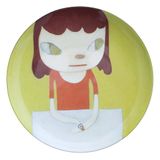
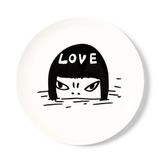
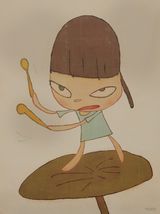
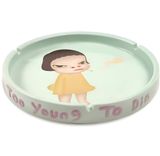
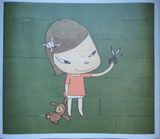
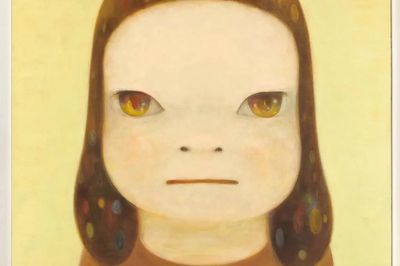
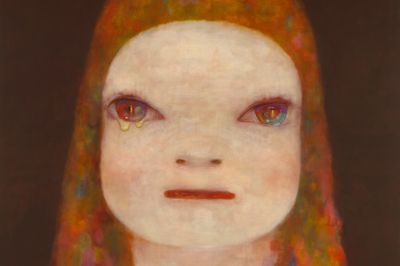
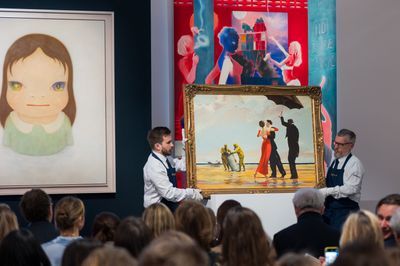
Yoshitomo Nara’s doe-eyed figures seem at first to be innocent children, their bold lines and bright colours appearing playful. But there are undercurrents of loneliness and rebellion in Nara’s work: some figures carry placards, one infamously hides a knife behind her back, and others are pictured next to slogans referencing geopolitical issues. His artworks layer paint in varied (sometimes subdued) pigments, giving his figures a “floating” presence. Without background detail, viewers’ eyes are drawn to the characters’ faces, prompting observers to consider the subjects’ emotions, projected through their eyes.
The time Yoshitomo Nara spent in Germany influenced his practice: he began to blend Japanese and Western popular culture. For instance, Nachtwandern (1994) adds his signature big eyes to a Wee Willie Winkie figure and Pony Tail (1995) feels as if its roots are in a Western comic.
- Nara’s “girls” and “boy” are a key element of his practice. Ramona is a recurring character, named after punk band The Ramones and with a rebellious spirit. Cosmic Girl is pictured with a Peter Pan-style collar. The Boy (as seen in 1999’s One Boy) seems more serious than the girls. Knife Behind Back (2000) is a large-scale canvas showing a standing figure of a girl with one hand concealed. Knife Behind Back sold for 195.7 million HKD (£20.2 million) in 2019.
- The Dog appeared in REM’s 2001 video for their single I’ll Take the Rain, which was also directed by Nara.
- My Drawing Room (2008) is a small wooden house—a centrepiece of his 2025 retrospective at London’s Hayward Gallery—inspired by his childhood idea of the perfect home. Filled with drawings, art materials and toys, it also has a music player, underlining the importance of music in Nara’s life.
- No War and Stop the Bombs (both 2019) both reference his childhood memories of listening to anti-war songs on the radio and the proximity of the conflict in Vietnam.
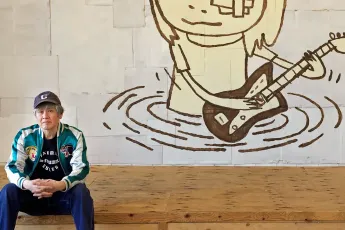
- In Pinacoteca (2021), Nara created an installation from construction cast-offs and wood, telling the Guardian in 2022 that he had “always felt quite uncomfortable with architecturally solid spaces such as museums.”
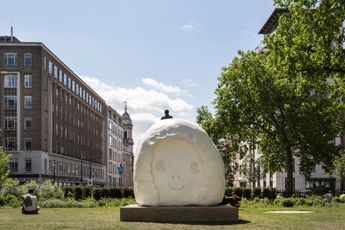
- Nara has re-engaged his connection to his hometown, Hirosaki—notably through Girl from the North Country (Study) (2025). During this period he also unveiled three outdoor bronze sculptures—Smiling, Slender Eyes and Basket Package.
Yoshitomo Nara: Exhibitions
Select Solo Exhibitions
- All Within the Detour, Huashan 1914 Creative Park, Taipei (2025)
- Yoshitomo Nara: I Don’t Want to Grow Up, Orange County Museum of Art, Newport Beach (2025)
- I Draw the Line, Blum, Tokyo (2024)
- A Lonely Place, Guggenheim Museum Bilbao (2024)
- All My Little Words, Albertina Modern, Vienna (2023)
- Pinacoteca, Pace Gallery, London (2021)
- Yoshitomo Nara, Los Angeles County Museum of Art (2021)
- Drawings: 1988–2018, Toyota Municipal Museum of Art, Toyota (2018)
- Yoshitomo Nara for Better or Worse, Toyota Municipal Museum of Art, Toyota (2017)
- Yoshitomo Nara: Life is Only One, Asia Society Hong Kong Center (2015)
- Yoshitomo Nara: A Bit Like You and Me, Yokohama Museum of Art (2012)
- Yoshitomo Nara: Nobody’s Fool, Asia Society, New York City (2010)
Select Group Exhibitions
- Plastic Utopia: Our New Ecosystem, Hirosaki Museum of Contemporary Art (2025)
- Breath(e): Toward Climate and Social Justice, Hammer Museum, Los Angeles (2024)
- STARS: Six Contemporary Artists from Japan to the World, Mori Art Museum, Tokyo (2020)
- Japanorama: New Vision on Art since 1970, Centre Pompidou-Metz (2017)
- Japanese Contemporary Art from the Museum of Modern Art, Gunma Museum of Art, Takasaki (2013)
- Little Boy: The Arts of Japan’s Exploding Subculture, Japan Society, New York City (2005)
- Superflat, Museum of Contemporary Art, Los Angeles (2001)
Further reading
- Yoshitomo Nara—the works website (managed by the Yoshitomo Nara foundation)
- Yoshitomo Nara’s Instagram
- A profile in the Guardian from 2022
- Yoshitomo Nara’s artist page from Pace Gallery
- A 2025 interview from Dazed
- 2025 interview with Esquire
- A 2016 conversation from Ocula marking the presentation of an award from the Asia Society
Yoshitomo Nara FAQs
Was Yoshitomo Nara affected by the 2011 Tōhoku earthquake?
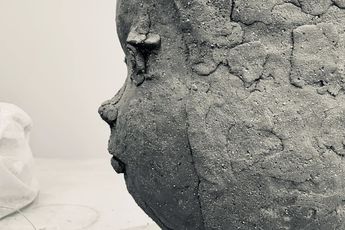
Yes, Yoshitomo Nara was deeply affected by the disaster, feeling depressed and powerless. Exhibitions after the earthquake showed new paintings with a closer focus on the figures’ faces, as well as bronze sculptures. Before the bronzes, he worked with ceramics and has said that kneading the clay helped his hands to think again.
What are Yoshitomo Nara’s influences?
Yoshitomo Nara is influenced by music—heard as a child through a radio broadcasting to US forces and, later, punk bands—which contributes to his characters’ rebelliousness. The loneliness of his childhood (a product of his parents and siblings working to rebuild the post-war Japanese economy) also influences the single-figure portraits he creates. Nara’s fusion of Japanese and Western culture comes from time spent in Germany. In more recent years, his artistic practice has also considered climate concerns.
What materials and techniques does Yoshitomo Nara use?
Yoshitomo Nara’s work spans painting, drawing, sculpture, and installation. His paintings—often in acrylic on canvas—feature soft, flat backgrounds and clean lines that heighten the emotional intensity of his figures. He has been making ceramics since 2007 and also expanded his practice into sculptures made of fibreglass-reinforced plastic (FRP) and bronze.
Do Yoshitomo Nara’s works sell well at auction?
Yes, Yoshitomo Nara’s works sell well at auction. In early 2026, Nothing about it (2016) hammered in South Korea at KRW 15 billion (£7.5 million). This record-breaking figure followed the 2025 sale of Can’t Wait ’til the Night Comes (2012) for 79.9 million HKD (£7.7 million) and the 2024 sale of I Want to See the Bright Lights Tonight (2017) for 95.9 million HKD (£9.3 million).
Ocula

View Yoshitomo Nara's Artworks














Explore Yoshitomo Nara's Exhibitions











Yoshitomo Nara in Ocula Magazine









Explore and Follow Artists Shaping Contemporary Art
A respected voice in contemporary art discourse.
Focusing on ambitious storytelling and insightful art-world commentary. Ocula Magazine publishes in-depth interviews, critical essays and timely analysis on the artists, exhibitions and ideas driving the global art world.
Learn more about Ocula Magazine
Showcasing the best of the art world.
Ocula partners with galleries from around the world to highlight their artists, artworks and exhibitions. Gallery membership is by application and invitation, with each member vetted by an independent panel.
Learn more about Ocula Membership
Specialises in the sale of major artworks.
Led by a team with deep ties to the world’s leading auction houses, galleries and collectors. Ocula’s advisory team offers bespoke services to high-net-worth clients from around the world who are looking to acquire the best of contemporary and modern art.
Learn more about our team and services