





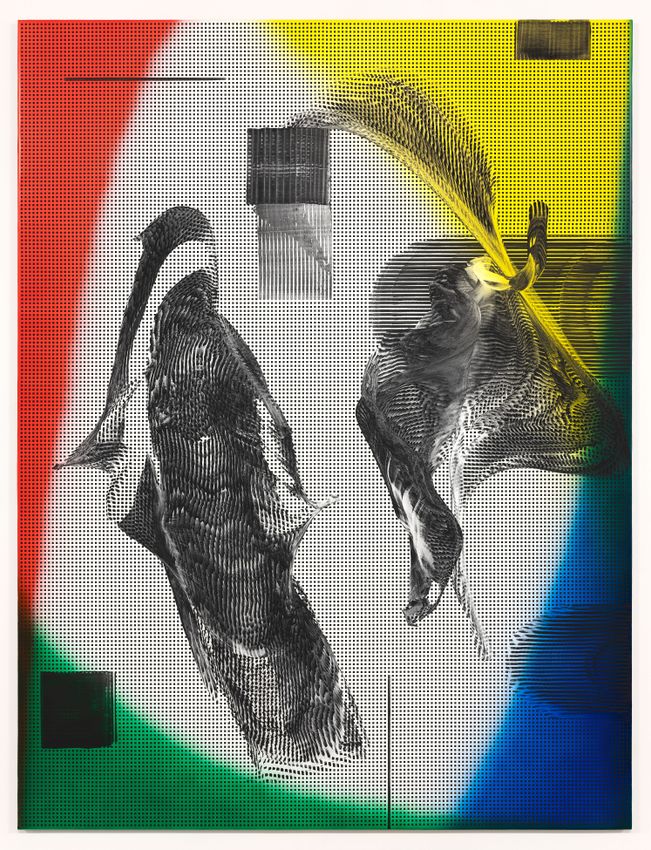
CHEYNEY THOMPSON
b. 1975, United StatesBorn in 1975 in Baton Rouge, Louisiana, Cheyney Thompson’s pale, multi-coloured and grid-based paintings are made by the artist imposing specific restraints or systems on his painting process. Positioned in a history of artists who use external factors to determine the outcome of their works, Thompson visualises complex data and formulae in order to investigate production, labour and systems of distribution in the art world.
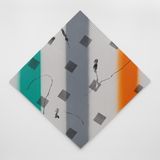
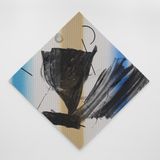
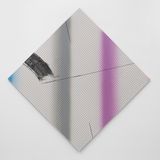
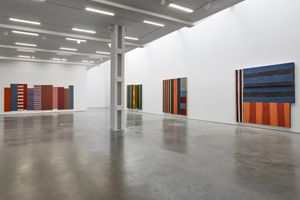
Exemplifying such a complex formula-turned-painting-method is ‘Chronochromes’ (2009–2011). The series is based off a system developed by the artist Albert H Munsell in the early 20th century, in which colours are defined by three co-ordinates: hue (colour), value (lightness), and chroma (colour saturation). For ‘Chronochromes’, a complementary hue pair is chosen each day and the lightness of that colour is altered as the hours progress, turning totally black at the arrival of midnight. The colour purity (saturation) shifts with each month. From afar, the result appears as a colourful, minimalist assembly of meticulous markings. However, as viewers approach, the labour behind the paintings reveals itself with the visibility of each minute stroke. The painting process and its history is further emphasised through Thompson’s use of canonical canvas shapes such as the Renaissance tondo.
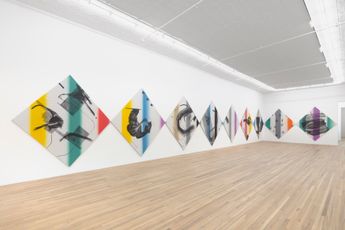
Breaking free of the grid, Thompson riffed on tropes of circulation and distribution in the art world for his 2012 exhibition Sometimes Some Pictures Somewhere at Andrew Kreps Gallery in New York. For the show, Thompson filled the space with large-scale, expressive, abstract paintings that were, in their looseness and colour, a far cry from his previous works. Yet the concern with systems was present; in the exhibition text, the artist conceptualised the gallery as a management operation rather than a space for exhibiting art. Ironically pointing at the capital-oriented organisation of contemporary art and the prevalence of art-based corporate ventures, the text referred to the gallery as ‘the most powerful, efficient, and comprehensive art, antiques, and collectibles gallery and collection management software available. ... [the gallery] automates virtually all art and antiques business and collection information management tasks.’
Thompson returned to monochromatic canvases for his ‘Quantity Paintings’ (2015–2017) series. Each painting is the result of the complex random walk algorithm—a term introduced by Karl Pearson in 1905 which is used to explain fluctuations in stock markets and other systems. Thompson applies the algorithm in his series to divide the total volume of pigment proportionate to the canvas, with each portion equal to a single stroke, the aim of the algorithm being that the canvas is covered as quickly as possible.
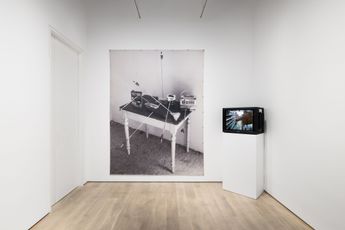
Further disrupting normative assumptions of art distribution, when one grouping of ‘Quantity Paintings’ were exhibited at Andrew Kreps Gallery in 2017, Thompson installed a biometrically secure punch clock in the gallery that cycled through the 152,587,890,625 unique orders in which the paintings could be arranged in the gallery. When a gallery staff member punched in each morning, a new installation was determined and the paintings were rehung.
Thompson’s artworks are held in the permanent collections of the Centre Pompidou, Paris; Whitney Museum of American Art, New York; San Francisco Museum of Modern Art; and The Museum of Modern Art, New York. Thompson’s first museum survey was held in 2012 at the List Visual Arts Center in Cambridge, Massachusetts. The artist received his BFA from the School of the Museum of Fine Arts, Boston, in 1997.
Thompson lives and works in New York City.
Tessa Moldan | Ocula | 2018

View Cheyney Thompson's Artworks
















Explore Cheyney Thompson's Exhibitions





Explore and Follow Artists Shaping Contemporary Art
A respected voice in contemporary art discourse.
Focusing on ambitious storytelling and insightful art-world commentary. Ocula Magazine publishes in-depth interviews, critical essays and timely analysis on the artists, exhibitions and ideas driving the global art world.
Learn more about Ocula Magazine
Showcasing the best of the art world.
Ocula partners with galleries from around the world to highlight their artists, artworks and exhibitions. Gallery membership is by application and invitation, with each member vetted by an independent panel.
Learn more about Ocula Membership
Specialises in the sale of major artworks.
Led by a team with deep ties to the world’s leading auction houses, galleries and collectors. Ocula’s advisory team offers bespoke services to high-net-worth clients from around the world who are looking to acquire the best of contemporary and modern art.
Learn more about our team and services