




SARA CWYNAR
b. 1985, CanadaSara Cwynar is a Canadian artist based in New York whose work spans photography, film, collage, installation, and books. She is best known for densely layered photographic tableaus and research-driven moving-image works that explore how advertising, design, and photography construct desire, beauty, and value in contemporary visual culture. Cwynar’s signature projects include the artist’s book Kitsch Encyclopedia (2013-2014), the films Soft Film (2016), Rose Gold (2017), Cover Girl (2018), Glass Life (2021), and the ongoing “Tracy” photographic series centred on Tracy Ma.
Her films have screened at major festivals, including the International Film Festival Rotterdam (IFFR), where Rose Gold received a Tiger Short Award; Red Film (2018) also received a Tiger Short Award, and Glass Life (2021) premiered at IFFR in the Ammodo Tiger Short Competition. Cwynar’s work is held in public collections including the Museum of Modern Art and Guggenheim Museum in New York, SFMOMA, MMK Frankfurt, Centre Pompidou, Fondazione Prada, the Art Gallery of Ontario, and Musée d’art contemporain de Montréal. In 2025, she was awarded a Guggenheim Fellowship.
Early Life and Career
Born in Vancouver and raised in Canada, Cwynar later established her practice in New York, working at the intersection of photography, publishing, and design. She studied English literature and graphic design, producing Kitsch Encyclopedia while a design student as a way to sift through the “public images” of advertising, encyclopedias, history books, and photographic manuals that surrounded her. She received a BA from York University in 2010 and an MFA from Yale University in 2016, consolidating a practice that bridges image theory with studio-based production.
Before dedicating herself full-time to her art, Cwynar worked professionally as a designer, a background that continues to shape her sensitivity to typography, layout, colour, and the visual rhetoric of commercial imagery. Early solo exhibitions at Cooper Cole in Toronto from 2012 onwards, along with a 2013 exhibition at Foam 3h in Amsterdam and recognition as a Foam Talent in 2015, introduced her work to international audiences and positioned her among a generation of artists rethinking photography in relation to mass media.
Works, Series and Methods
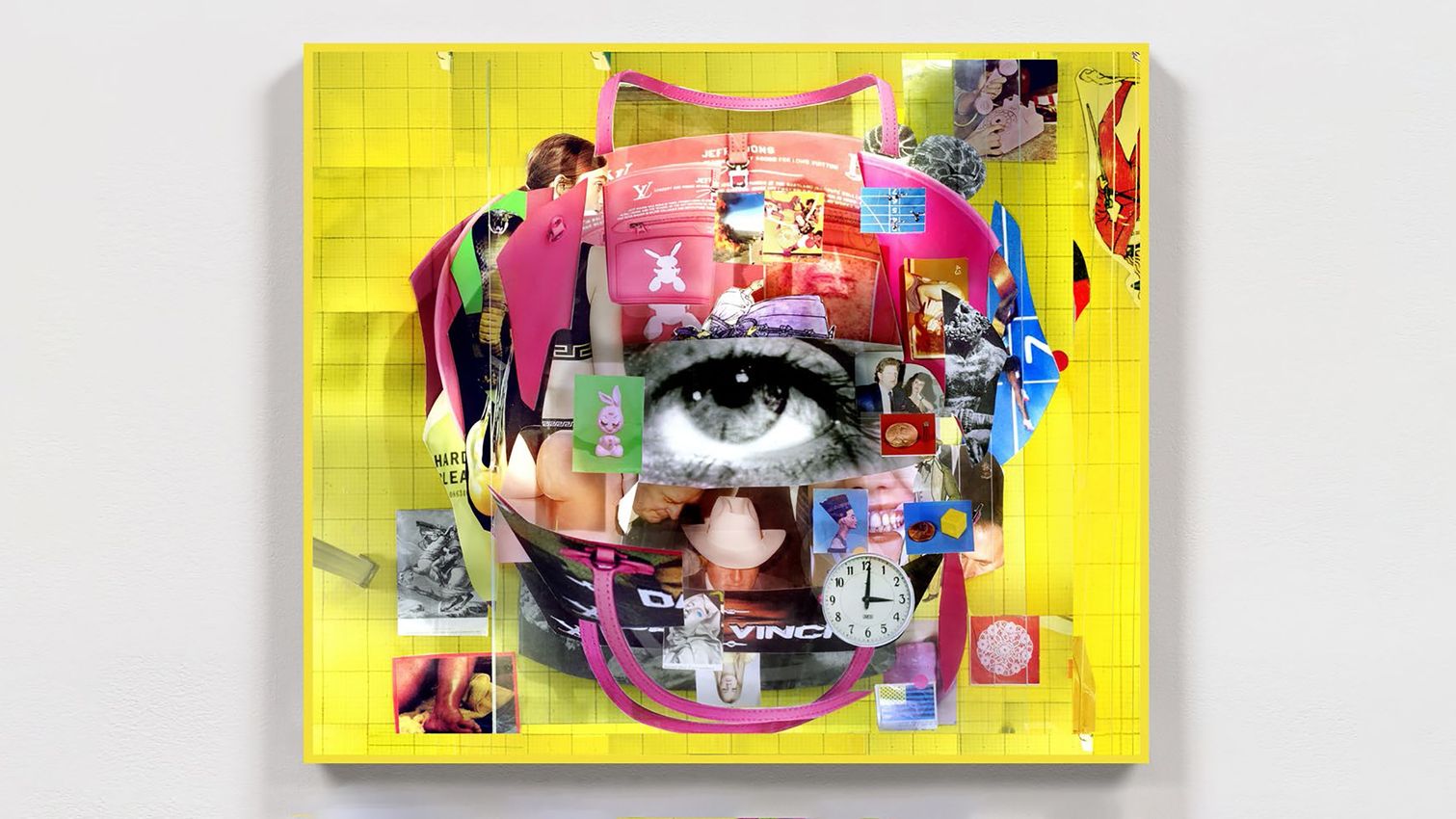
Across her photographic work, Cwynar constructs intricate tableaus from found objects, stock photographs, postcards, darkroom manuals, and her own studio images, which she repeatedly arranges, re-photographs, and recombines. The resulting compositions often recall catalogues and advertisements: tiled, brightly coloured fields of cosmetic products, consumer goods, and art-historical reproductions built up to the point of visual saturation. This iterative process of archiving, collage, and re-photography produces images that feel at once familiar and unstable, foregrounding how pictures circulate, age, and shift in meaning over time.
Her films extend these concerns into time-based, research-oriented works that combine studio performances, on-screen text, rapid montage, and scripted voice-overs. In Soft Film (2016), Cwynar appears on screen sorting a collection of vintage velvet jewellery boxes purchased on eBay, using their sentimental appeal to reflect on how colour and design operate politically, socially, and historically, especially in relation to beauty and the desire for objects. Rose Gold (2017) takes the colour of the iPhone 6s as a focal point, linking the seductive surface of a consumer device to histories of femininity, labour, and technological desire. Works such as Cover Girl (2018) and Glass Life (2021) continue this montage-driven, citation-rich approach, showing how media and advertising shape ideas of beauty, authenticity, and self-improvement.
The ongoing “Tracy” series (2014–present) centres on Cwynar’s friend and collaborator Tracy Ma, who appears within dense studio tableaus of cut-out images, printed matter, luxury brand labels, perfume bottles, and historical and contemporary images of women. Treating the studio portrait as a site where bodies and ideals are constantly composed, these photographs highlight how femininity is mediated through image economies, while visible seams, taped edges, and overlapping surfaces resist the seamless polish of commercial photography. In other works, such as Alphabet (Index) (2025), Cwynar creates 26 panels of collaged imagery based on her own Google searches, algorithmic suggestions, and popular search terms from 2020–2025, alternating between straightforward words like “Apple” or “Eye” and more abstract concepts such as “Disinformation” or “Knowledge”. Referencing Aby Warburg’s Mnemosyne Atlas (1925–1929), the project maps a shared cultural moment while underscoring the subjectivity and bias built into digital image archives.
Themes and Context
Cwynar’s work consistently investigates how photography and design shape desire, particularly around consumer products, colour, and beauty conventions. She is interested in how mass-circulated “public images”—from advertising and catalogues to lifestyle photography—enter consciousness and naturalise specific values, often masking the labour, histories, and power relations behind objects and styles. By collecting, restaging, and overloading these images, she reveals the visual strategies through which ideals of femininity, luxury, progress, and authenticity are constructed and sold.
Books and publications remain central to her practice. Kitsch Encyclopedia brings together writings by Milan Kundera, Jean Baudrillard, Roland Barthes, and others with Cwynar’s own texts and re-photographed images, examining the aesthetics and politics of kitsch and its ties to sentimentality and mass imagery. References to theorists recur across her scripts and book projects not as footnotes but as fragments embedded within the works, underscoring how theory itself circulates as part of the image economy. At the same time, her focus on specific colours—such as the “rose gold” of a smartphone, Cover Girl Pink, or shades like “baby blue” and “Ferrari red” in Baby Blue Benzo (2024)—grounds these conceptual concerns in the everyday surfaces of phones, cosmetics, packaging, and automobiles that structure contemporary visual life.
Exhibitions, Collections and Recognition
Select solo exhibitions
- Soft Film (2017), MMK Museum für Moderne Kunst, Frankfurt am Main.
- Sara Cwynar: Image Model Muse (2018), Minneapolis Institute of Art, Minneapolis.
- Sara Cwynar: Image Model Muse (2019), Milwaukee Art Museum, Milwaukee.
- Sara Cwynar: Source (2021), Remai Modern, Saskatoon.
- Apple Red/Grass Green/Sky Blue (2022), ICA Los Angeles, Los Angeles. S/S 23 (2023), Foam Photography Museum, Amsterdam.
- Baby Blue Benzo (2024), 52 Walker, New York.
- Alphabet (2025), The Approach, London.
- Sara Cwynar (2025), ICA Boston, Boston.
- Baby Blue Benzo (2026), Museum of Contemporary Art (MOCA), Toronto.
- Sara Cwynar (2026), The Approach, London.
- Sara Cwynar (2026), Esther Schipper, Berlin.
Film Screenings and Awards
- Soft Film (2016), International Film Festival Rotterdam (IFFR), Rotterdam.
- Rose Gold (2017), International Film Festival Rotterdam (IFFR), Rotterdam — Tiger Short Award.
- Red Film (2018), International Film Festival Rotterdam (IFFR), Rotterdam — Tiger Short Award.
- Glass Life (2021), International Film Festival Rotterdam (IFFR), Rotterdam — Ammodo Tiger Short Competition.
Collections and Recognition
- Museum of Modern Art, New York; Guggenheim Museum, New York; SFMOMA, San Francisco; MMK Frankfurt, Frankfurt; Centre Pompidou, Paris; Fondazione Prada, Milan; Art Gallery of Ontario, Toronto; Musée d’art contemporain de Montréal, Montréal.
- Guggenheim Fellowship (2025), John Simon Guggenheim Memorial Foundation, New York.
Sara Cwynar FAQs
What is Sara Cwynar best known for?
Sara Cwynar is best known for her multilayered photographs and research-driven films that analyse how advertising, design, and photography shape desire, beauty, and consumer identities. Key works include Kitsch Encyclopedia (2013), the films Soft Film (2016), Rose Gold (2017), Cover Girl (2018), Glass Life (2021), and the “Tracy” photographic series.
What themes does Sara Cwynar explore in her work?
Cwynar’s work explores the politics of images, from the sentimental pull of kitsch to the ways colour, design, and photographic style relate to power, gender, and ideals of femininity. She examines how mass-circulated images—ads, catalogues, stock photos—construct shared ideas of value, progress, luxury, and authenticity, even as those images age or fall out of fashion.
How do Sara Cwynar’s films like ‘Soft Film’ and ‘Rose Gold’ relate to her photographs?
In Soft Film and Rose Gold, Sara Cwynar translates her photographic strategies of collection, collage, and re-photography into moving image, using performance, montage, and voice-over to unpack how objects and colours acquire emotional and economic value. The films echo motifs from her still works—studio tableaus, cosmetic packaging, archival images—offering another way to probe the same systems of desire and visual persuasion.
Where can I see Sara Cwynar’s work?
Sara Cwynar’s work is held in major public collections including MoMA, the Guggenheim Museum, SFMOMA, MMK Frankfurt, Centre Pompidou, Fondazione Prada, the Art Gallery of Ontario, and Musée d’art contemporain de Montréal. Her films and photographs are regularly shown in solo and group exhibitions at institutions such as ICA Los Angeles, Milwaukee Art Museum, Remai Modern, Musée d’art contemporain de Montréal, and ICA Boston, as well as at Foxy Production, Cooper Cole, and The Approach.
What is ‘Kitsch Encyclopedia’, and why is it important to Sara Cwynar’s practice?
Kitsch Encyclopedia (2013) is an artist’s book in which Cwynar assembles writings by Milan Kundera, Roland Barthes, Jean Baudrillard, and others alongside her own reflections and re-photographed images to examine the aesthetics and politics of kitsch. Produced during her design studies, it establishes many of the concerns that underpin her later work, including how sentimental, widely circulated images simplify complex experiences into comforting motifs and reinforce values in mass culture.
Ocula | 2026












Explore and Follow Artists Shaping Contemporary Art
A respected voice in contemporary art discourse.
Focusing on ambitious storytelling and insightful art-world commentary. Ocula Magazine publishes in-depth interviews, critical essays and timely analysis on the artists, exhibitions and ideas driving the global art world.
Learn more about Ocula Magazine
Showcasing the best of the art world.
Ocula partners with galleries from around the world to highlight their artists, artworks and exhibitions. Gallery membership is by application and invitation, with each member vetted by an independent panel.
Learn more about Ocula Membership
Specialises in the sale of major artworks.
Led by a team with deep ties to the world’s leading auction houses, galleries and collectors. Ocula’s advisory team offers bespoke services to high-net-worth clients from around the world who are looking to acquire the best of contemporary and modern art.
Learn more about our team and services