



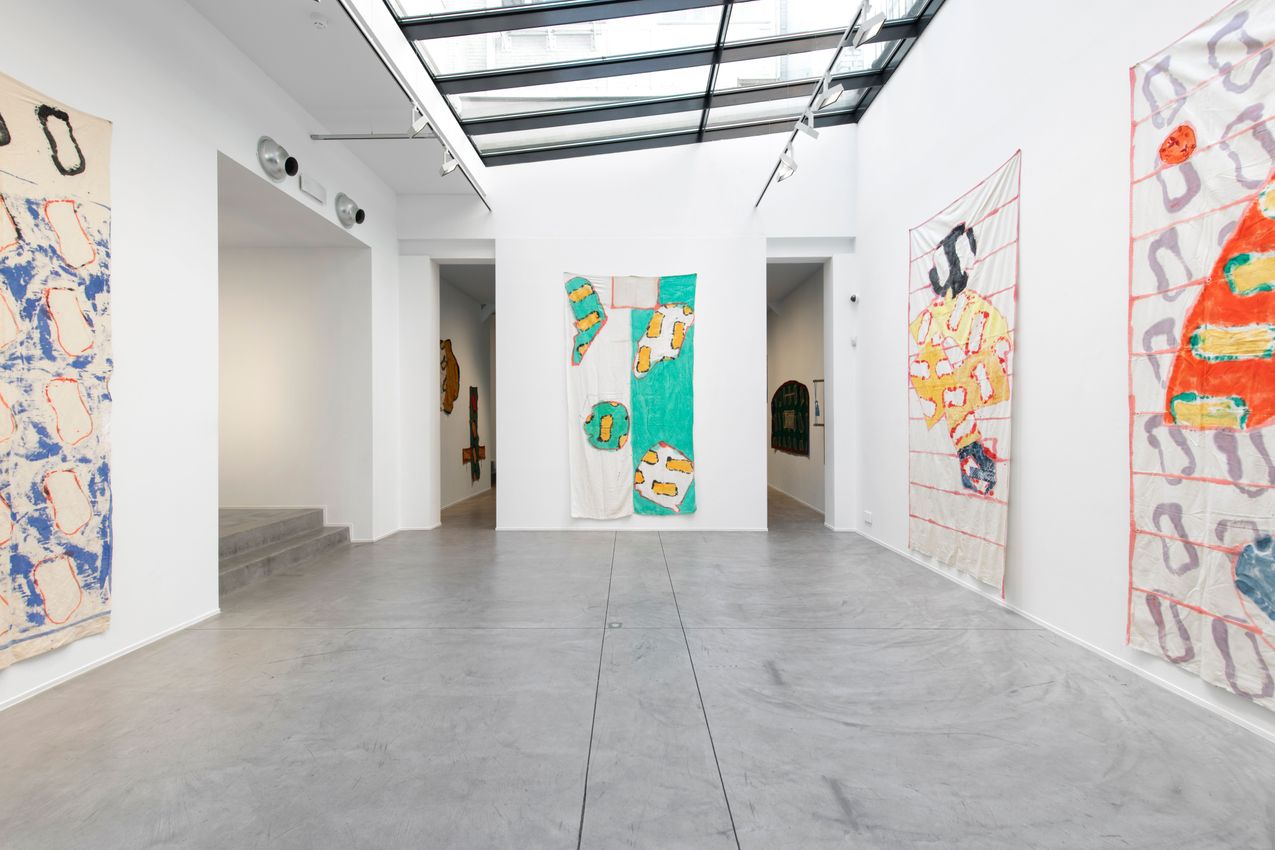
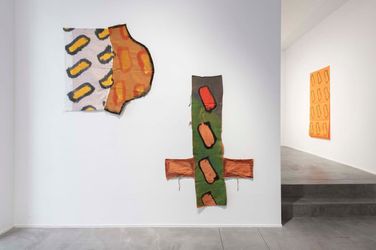
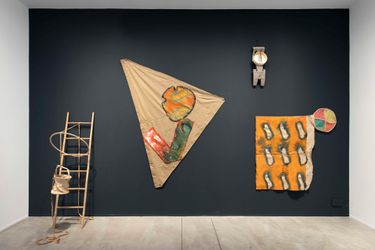
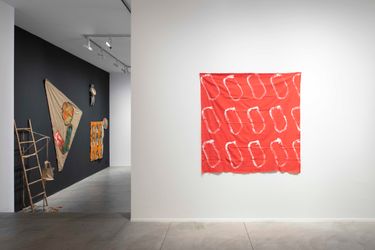
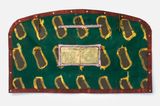
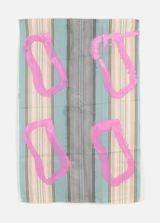
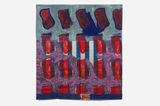
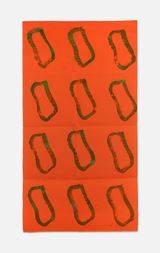
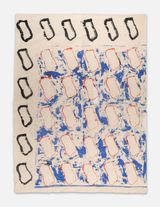
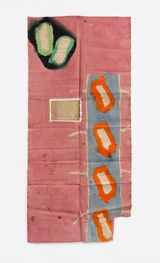
Templon Brussels is marking the 60th anniversary of Claude Viallat’s signature motif with an exhibition bringing together his most recent works, paintings as well as objects.
A leading figure and founding member of the avant-garde Supports/Surfaces group, Claude Viallat has spent six decades pushing the boundaries of painting. He does so by endlessly reworking his distinctive bone-shaped mark, across a wide range of fabrics and tarpaulins, loosely hung throughout the space. First emerging in the summer of 1966, this “ form of chance” unfolds through repetition, shaped by variation and accident.
“I feel like an unconscious at work,” he says, embracing an open-ended, experiment-driven approach. The exhibition features around thirty experimental canvases produced between 2024 and 2026. By multiplying the motif, the artist breaks up the pictorial space: “It’s as if there were only one huge, ideal canvas, and I am cutting fragments from it. So each canvas, can in theory continue, or reverberate in other canvases.” Every piece thus reads as part of a boundless pictorial continuum, with no clear beginning or end, turning the exhibition space into an immersive environment that invites both contemplation and wandering.
Viallat’s objects, which he began exploring as early as 1969, follow the same impulse to dismantle the traditional canvas and free up gesture. Far from being a departure, they are integral to his practice. Made from driftwood, rope, and planks, these works part travel mementos, part echoes of a childlike imagination, reflect his ongoing engagement with everyday materials, at the heart of a practice that constantly tests its own limits.
Courtesy Templon.


Claude Viallat was born in 1936 in Nimes, France, where he continues to live and work. He is one of the founders of the Supports/Surfaces movement in the 1970s, which called for art to renew itself through a deconstruction of traditional materials. Viallat started to work on industrial tarp, endlessly repeating the same abstract pattern, resembling a small bone, which became his signature. Stencilled repeatedly onto a range of supports, the pattern asks us to reflect on the meaning of the creative act and the status of the work of art.


The gallery was founded in 1966 by Daniel Templon, who was then only 21. It first opened rue Bonaparte, in Saint-Germain-des-Prés in Paris, before moving in 1972 to its current location, rue Beaubourg, in the Marais, close to the Pompidou Center, which opened in 1977. Daniel Templon first gained recognition by exhibiting conceptual and minimal artists such as Martin Barré, Christian Boltanski, Donald Judd, Joseph Kosuth, Richard Serra. In the seventies and eighties, Daniel Templon was one of the pioneers of the contemporary art and introduced many important American artists to the French public: Dan Flavin, Ellsworth Kelly, Willem de Kooning, Frank Stella, Andy Warhol. The gallery quickly became one of the references in contemporary art in France. In 1972, Daniel Templon and Catherine Millet co-founded the monthly art magazine ART PRESS.

A respected voice in contemporary art discourse.
Focusing on ambitious storytelling and insightful art-world commentary. Ocula Magazine publishes in-depth interviews, critical essays and timely analysis on the artists, exhibitions and ideas driving the global art world.
Learn more about Ocula Magazine
Showcasing the best of the art world.
Ocula partners with galleries from around the world to highlight their artists, artworks and exhibitions. Gallery membership is by application and invitation, with each member vetted by an independent panel.
Learn more about Ocula Membership

Specialises in the sale of major artworks.
Led by a team with deep ties to the world’s leading auction houses, galleries and collectors. Ocula’s advisory team offers bespoke services to high-net-worth clients from around the world who are looking to acquire the best of contemporary and modern art.
Learn more about our team and services
