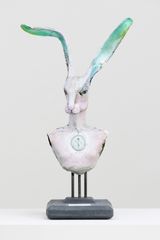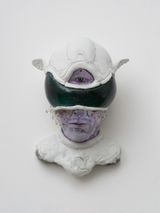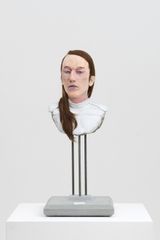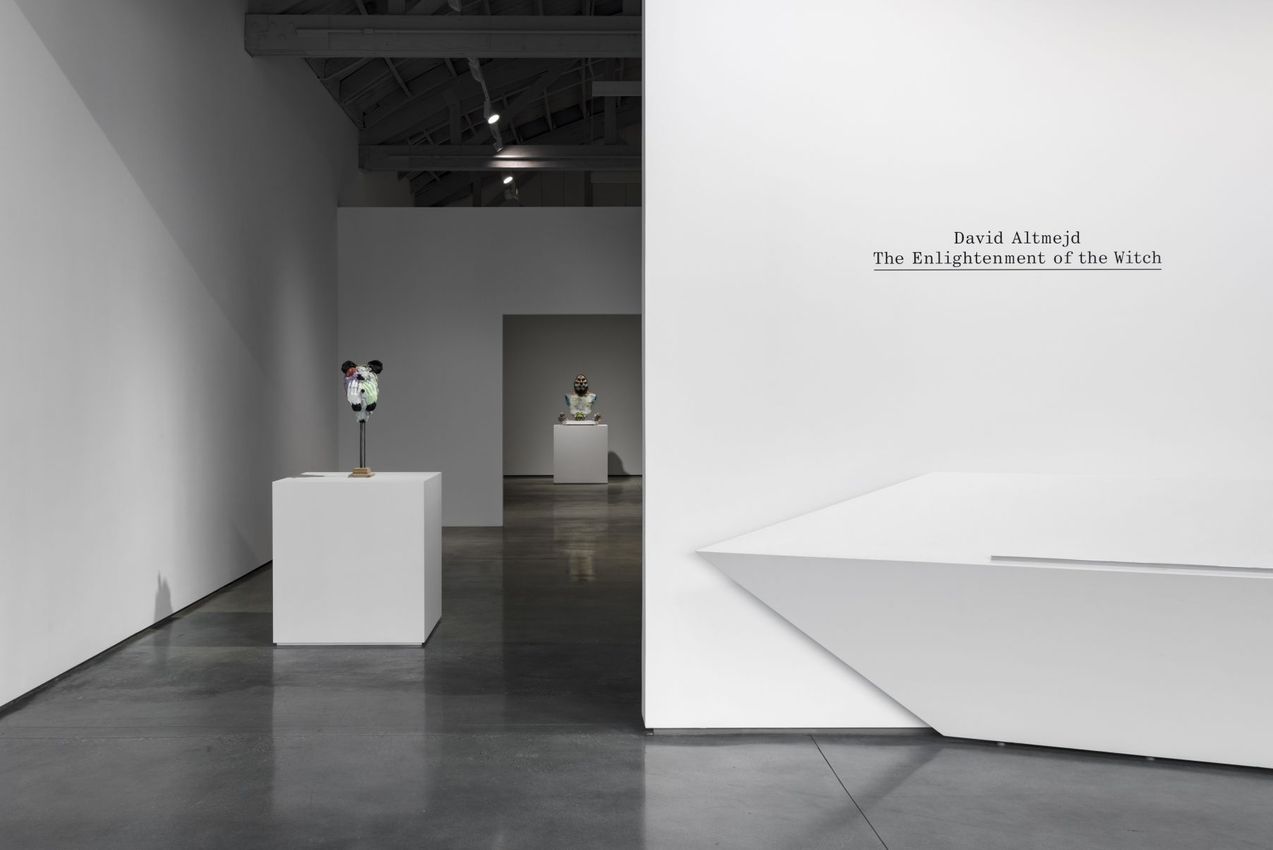
David Kordansky Gallery is pleased to present The Enlightenment of the Witch, its first exhibition of new sculptures by David Altmejd. Conceived as a series of four discrete rooms in which an open-ended journey takes shape through a series of inter-related figures, the show features Altmejd’s uncanny ability to transform human forms into teeming universes of material invention, as well as his propensity for employing physical things to question mysteries of consciousness and other facets of the immaterial world. The Enlightenment of the Witch is on view May 15 through July 2, 2021.
David Altmejd’s explorations of the outer and inner spaces of the human body and mind constitute a key contribution to the sculptural discourse of the last twenty-five years. His ever-expanding array of materials is as varied as the installation-based contexts he has imagined for his work. Also in constant flux are the artist’s ideas about the construction of both the physical world and the human psyche.
Intimately attuned to the inner realm, the ten sculptures in The Enlightenment of the Witch find Altmejd at his most mythic and introspective. The works are installed in four rooms, which allows them to be experienced as a sequence of propositions about the evolution of consciousness: each head has been built up and broken apart to reveal, in physical terms, varying degrees of self-awareness. But the sequence is also a fairytale-like reflection on the many shapes that the journey from life to death can take in the human imagination, with ‘life’ and ‘death’ understood to pertain not only to the body, but to the personality, spiritual makeup, and total worldview.
This sense of progression can be most readily traced in the gradual disintegration of the body that appears from one work to the next. Beginning with a relatively intact bust of a man who holds his face in his hands, and ending with a full-figure representation of the titular witch as she gives birth and comes apart physically, psychologically, and spiritually, Altmejd animates The Enlightenment of the Witch with depictions of biological and elemental processes alike. The sculptures are defined by their details as well as their overall forms: each is a synthesis of a multitude of compositional moves and improvisations, with every one of their elements the result of meticulous attention. Many of the highly lifelike eyes that populate his characters’ faces are the result of Altmejd’s handiwork, as well as the surreal clay distortions, mineral-encrusted cavities, and painterly notations that denote the presence of a faintly intelligible symbolic code.
For Altmejd, however, this virtuosic approach is more than a driver of visual elaboration. It is the result of complete submission to the whims of the objects as they emerge from the formless state in which they began their lives. Accordingly, it is also an acknowledgement that objects, along with ideas and images, have spirits of their own that communicate with their makers and observers. Altmejd increasingly allows these spirits to dictate the terms by which the sculptures are made; in this equation, the artist himself is merely a conduit through which other forces operate, assert their identities, and assume physical form. The enlightenment of the witch in question, then, can be described as a psycho-spiritual reckoning that encompasses the other figures in the show, each of which is the manifestation of a stage in her self-realisation. Among them, however, are several heads largely defined by the pervasive presence of crystal; installed alternately on the floor, a pedestal, and the wall, these seem to indicate the simultaneous presence of a less earthly—and perhaps more masculine—realm of the spirit.
That an artwork (or literary text or musical composition) comes about through the possession of its maker by ‘demonic’ forces is an idea as old as art. What Altmejd brings to light is even more radical, however. The exhibition is full of fairy tale archetypes, with hybridised beings sharing attributes with trolls, unicorns, and fairies, in addition to witches; though all of the sculptures are recognisably human in some ways, in many others, they are not, and taken together, they amount to a laboratory for expressing how humans are often—if not always—possessed by non-human spirits, dreams, or, in the case of more rigidly scientific notions, natural instincts.
The challenge Altmejd sets out in The Enlightenment of the Witch is to make figurative sculptures about—and possessed by—energetic principles that transcend figuration. Put another way, he summons all of his technical and aesthetic knowledge to make works that address the primal states of unknowing which lie at the root of human experience. And yet the exhibition also makes plain his intense, even erotic connection to the tangible stuff that surrounds us. Indeed, as viewers make their way from room to room and sculpture to sculpture, they are presented with an increasing diversity of materials, and an enriched sense of what happens when consciousness collides with the body and spirit engages matter—or vice versa.
David Altmejd (b. 1974, Montreal) has been the subject of solo exhibitions at David Kordansky Gallery (2021); Musées royaux des Beaux-Arts de Belgique, Brussels (2016); Kunsthal KAdE, Amersfoort, Netherlands (2016); Louisiana Museum of Modern Art, Humlebaek, Denmark (2015, traveled to Musée national des beaux-arts du Québec); Musée d’Art Moderne de la Ville de Paris (2014, traveled to Musée d’Art Contemporain de Montréal and Mudam Luxembourg–Musée d’Art Moderne Grand-Duc Jean), among other institutions. In 2007, Altmejd represented Canada at the 52nd Venice Biennale, Italy. Recent group exhibitions include In the Spotlight of the Night Life in the Gloom, Marta Herford Museum, Herford, Germany (2019); Zombies: Pay Attention!, Aspen Art Museum, Colorado (2018); ANIMA MUNDI, Museum Boijmans Van Beuningen, Rotterdam, the Netherlands (2018); Voyage d’hiver, Château de Versailles, France (2017). His work is in the permanent collections of museums such as the Museum of Contemporary Art, Los Angeles; Whitney Museum of American Art, New York; Guggenheim Museum, New York; Art Gallery of Ontario, Toronto; and Musée d’art moderne de la Ville de Paris. Altmejd lives and works in Los Angeles.
David Altmejd explores the constitution and disintegration of the self, producing sculptures that expand the range of figurative representation, and conjuring abstract regions beyond the realm of recognisability. His work is centred on the human form, which in Altmejd’s vision includes not only the body but the mind, the imagination, and the soul, not to mention the ways the material world is perceived and felt through these channels. To this end, each of his works arises from an ongoing intuitive relationship with the large array of materials with which they are built, including clay, foam, mirror, quartz, resin, and both synthetic and human hair. Traditional processes like casting exist alongside idiosyncratic forms of bricolage; no two sculptures are alike, even when they seem to address related subjects. Altmejd approaches scale as a relative quantity, and over the course of his two-decade career he has treated room-sized installations and intimate busts with the same levels of intensity and commitment. Cosmological in scope, his work reveals a world-making ethos across its surfaces and in its details, where countless moments of invention and curiosity reflect ever-unfolding mysteries of consciousness.


David Kordansky Gallery is one of the most dynamic venues for contemporary art, and is internationally regarded as a leading gallery of its generation.

A respected voice in contemporary art discourse.
Focusing on ambitious storytelling and insightful art-world commentary. Ocula Magazine publishes in-depth interviews, critical essays and timely analysis on the artists, exhibitions and ideas driving the global art world.
Learn more about Ocula Magazine
Showcasing the best of the art world.
Ocula partners with galleries from around the world to highlight their artists, artworks and exhibitions. Gallery membership is by application and invitation, with each member vetted by an independent panel.
Learn more about Ocula Membership

Specialises in the sale of major artworks.
Led by a team with deep ties to the world’s leading auction houses, galleries and collectors. Ocula’s advisory team offers bespoke services to high-net-worth clients from around the world who are looking to acquire the best of contemporary and modern art.
Learn more about our team and services